Showing posts with label blogs. Show all posts

Thursday, July 21, 2016

Line Opening with Paul Morphy

I put up a couple of positions by the great Paul Morphy from his most famous games the other day. Time to have a look.

Paulsen-Morphy USA ch 1857
This has been my game of the week this week for showing to kids. It starts with a sensible 4 knight's opening, there are some nice tricks, and some strange/poor moves that are instructive. Morphy, as black in this position played to his strength which was opening lines for rapid development. He came up with the great sacrifice, 17..Qxf3!! Paulsen must take back 18.gxf3


White's king has been ripped open, and Morphy's pieces now stream into the holes. 18..Rg6+ 19.Kh1 Bh3

[The threat is 20..Bg2+ 21.Kg1 Bxf3#. 20.Rg1 is not playable as white is mated after 20..Rxg1+ 21.Kxg1 Re1+ 22.Qf1 Rxf1#] Paulsen carried on but was forced to resign on move 28. Morphy did miss a couple of quicker mates, but the sacrifice of the queen on f3 to open lines was simply excellent.


The second position I put up was from the game Bird-Morphy London 1858, one of the most analysed games in history.

Bird-Morphy (m5) London 1858

I wonder if Morphy was thinking about his masterpiece against Paulsen from the previous year when he came up with a plan to offer his queen to open lines for rook and bishop. 17..Rxf2 An astounding idea, opening the third rank. This move, and the few following have been subject to an immense amount of analysis over the years. Was this sacrifice correct? Should the game have ended a win for black, a draw? Try googling bird-morphy and see what results come up, or just try to make the white defence stronger. 18.Bxf2 Qa3!!


An amazing queen move from Morphy! Obviously, the queen can't be taken, 19.axb3 Bxa3#. Notice the similarity to the Paulsen game? Bird, who wasn't the best defender succumbed to the onslaught on move 29, and one of the greatest queen moves of all time proved successful.


More Morphy to come....

Thursday, June 30, 2016

Following on from Yesterday

Yesterday, I wrote about a Korchnoi game I looked at. I asked a few questions about some positions.

1.

This position was from Honfi-Korchnoi, EU ch 1961. Korchnoi, as black won the game after 38..Qd3, but he had a much fancier win. 38..Bxf4+!! 39.Bxf4


39..Rxe2!! A great follow up offering the queen. 40.Bxd6


Now black wins using a "Windmill" tactic. 40..Rxg2+ 41.Kh1 Rxa2+ [Necessary so that white can't block a check with the queen on d5] 42.Kg1 Rg2+ 43.Kh1 Rg5+ 44.Kh2 Re2+ 45.Rf2 Rxf2#


2.

This is a simple black to play and win from the game Kipping-Pindar Manchester 1861. Black sacrificed the exchange to win bigger fish. 31..Rcxc6! 32.Nxc6 [32.bxc6 was an alternative, though the c-pawn is never going to be a threat. 32..Qe4 33.Rg1 Qb1+ 34.Qe1 Qxa2 35.c7 Re8 saves the day]

Now black has 32..Qe4 simultaneously hitting h1 and b1. White resigned

3. 

This was one of the maddest games I saw yesterday, and I'll post the whole game after. White played 16.Bb5 here but was swiftly blown away by 16..Nxf3+! 17.gxf3 Qxf3


What a transformation over the last diagram. White's king has no cover, nowhere to run, and little help in stopping black's forces. This is a textbook attack on the king in the centre by Kazimdzhanov as black. 18.Rf1 Bh4+ [Attack with as many pieces as possible] 19.Bf2 Qe4+ 20.Be2


All white can do is block the checks, but now e2 is very weak. The game finished 20..Bg4 21.Qc4 Rd4 22.Qxd4 Qxe2# A shame for white who had stared very well against a very strong opponent, but it just goes to show how even one slip can count against a strong player, and how we must be vigilant about opportunities to attack an unguarded king, or ways of opening a king's defence, even if it means a sacrifice.


4. The last position from yesterday was from a game Corden-J Littlewood Hastings 1969. The Littlewood family produced a number of good players, and they had a reputation for attacking flair.


So what did black play here? John Littlewood played the crazy looking 32..Rh3! [The rook can't be taken 33.gxh3?? Qe4+ 34.Kg1 Bd4+ 35.Rf2 Qxb1+ etc winning a mass of material] 33.Rbe1


And now came the king hunt! 33..Rxh2!! 34.Kxh2 Be5+ 35.Kg1 Bd4+ 36.Kh2 Qh5+ 37.Kg3 Qh4+ 38.Kf3 Qf4+ 39.Ke2 Qe3+ 40.Kd1 Qd3+


Another transformation in position. Black has successfully dragged white's king out into the open and has 2 attackers while the king has no defenders. Black managed to successfully chase the king around until this final position was reached.


White did have a chance earlier to give back material to go into a worse endgame that would have offered some chance of resistance, however this was the final tactic. Black finished off with 51..Qc3+ 52.Ka4 b5+, a discovered attack which wins white's queen, and forced him to resign.


All of these great tactical games were seen by me because I looked at an old game and followed up by looking at some games that happened in a similar opening. I therefore have learned a bit about an opening, and have also added some tactical motifs into my knowledge base. There were a load of fairly boring games that I also looked at, and few others of interest that I'll look at tomorrow, or the next time I post.

Tuesday, June 28, 2016

Compulsive Reading

I must admit to being an avid reader. I primarily read fiction of all genre, and I read about chess, my main hobby and passion (and work). I prefer paper books to kindle or other e-readers but I'll also read online. I belong to the group that like to read more than one book at a time. I am currently reading "The Cuckoo's Calling" by Robert Galbraith (JK Rowling) and rereading "Never Let Me Go" by Kazuo Ishiguro. I also have a number of chess books open, but I won't bore you with them, or remind my wife to nag me to clear some of them away.

The online coverage of the Brexit referendum in the UK has been compulsive reading for me over the past week. I've tried to stick to news sites, but have sometimes been waylaid by opinion pieces, and non expert analysis. To be honest, I haven't been gripped by anything such as this since the 9/11 World Trade Centre destruction dominated the news on TV's. And once again, reading about it has been just as depressing from an outsider's point of view. For living in Australia now, though still a UK citizen, that is what I am, an outsider. An outsider with a distinct perspective.

Let's get something straight. If I'd have voted, I'd have voted to remain in Europe. Does this bias my opinion? Probably, but I guess everyone has a bias, and some certainly have more of an agenda to push than others.

So my justifications for remaining in Europe:

- I prefer Internationalism to Nationalism, and have started to appreciate Federal systems, while I am certainly against Monarchy as a form of rule in any sense, even as a rubber stamp.

- I was concerned about the elite economic community warning about the likelihood of recession in local and probably global terms.

- I was wary of the leave campaign's emphasis on immigration which struck me as close to racist incitement when it was being presented.


I must admit, I did have some sympathy for some leave policies, but overall I was in the remain camp. From what I've been reading, the majority of people are like me. There were 2 or 3 issues that swung the situation for them, and they voted on that, one way or another.

The aftermath has been absolutely gruesome.

The nation is divided and seems to be going through some sort of crisis. News media outlets are swinging between leave to remain support on an almost daily basis, and even individual writers and journalists are changing tune depending on situations.

The Parliamentary parties are really struggling at the moment. PM David Cameron made possibly the biggest blunder in recent UK political history by agreeing to a referendum that in his arrogance, he thought he'd win. When the vote came against him, he resigned within 24 hours, leaving the country and the Conservative party without anyone to fulfil the task of seeing the Brexit decision through to it's logical conclusion. The Labour party are equally divided with an all out coup from the centre of the party currently trying to put pressure on leader Jeremy Corbyn to step down. Opinion polls I've seen have shown the parties running about equal at the moment, but with leadership changes coming from both sides who knows how that will affect the way the country votes at a next General Election.

Financially, the UK and Europe (and the world) face an unsettled time. I've read about stock market crashes happening around the globe, wealth destroyed in the UK, pensions threatened for the future, and worries over trade agreements. If the news has it right, then it would appear that the EU do not want to treat kindly with the UK on its exit.

Socially, it is just as concerning. Racially motivated hate crimes are up by nearly 60% since the Brexit referendum according to police. Social media has been very strong about this issue, and to an outsider like myself, it appears very worrying. However, taking that aside, the news sites have shown enough worrying material to be concerned. The vote to leave seems to have galvanised those groups and individuals with racially motivated agenda as if they feel they have now a right to peddle their trade.

And linked to this, there have been accusations and generalisations which have polarised the public. People calling the race card are offending leave voters without racially motivated intentions. Older voters have been accused of swelling the ranks of leave voters, but again this is a generalisation. My 88 year old Mum and Caroline's 87 year old Mum both voted remain. Basically, generalisations about every group have not helped with the unity of the country. Regionally, Scotland won the Remain vote by the biggest majority but that still left nearly 40% voting to leave or in real terms, still a little over a million people. Meanwhile, many leave voters seem to be accusing remain voters of being bad losers, and telling them to just accept the situation. While there are always going to be loud advocates for both sides, being told that your opinions are unwanted when you are worried about racial harassment and how it might affect your family is somewhat intolerant. Calls by members of both leave and remain camps to show unity at this difficult time are a farce. The country is clearly not decided, with leave voters openly admitting they made a mistake.

It's sometimes said the worst thing is not knowing, and that seems to be the situation in the UK at the moment. Which way will things go? Will a Government invoke Article 50 and leave the EU or won't they? Will there be an economic crisis in the UK? Will the right wing grow in strength? Will the Tory and Labour parties suffer losses? Will the member countries of the UK leave? Until there is some resolution of these fundamental issues, I don't see that the UK will be sorting anything out, and the longer it takes to decide these issues, the worse things are likely to get.

Wednesday, June 4, 2014

Following Chess Online

Every once in a while I post about some chess sites that I've seen and really like, so it's time for another one of these. First, the sites that I regularly go to and think are great haven't changed. I take a daily look at Chess.com and TWIC, regularly keep tabs on chessbase, chesscafe, and chess24 as well as following a number of Australian sites and blogs. But that doesn't mean that I don't check out new stuff.

The first thing that has me seeing new things is my Twitter feed. I can't praise it too much as a chess portal. I remember that there used to be chess websites that just had loads of links to other chess sites, and seem to remember one called chessopolis...actually, I wonder if that still exists? Apparently, chessopolis does! Ok, back to the plot. On Twitter I follow a number of chess players, chess journalists, chess writers, and chess sites and they link to other amazing sites. So here we go...

There are a number of Grandmasters who write online, and their material is excellent. I've followed Kevin Spraggett's blog for quite a while now and I'll be following some other GM's as well. Tiger Hillarp Persson's blog is amazing. He doesn't write often, but when he does, the material is unbelievable with deep analysis. Also, I like the name, Chess at the Bag of Cats. Another fantastic GM blog is that of English number 1 Michael Adams. I might be a bit biased here, as I am from England originally. I'm going to be trying more GM blogs in the future as the quality of material is excellent, and the personal comments about their chess experiences is great for a chess fan. I haven't really looked at World Champion, Magnus Carlsen's site yet, though it is an obvious one to consider. (on another patriotic note, Australian Grandmaster, David Smerdon's blog is an entertaining read).

But chess is not just about the top players. There are a lot of people writing about chess who aren't titles at all (I've decided to not claim my CM title!). The best site I've recently found is called old in chess. This site looks at news from 100 years ago and as this is 2014, 100 years ago saw one of the greatest tournaments in history, St Petersburg with Lasker winning ahead of a star studded field including Capablanca, Alekhine, Tarrasch, Marshall etc. The tournament was played in the first half of 1914, so go check out the site and read about a piece of chess history. This is now a big favourite of mine! Much more so than the new playing site FIDE online arena which I'll advise people to go check out for themselves as I don't like much negativity in my blog. I didn't like the site, though it is still being developed so it may become better so check it out as a playing site.

Finally, the absolute stars of online blogging are women, with Grandmasters Susan Polgar and Alexandra Kosteniuk leading the way. I personally have been enjoying the site of another top woman player, Natalia Pogonina. It has regular updates (daily mainly) with great photo's, analysis and stories

Hope you enjoy some of these sites, check out the ones in my links, and if you can recommend any others please do as I'm always on the lookout for new material.

Wednesday, January 16, 2013

Women's Chess

Today I went to the Melbourne Chess Club where the inaugural Australian Women's Master's tournament is being staged. It is an 8 player round robin with the hope to grow it to a full tournament with norm potential in the future. In fact, arbiter, Jamie Kenmure has ideas not only to grow this event, but to resurrect the Australian Women's Championship.

These ideas are all very laudable, but to be honest I'm not sure that having women's only events is anything other than demeaning and patronising. We had a little discussion on this theme at the MCC today, and it seemed to sit a little uncomfortably with the players who I discussed it with. So I'll put my neck on the block as a player and coach. In my opinion women (and girls for that matter) shouldn't be treated any differently to men. I can't see why women should be considered as second class citizens in the chess world, nor why they shouldn't aspire to the very top of the World's game. Of course, if women are directed to a certain level, then it is unlikely they will progress much beyond that, just like anyone in any activity.


In her excellent book "How I Beat Bobby Fischer's Record" Judit Polgar recalls the Novi Sad Olympiad in 1990 as the time when she decided to not participate in exclusively women's only events any longer, setting herself the goal of breaking into the Hungarian men's (open) team, a feat that she managed, of course. This first volume deals with her performance up to that point so I guess we'll have to wait for the next volume until we hear her true feelings about women's only chess, although her wikipedia page gives an illuminating quote:

"I always say that women should have the self-confidence that they are as good as male players, but only if they are willing to work and take it seriously as much as male players"

It is this point of view that I also subscribe to, and for that reason I prefer to see all players in open's. Of course, there is an alternative side of the argument that US GM Jennifer Shahade eloquently expresses:

"If there were a 1:1 ratio of women and men in the chess world I would agree that all tournaments should be integrated. But a lot of women feel alienated at these mixed events, so it’s positive to have occasional all women’s events."

Ok, I have little trouble with this, as with junior, senior, or geographically closed events. However, when the standard for titles is dropped by 200-300 FIDE rating points (compared to men's titles) it seems that women are being encouraged to be content with a mediocre game. Yet we currently see Hou Yifan playing in the top section of Wijk aan Zee, more women are attaining the male GM title than ever before, and the most successful chess bloggers are both women, Susan Polgar and Alexandra Kosteniuk. Both have proved interesting and informative writers and their sites are visited by thousands of chess enthusiasts on a daily basis.

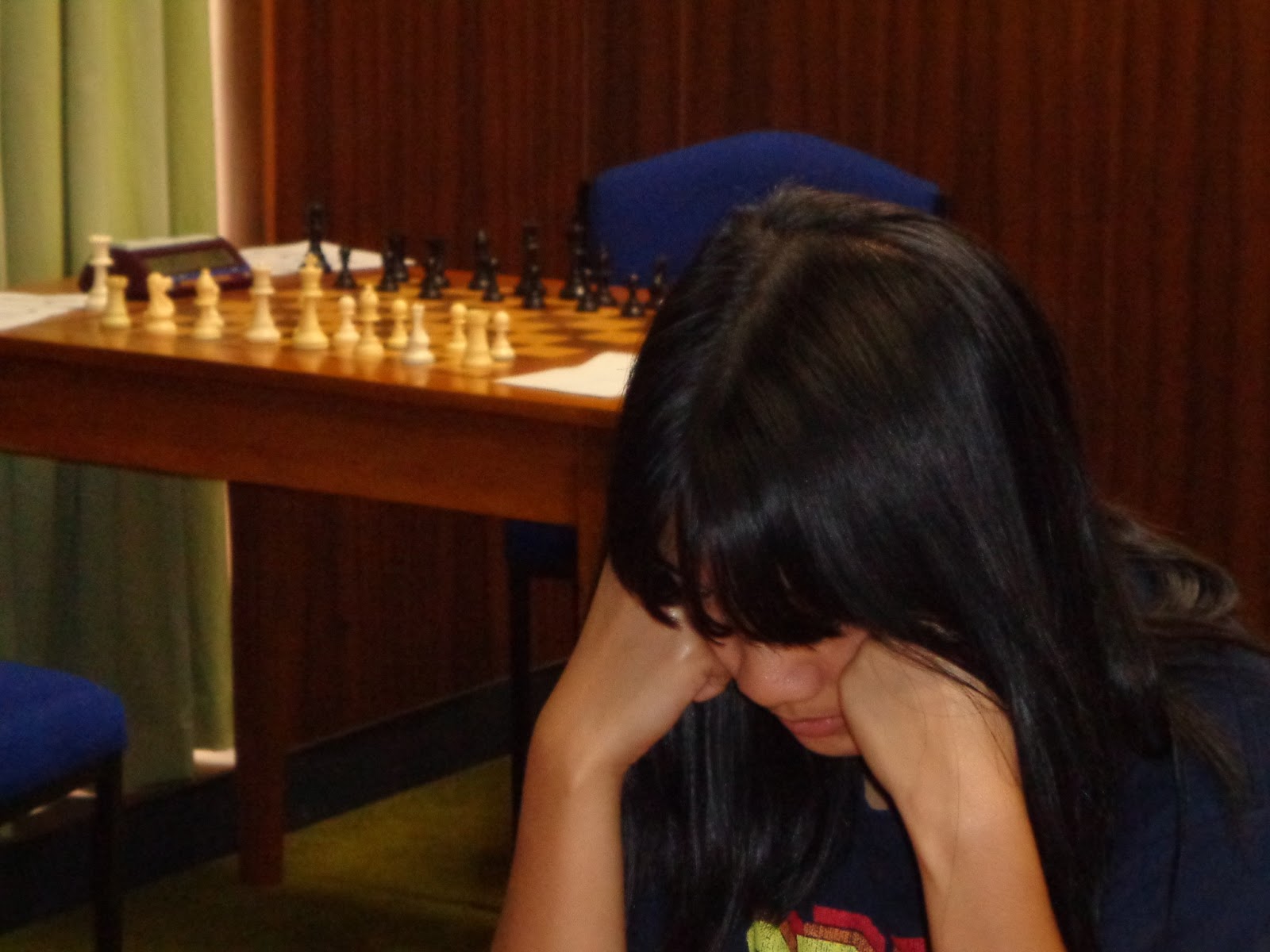
So that's a rant off my chest and I would be happy to get feedback about this as I'm not often opinionated on this blog. Anyway, back to the MCC Women's Master's. The tournament has only reached round 3 though 3 players are on a perfect 2/2, Megan Setiabudi, top seed Katherine Jarek, and Leteisha Simmonds (who won her game today while all the rest were still playing when I left, leaving Leteisha clear first). Good luck to all the players in the remaining rounds. Here are the players who were present at the start of the round when I was allowed to take a few snaps.

Tanya Kolak


Alana Chibnall

Megan Setiabudi

Katherine Jarek

Wednesday, January 9, 2013

Premature Results

I know what this title has you thinking about and you will be disappointed! I was running some chess holiday programs this week and I noticed some kids giving in too easily. So it's back to the well known subjects of resignation and draws in chess.

Firstly I am now aware of a group of chess players who believe that resignation shouldn't be allowed. This play till the death lobby are taking things a bit far, but for beginners and juniors resigning denies many chances to earn draws, or even learn technique on how to win games that they, in turn, can use in their own games. At Chesskids we vehemently recommend our kids to play to the end. Here's an example of what can happen at junior level chess that occurred in one of my classes only today:

White would have been happy with a draw before the game began, but it was black that was playing for the draw now. The game continued 1.f5 Kh7 2.f6 Kg8 3.f7+ Kh7 [setting up a clever trap that his young opponent fell straight into]
The young player with the white pieces couldn't contain himself and without a second's thought promoted his pawn to a queen realising a moment later that he'd stalemated his opponent 4.f8=Q 1/2-1/2

I find it quite amazing that kids can find incredibly difficult tactical chances for themselves, but have great trouble in spotting what I consider simple stalemating tricks. I even wonder if most kids think about draws, or whether they are playing on in the hope of winning even with minuscule material? Anyway, after a tactics session where the kids were working on some easy and not so easy checkmate patterns, I showed a classic endgame with a stalemate theme.

This position is from the game Reshevsky-Geller Zurich Candidates 1953. I asked the kids what they thought black played here and I received Kg4, Ra5 (defending the pawn) Ra2+ but no one worked out what was actually played without some help. 1..Rf3+ is obvious once you realise that the rook cannot be taken because of stalemate, and that black is actually going to be happy with a draw here!

On the related (sort of) subject of premature draws we also encourage our kids not to agree to draws but to play on in level positions to try to win them. Hopefully this will give them invaluable endgame experience, and we try to explain to kids that losing these types of games is better for them than agreeing to draws. It certainly sweetens the bitter taste of defeat though how much I'm not sure! Anyway, one of the things I've been trying to undertake this week is analysing live games as they are happening. We've been lucky in Australia to currently have the Australian Open Championship with the live games starting at 1pm in the afternoon. It is great to introduce the kids to the country's top players and some local talents. They can relate to 15 year old Bobby Cheng and 12 year old Anton Smirnov while Grandmasters like Zong-Yuan Zhao and Darryl Johansen are promoted as favourites.

I was showing the live games on Monday to my group of young students but 2 of the 4 games finished as relatively quick draws and my students wondered why they'd agreed to draws. I have to admit, I had some trouble working it out myself so lets have a look at the positions.

This was the final position of the game Zhao-Cheng. It is a very interesting position and most of the kids were getting excited about Bobby's centre against Australia's number 1. When I pointed out his king might be a bit open they shrugged it off! (typical junior optimism!) However, they were generally disappointed that this game went no further.
Most of my juniors are a pretty patriotic lot and they were all cheering for Melbourne based GM Johansen. Here, as black against Yita Choong the kids were happy that they were supporting the guy who was a pawn up. As it is not possible to take on b7 with the bishop because of the forking Qb6+ it would appear that black will maintain his material advantage. I had real trouble explaining why this one might have ended in a draw here (as I don't fully understand myself!) and the kids seemed genuinely disappointed. I'd be interested to know what prompted the draw offers and their acceptance by the players themselves.

However, excitement was provided on the other 2 boards, and the kids seemed fascinated by Junta Ikeda's time trouble and they liked top rated German GM, IgorKhenkin's following move:
Black here played 19..Bxb2+ which was greeted with "He's lost his bishop! The top guy's gonna lose!" Then when they'd calmed down we worked out why he'd played his bishop to a square where it can just be taken. If 20.Kxb2 then 20..c3+ discovers an attack on the e2 bishop from black's Ba6. The kids had to admit that it was a pretty neat move. They still want an Aussie to win though!


Wednesday, October 10, 2012

Mistakes can happen...

Today, I faced one of the biggest challenges in my role as a chess coach. Over the past 8 years of teaching chess for chesskids in Melbourne, I have experienced all sorts of problems, some caused by myself and some incidental. Over time I have arrived at classes without a demo board (minor inconvenience), with a demo board but no pieces (minor inconvenience), with a demo board and some pieces (frustrating), with a demo board and pieces but no normal playing boards (panic!!). I have been sent to the wrong school, the right school, but wrong campus, a school with no rooms to teach in, and best of all was a outdoors simul given in what can only be described as a blizzard!

Today the new challenge came through a lack of voice. I think that I caught a chill when running a few days ago. I had started out in sunshine, and then the temperature dropped and it started raining heavily. I was probably under dressed for the conditions, and caught a chill on my chest. The upshot is that I now have no voice and the making of a cough. Well, at least I got through it, and I now know that I can control a class without raising my voice :)

I wasn't feeling too great on Monday, but it was no excuse for my play against Ari Dale. I had intended to continue our theoretical duel in the main line of the Caro Kann. However, on Monday I didn't have the energy to finally prepare, so I decided to just play 1.d4 and stodge it. But a blood of rush to the head saw me throw in an early g4 in a Queen's Gambit Declined. To be honest, it was quite an interesting game up to a point, but I lost the plot and Ari put me away relatively easily. The tournament remains in the hands of Dusan Stojic who won against Mehmedalija Dizdarevic to go to 5/5. The board 2 game between Guy West and Malcolm Pyke was postponed due to Malcolm being ill, but the big sensation was young Jason Chew beating MCC stalwart IM Mirko Rujevic. Mirko castled queenside riskily on the white side of a French and was punished in no uncertain terms. These results mean that Dusan is followed by Ari and Jason who are a point behind (of course, Guy or Malcolm could join the leaders), with the rest of us trailing behind.


Tuesday, July 31, 2012

A great.....and not so great week

I wonder what the news headline of this week will turn out to be?

Fantastic finale in Biel?


National Championships of Ukraine and Britain decided!


French players banned for cheating.


9 year old beats Grandmaster!

Of course, we would love for the tournaments to have dramatic finales and National Championships usually do have moments of interest as the players tend to know each other and their playing styles very well. The Ukrainian Championship is a strong (2724-2584) 12 player round robin with Ruslan Ponomariov the highest rated player. It has just started while the British Championship is drawing to a close with Jones and Gordon leading the way while Howell leads the chasing pack. The Biel super-GM event is also drawing to a dramatic conclusion with rating favourites Carlsen and Nakamura having to come from behind Giri and Wang Hao.

The big cheating scandal from the 2010 Olympiad concerning French players has finally been resolved with bans being handed out for all 3 Grandmasters. Thankfully, chess is not riddled with cheating scandals but in some ways that makes each one seem worse. When a cyclist is suspended for using a banned substance, I tend to think, 'here we go again, another one caught....I wonder how many others don't get caught'. But with chess, it's more like, 'oh my God, how did they do that, and why?' Actually, now that I think about it, I wonder how much cheating does go unnoticed at chess events? As an amateur enthusiast, I would hope very little.

As a coach of mainly young players, the most impressive headline to me would be the last one. I am constantly being amazed by the talents of young players. Here in Melbourne this past Sunday we ran a 7 round 15 minute per player tournament. In the under 10 section, second place was taken by a 4 year old! I saw the headline in the excellent Chicago Chess Blog of Bill Brock. I've been reading this blog for a while now, and find it really enjoyable reading, with excellent local coverage from the Chicago area. A 9 year old beating a Grandmaster is an incredible feat, though the record for the youngest player to beat a Grandmaster in a regular tournament game goes to a player already mentioned in this article, David Howell. Howell was only 8 when he beat GM John Nunn....unbelievable! And another previously mentioned player in this piece, Ruslan Ponomariov was the youngest to hold a World Championship at 18 (though some would dispute the legitimacy of this title).


Loading embedded chess game...

Tuesday, July 24, 2012

British Champs and more...

...much, much more in fact! The blogs which I subscribed to in my last post have been unbelievably active and have turned over some very interesting things (to me at least). There were mixed reactions to the return to adjourned games which were held at the Amsterdam tournament last week, but I can't say I've seen much coverage of the positions that actually were adjourned in any games. Growing up in the pre-digital clock age, I well remember adjournments. As much as a pain as it was, especially travelling long distances to finish team games, I am certain that adjournments were a great tool for analysis. Studying positions in late middlegames and endgames really helps your chess, and in depth analysis of any position can only help your chess. The change in time controls came at a time when a big shift in opening theory was underway, and now knowledge of openings and opening preparation, along with tactical vision are the priorities in a players study.


On Alexandra Kosteniuk's blog I saw another interesting development in tournament chess, this time to do with scoring. At a tournament in the Philippines the scoring is as follows

2 points for a win
1 point for a draw
0 points for a loss

A stalemate, however, is split 1.5-0.5 with the player stalemated scoring 0.5.

This is an interesting attempt to keep games interesting longer, though it seems a bit harsh to me as some of the most beautiful combinations I've ever seen have been stalemate saves. To punish these in terms of points on the board doesn't seem right to me.

The British Championships started yesterday, and the 'local' blogs noted some controversy. Steve Giddins is disappointed by the strength of the event and he has a point. Although there are a strong group at the top, the event does have a rather long tail, not that I would begrudge these players a chance. It would just be good to see more of the 2300+ level players involved. In fact, the exclusivity of the Australian Championships with a minimum rating leads to a more top heavy field. It is, of course, a pay off either way, as here in Australia we have some people claiming the field is too limited. On the Streatham and Brixton blog, it's the ECF that is criticised (actually, it is on Giddins blog too) and the following question is raised:

"is the ECF an organisation that runs the game on a collective and open basis for the benefit of all of us, or is it the plaything of individual officers who are welcome to do whatever they might happen to feel like doing at any given moment?"


When I left England the English Chess Federation was a fledgeling organisation, I left in early 2005 and the ECF formed in 2004 to take over from the British Chess Federation. It seems that much has happened in the 7 years I've been abroad. I think I'll have to look into this in a bit more detail, as I'm now in a position to change my federation.


On to the Championship itself! The first round of any swiss is usually filled with a number of mismatches. However, the 2012 British Championship has a field of 62 players in an 11 round swiss, and it was decided to accelerate the event. I'm not much of a fan of acceleration and I'm not sure why this happened. If it has something to do with keeping strong players away from much weaker players, then the Championship should probably look at entry requirements rather than acceleration. Anyway, I was happy to see my 2 old mates scoring half points in the first round. Mike Surtees (2114) drew with Henrik Fabri (2004), while Don Mason drew with IM Richard Palliser. At the top none of the GM's lost, but not all of them won either. Late entry Stuart Conquest was held by Marcus Osborne, while in form Olympiad team member David Howell, was held by James Adair who is rated 350+ points below him. However it is a long event and early days.


Unfortunately for me, the games start at 2.15pm which is 11.15pm where I live, so I'll be seeing most of the games after they've been played. In the morning, the under 16 tournament is being broadcast live and this is a relatively strong event with 3 players rated 2000+. It is a small field but interesting as there isn't much between any of the players. I found these games interesting (I was watching these rather than the games in Biel with Carlsen et al) with some positions that I could use to help my own students. I was also happy to see a trap that I once used to pick up one of my first decent scalps back in the early 1980's. I was playing in the Basingstoke Championships against a strongish local player called Jim Calleja. The pattern was repeated yesterday.


Loading embedded chess game...


Sunday, July 22, 2012

British Chess Championship

Tomorrow, the 2012 British Chess Championships starts. As I know a lot of the players in both the Championship and the Major Open I'll be following it with interest. Actually, I have to admit that since the World Championship has ended, I've really enjoyed the high level chess that has been happening around the world. First the Tal Memorial, then the Russian Higher League and Dortmund have all been great with interesting stuff at the match between Russia and China and the mass of open tournaments around the world. Besides the British Champs, world number 1 Magnus Carlsen will be in action at Biel where he comes up against strong opposition in Nakamura and Morozevich. However, though I'll be keeping an eye on this, my mind will be firmly fixed on the North of England, and the British Championships.

It is a tournament I never played in, though I did qualify for it. Unfortunately, the year I qualified was the year I emigrated to Australia so I ended up not playing. This year there are 7 Grandmasters (Jones, Howell, Gordon, Turner, Gormally, Conquest, Arkell) and 6 International Masters (Hawkins, Palliser, Hanley, Houska, Kolbus and Rudd) out of a field of 62 players. A bit further down the list, I'll be watching to see how Don Mason and Mike Surtees get on. I always used to have some great games with Don in the Birmingham league back in the 1990's and I hope he has a good tournament. I've also had a few games against Mike Surtees, mostly at weekend congresses in the North West of England, and they usually turned out to be hard fought affairs. Mike also has his own thoughts on opening theory so his games are certainly not tied down with theoretical dogma!

To help me follow these, I've checked out some blogs and websites that I'm going to read for the next 2 weeks (at least). I guess I should really be following some British sites, so I'm going to use the following:

- Streatham and Brixton Chess Blog seems to updated regularly, with a group of different contributors
- Steve Giddins blog should have good content regarding on and off the board action
- The Week in Chess (TWIC) Although some games will be published live on the British Championship site, I will use the live games server at TWIC as well, and follow commentary by Malcolm Pein. The advantage of TWIC is that it can show other tournaments live at the same time!

I have also subscribed to the following blogs
- Alexandra Kosteniuk's blog is a news blog which on first look seems excellent
http://chicagochess.blogspot.com.au/ is a totally random choice of blog to follow, but when I had a look at it I really enjoyed the writing style, and the local flavour of the content, which is what I usually strive for here. It also has an awesome set of links!

Finally, here's a game to hearten underdogs in the British Championship. The unpredictable Mike Surtees plays his own brand of chess, which will no doubt give him some unpredictable results. Here he plays a GM in the 2009 British Rapidplay Championships and by move must surely be close to lost. Maybe you should try to guess the move for black in this game!


Loading embedded chess game...

Saturday, July 21, 2012

Reading Material


There's nothing better than getting comfy with a good book. I'm sure I've heard that somewhere before! Anyway, there is no shortage of chess books, some good and some not so good. My personal favourites are tournament books, and I remember going through books such as Zurich 1953 by Bronstein, Botvinnik-Tal 1960 World Championship match, Spassky-Fischer by Evans, 2nd Piatigorsky Cup by Kashdan and the Leningrad and Petropolis Interzonal tournaments when I was younger. I suppose that a book of a tournament is more of a story than a typical theory book. In a tournament there are major and minor characters, a plot with twists and turns and a deal of varied material.

Believe me, I have tried to look at opening manuals, but I generally find them rather boring, or overly detailed or with large parts that are irrelevant to what I want. Practical players need repertoires and opening manuals don't tend to deal with this. There are repertoire books, but they may suggest certain variations that a player has no intention of ever playing. I know this sounds as if I do no opening work at all (to be honest I don't do too much) but rather my opening work tends to be inspired by actual games that I see and then I go into a frenzied rush of work on that system. As an example, I saw a mad game last night in the Amsterdam tournament where the outsider Anna Muzychuk was white against Israeli GM Emil Sutovsky.

Loading embedded chess game...


I've already analysed some lines in this offbeat system and and seen a whole load of games. Maybe I'll get to play it at some stage.

If I'm going to work on the game, I'm more likely to use a book on the endgame or general/specific chess strategy. Like many, I once went through Nimzovitch's "My System", but I think my favourite book of this genre is Watson's  "Secrets of Chess Strategy", and his follow up, "Chess Strategy in Action". However, I still think that working through well annotated games collections will teach invaluable strategic lessons as well as putting those lessons into practical settings. For the diligent (because the books are fairly heavy tomes) Karolyi's books on Karpov's Strategic wins, and his book "Endgame Virtuoso Anatoly Karpov" are tremendous.

Perhaps a good place to start for anyone looking for good chess books is the FIDE Trainers Commission recommendations. Out of the 100 books, I've studied about 20 I think, and browsed into about another 10-20 and I don't think there were any bad ones.

Another resource is the internet, and there are a whole load of interactive sites, informative sites, and fun sites. There are loads of blogs and it's about time I started to look through some of these. I already regularly read some blogs. Kerry Stead's blog is a nice personal look at the Australian (and more specifically Victorian) chess scene. Kerry has a penchant for some unusual opening systems, so there are often games with an unusual start which lead to some interesting positions. Another cool Aussie blog is by IM Alex Wohl.  He writes in both humorous and informative style and is perhaps the strongest Australian player to regularly maintain a chess blog, though GM David Smerdon is catching up (in terms of regularly posting!).

I also try to follow the chess scene from my native UK. I really do need to look at more UK blogs, but I regularly read the British Chess Magazine which I grew up with, and FM Steve Giddins Blog, an ex-editor of the BCM who enjoys studies and problems as well as being a man who isn't shy of saying what he thinks!

Anyways, as I'm taking a bit of a break from playing, I'm going to be looking at some reading material, both online and in print and I'll post what I think of them as honestly as I dare!