Showing posts with label lasker. Show all posts

Saturday, August 11, 2018

Game of the Day 7

What makes a game great or important? There are a number of considerations to take into account, but the occasion, the players, the fight and the brilliance of play are all contributing factors. There will also be second hand opinion, by those who witnessed, or have seen and analysed the game. One of my favourite tournaments is Hastings 1895 and I must have looked at most of the games at least once.But a game I never really considered much was the first round game Lasker-Marco. It really isn't a brilliant game, certainly not the best by either player, and not even the best of the round, but it was an historically significant game. It was the first tournament game that Lasker played as World Champion, and as Hastings 1895 was his first International tournament after winning the title, it can be surmised that it wasn't the glorious start he would have hoped for, finishing third behind Pillsbury and Chigorin.

But Lasker isn't the only World Champion who didn't start their tenure with a bang. Euwe could only finish second, behind Reuben Fine at Zandvoort after beating Alekhine, and Botvinnik fared even worse finishing sixth at the super strong 1951 USSR Championship won by Keres. Admittedly, Botvinnik didn't play much after 1948 so would have been rusty, but this must have been a disappointment. In recent times, both Kramnik and Anand could only finish third in their first classical tournaments after winning the title. Then there were Steinitz, Smyslov and Fischer who never played tournaments as World Champions. As far as I can tell, all the other undisputed Classical World Champions started with a tournament win.

In the tournament book of Hastings 1895, the games were annotated by players, though they didn't comment on their own games. The 1st round game of Lasker-Marco was commented by the great German player, Tarrasch who tends towards the critical in his analysis style! Tarrasch was known for his dogmatic opinions on the game, but he was still a brilliant player and a magnificent calculator at the board. His fantastic win against Walbrodt from Hastings 1895 is a great example of his brilliance.

The game has an interesting middle game with black taking hanging pawns from a Queen's Gambit Declined opening. Unfortunately, the game finishes when it is just beginning to get interesting, as Marco made a huge, and somewhat elementary blunder.


Black here played the shocker 22..Bf6?? allowing 23.Bg4 skewering queen and rook without the possibility of blocking with the f-pawn. The game falls apart quickly after that. Tarrasch's notes to this position are quite interesting and show a lack of regard for dynamics in the position which were not so well understood at the time (strange really, as the idea of gambiting for an attack was still quite prevalent at the time). Tarrasch considers 22..Qb6 as forced, but 22..f6!? keeps the position fluid. It looks as if White wins a pawn by 23.Nxg6 hxg6 24.Qxa5.
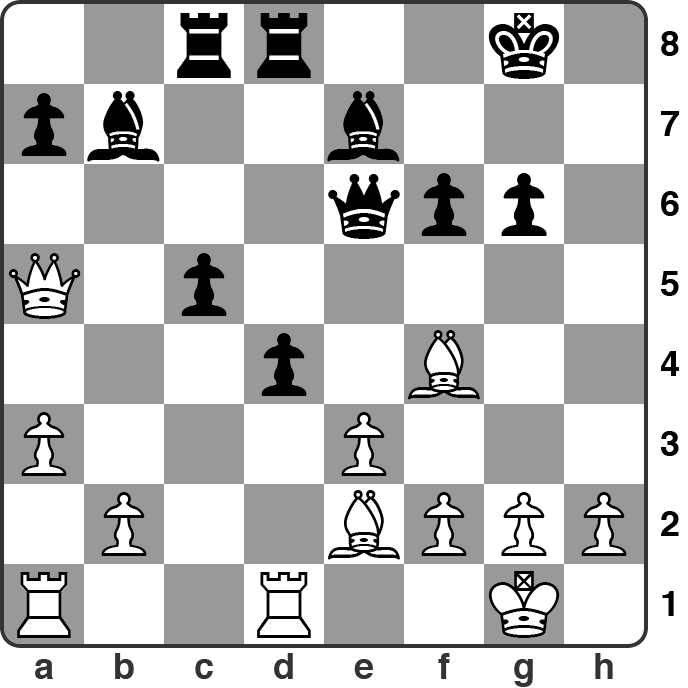

However, the position is highly unbalanced with White's forces dispersed. Black has 24..g5 (a move Tarrasch thought about in an earlier position) 25.Bg3 dxe3 26.Rxd8+ Rxd8 27.Re1 Qd5 28.f3 with an absolutely unclear position.


In fact, this crazy dynamic game would have suited Marco who played a game from the same opening position a couple of years earlier against von Scheve at Dresden 1892 where he took an IQP and managed to create all sorts of complications for himself and his opponent, who finally ran out of steam and blundered the game away. Here's that game, and then the Lasker game with notes by Tarrasch (and the f6 line added). Enjoy!


Loading embedded chess game...

Loading embedded chess game...

Tuesday, July 3, 2018

Game of the Day 2

I had intended to post games and ideas from many of my chess books showing classic games and using them as talking points. But after posting yesterday's game, Lasker-Lipke Breslau 1899, I couldn't help but notice that the second game in the book is Lasker's amazing double bishop sacrifice against Bauer from Amsterdam 1899, so I will look at this game and go on to another book next (though I'd better not look at the next game in the Lasker book!)

While not quite the originator of this type of sacrifice, Lasker undoubtedly made it famous by this game. If you've never seen this game before, then be warned, it is fantastic. Lasker used Bird's Opening (like Magnus Carlsen did) and set up aggressively as if he wanted to attack from the start. When given the chance, Lasker took it with style!


Black expected White to play 15.Qxh5 when it is simple to shut down the attack with 15..f5. Lasker sped things up with 15.Bxh7+! sacrificing a piece, as he is already a knight down in this position. After 15..Kxh7 16.Qxh5+ Kg8 White has brought his queen into the attacking sphere but lacks support or targets. Another sacrifice helps with that!


Lasker opens up his opponent's position with a second bishop sacrifice, 17.Bxg7!!. With Black's king lacking cover, a White rook lift will be deadly, Rf3-g3/h3. Playing through the game with the comments from Fine and Reinfeld one sees the way that Lasker quickly developed a position from which to attack, and then forcefully followed that attack through. Another important thing to remember from this game is that a sacrificial attack needn't always lead to mate. Here, Lasker used the opening of Bauer's king to win more material than he gave up, eventually ending up with a queen and 2 pawns for a rook and bishop. Of course his position was also dominating.

Enjoy this game :)

Loading embedded chess game...

Monday, July 2, 2018

Game of the Day 1

In my last post, I said that it was a good idea to look at classic annotated games where a lot of skills can be learned. I also said I would try to put up a game from my collection each day, so here we go.

Day 1:


The earliest player I have a set of games for is the second World Champion, Emanuel Lasker. I have "Lasker's Greatest Chess Games: 1889-1914" by Reinfeld and Fine, a book in the old descriptive notation which I am old enough to remember and have used! You don't have to go very far in the book to find beautiful ideas. In fact the first game, Lasker-Lipke Breslau 1899, has an excellent winning point to it


Lasker, as White, is a piece up, but Black threatens mate on h1. White can't play play Kh2, or it's a perpetual. But Lasker came out with 1.Bxf5+! giving back the piece with check. 1..Qxf5+ 2.Qg4!! an amazing retreat, giving up his active queen and a pawn to reach a winning endgame. This transition from aggressive middlegame, to winning endgame is something that we all need to understand. In fact, transitions are a hugely important aspects of the game that aren't really discussed much in books.


Earlier in the game Lasker showed his understanding for transitions. In the above position most of us would throw the c-pawn up to c4 holding on to the d5 pawn, but Lasker wants to play d4 to take control of the centre, and gain some extra space. So White played 10.Bg5! pinning at least one of the knights, and thus defending d5. While Black was untangling, White played d4 and took some space for his bishops.

Anyway, here's the game, in an algebraic form, with the notes of Reinfeld and Fine.

Enjoy :)

Loading embedded chess game...
Thursday, April 4, 2013

Chess again...

After the shock of the past few days, I'm bringing this blog back to it's chess and coffee content. I'm still a little dazed as I'm sure most of the Melbourne chess community are, and so this blog might not move too fast for a while yet. Hopefully you'll understand and be patient with me.

I did leave some tactics and endgames on Monday and never got back with the answers. Well, the endgames are going to be serialized here, but I can look at the tactics now.

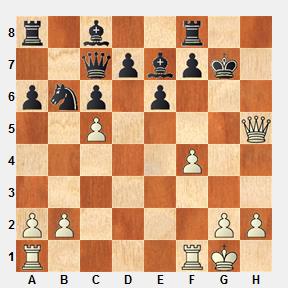
It was white to play and win here. Ukrainian GM Gennadi Kuzmin played 22.Nxd6! pinning his own knight and after 22..Ne8 he unpinned with the amazing 23.Nxf7!! leaving the following position
The point is that 23..Rxd4 loses to the double check 24.Nh6+ Kh8 25.Rxf8# Ftacnik tried to close the f-file with 23..Bf6 but resigned after 24.Ne5+!! when the bishop on f6 becomes pinned so after 24..Kh8 white can take the exchange 25.Nxd7 as 25..Bxd4 loses immediately to 26.Rxf8#

The other position led to a classic tactical shot.

Kuzmin-Sveshnikov USSR ch 1973 it is white to play and win. Kuzmin came out with the double bishop sacrifice 17.Bxh7+!! Kxh7 18.Qh5+ Kg8 19.Bxg7!! [threatening 20.Qh8#] 19..Kxg7
White has sacrificed both bishops to destroy black's king cover. After 20.Qg4+ Kh7 21.Rf3 black resigned as he will have to give up his queen to avoid immediate mate.

This is, of course, an excellent tactic to bring off in a tournament game, but Kuzmin would have been fully aware of the double bishop sacrifice, as should all chess players. The famous Lasker-Bauer game is the classic early version of this great attack:

Here's the famous position after black's 14th move, and it is probably easy to spot what the second World Champion did as white in this position now that you already know the theme. Here's the game:


Friday, March 15, 2013

Elementary Chess Endings

I was talking to a friend the other day about our favourite chess ending. We spoke about quite a few old classics and each had our particular favourite. Hopefully we will see some more over the next few weeks in London at the Candidates' tournament, and with some great endgame players, I can't imagine there not be a few classics.

But after my post last week, I thought I'd share my favourite classic endgame. I have always liked pawn endgames, and I prefer endgames that actually happened in games compared to composed studies. One of the first endgames I was shown is still one of my favourites, Lasker-Tarrasch St Petersburg 1914.

It looks bad for white. Black has a pawn majority on the queen side, his king is nearer to the queen side than white's king and is also able to easily stop white's pawn from advancing far. Yet Lasker managed to draw this position and it was black fighting for that draw in the end!

1.h4! This wins time against the advance of black's queen side as Tarrasch can't allow white to play 2.h5 1..Kg4 2.Kg6!! Again winning time as white now threatens 3.h5 so black's next is forced 2..Kxh4 3.Kf5 and now white's king "shoulders" black's king in the race to the queen side.

The game finished 3..Kg3 4.Ke4 Kf2 5.Kd5 Ke2 6.Kxc5 Kd2 7.Kxb5 Kc2 8.Kxa5 Kxb3 Draw.

Study of classic endgames is good for anyone. I hope to bring some more favourite classics to this blog :)


Friday, February 8, 2013

Time for some Classics

My lessons recently have focused on the tactical and some great attacking games. I think some of my young students are ready to take a look at some classic games. In his book "Modern Chess Preparation" Ukrainian Grandmaster and Olympiad team Captain, Vladimir Tukmakov devotes over a third of his book to looking at classic games claiming that for improving players, the "games of Capablanca are far more instructive than the extremely complex works of modern super-grandmasters". He goes on to say that strategic rules should be learned from "simple and logical examples" and that "the games of Capablanca not Alekhine, Botvinnik not Bronstein and Karpov not Kasparov" should be looked at.

So with this in mind, I am inspired to show my pupils 2 of the most famous games in history, both of them appearing in Tukmakov's book, as well as many other sources and I'll share them on this blog. In fact a little earlier this evening I looked through one of the games for the first time in a long time, and see in it one of the greatest knight outposts I can remember. Of course, this is the game Lasker-Capablanca St Petersburg 1914. I can't wait to see the kids faces when the queens are exchanged early on. Hopefully their disbelief will turn to resourcefulness when they are challenged to join Lasker in making the most of his other pieces. Another issue that is of paramount importance in this game is space which Capablanca had little of, and a permanent weakness on d6. Strategically it is a masterful game, and I hope the kids appreciate it for what it is.


To make things up to Capablanca I intend to show one of his masterful performances. I intend to show his game against Marshall where he had to defend against the Marshall Gambit. This will introduce the concepts of gambit play, attacking methods and defensive techniques, including giving back material which is something kids are always reluctant to do. I will again be interested to see the kids reactions to a game where the attacking player is the one who ends up losing.