Wednesday, August 15, 2012

Midweek Look at Chess

Before taking stock of what is happening in the chess world, I was sad to see that Yugoslav chess legend Svetozar Gligoric passed away. As with many players of my generation, I grew up with the King's Indian Defence a major system in chess and part of my own repertoire, and therefore had plenty of chance to study games of Gligoric. Perhaps one of his most famous is his win against Najdorf from the 1953 Mar del Plata tournament. Of course, this game was partly responsible for the opening being called the Mar del Plata Variation!

Loading embedded chess game...


The Russian Championship finished with  rapid play off which was won by young (22 I think?) Andreikin. Hot on the heels of this comes the French Championship, another round robin elite event with another youngster, Maxime Vachier-Legrave one of the favourites. All this talk of young players comes in the midst of the World Junior Championships which have just one round left. Richard Rapport of Hungary and Alexander Ipatov of Turkey lead by half a point going into this final round, but they've already played so a tense finale awaits.

In Melbourne another young player, Dusan Stojic, has taken the lead from Guy West in the MCC Club Championship play off. Currently game number 3 is in progress but I would imagine this endgame of queen and opposite bishops will end in a draw. If this is the case, then Dusan needs only a draw in the final game to clinch the title.

Monday, August 13, 2012

Melbourne Chess Calendar

I said yesterday that there is no end of chess in Melbourne at the moment. But soon after posting I thought to myself, where could I find out about this if I wanted to know where to play? At the moment the state governing body Chess Victoria has some information though it is hardly easy to follow, and nowhere near comprehensive. So I guess you would have to follow the links to the clubs themselves, or even non affiliated chess organisations which still run events. Wouldn't it be great for all these events to be linked together, and advertised in one place? Potential clashes could be avoided, or if events had to scheduled simultaneously, players would be able to make a choice.

I'm happy to give it a go here if anyone wants a place where all club events appear in one place. Would anyone find it useful? I tell you what, I'll even include the Australian and Oceania GP circuit and some international events. Of course, if anyone else wants to do it, then I'll be more than willing to let them!

Sunday, August 12, 2012

Tournament Formats

I touched on this subject when talking about the British Championship, and I have just been invited to voice my opinions on this subject for the benefit of my club, the MCC. Of course, the format of a tournament depends on the type of tournament, the venue, the participants or likely field, the fees and prizes, and the cost to the organisers.

Currently, the MCC run a variety of events, though not many formats. On Monday evenings, FIDE rated tournaments are held. These are mainly 9 round swiss tournaments, though there is also a 7 round swiss, and the final tournament is broken down into round robin groups. The MCC runs 15 minute 7 round swiss tournaments on Saturdays, and these happen virtually every Saturday of the year. There are some weekend tournaments, again run on a swiss system and always FIDE rated and there are some special events such as blitz marathons (twice a year I think) and the Skittles (an elimination blitz where you are given points at the start of the tournament dependent on your rating, the higher rated getting the least points. As soon as you lose your points, you're out).

These tournaments run on the whole pretty successfully. However, the MCC is open 7 days a week which means there is a lot of time the club could be offering more. But what? Events that I would certainly like to see would be:

- more round robin tournaments
- matchplay events (possibly a yearlong tournament based on the mini match knockout format)
- team events (a couple of weekend jamborees could prove popular)
- tournaments with adjournments (yes, I miss this, and with everything in one venue, it is no hassle getting back to play at a later date)
- problem solving (another weekend event!)
- thematic tournaments
- quads (possibly 3 30 minute games in an evening)

One thing I would caution, however, is offering too much chess. In Melbourne, there is only so many chess players and we already have a number of clubs offering events. I am of the opinion that we are nearing saturation point for tournaments in Melbourne. As an example, I ran a free endgame group every Wednesday for about 2 years. The group was designed to help players to improve this part of their game through discussion, practice and playing from preset positions. The group was ardently followed by a small group, but never really caught on by many. The question is 'how much can you expect an amateur player to commit to the game per week?' From my own perspective I can really only give one night a week, and a few weekends. I have directed my work commitments so that the main Monday night tournament chess is free for me. Could, or would I do the same for other times of the week? Perhaps, but not often and I guess that many others with heavy work commitments and family commitments (let alone other interests besides chess!) would be in a similar position to me.

I think it is a great thing that the MCC is canvassing its members to see what they want. I also hope we get some exciting initiatives. How about a Scheveningen tournament between our club and another club? How about email matches with clubs from around the world? How about a club blitz ladder based on time handicaps?

Good luck guys :)

Saturday, August 11, 2012

Opening Diversity vs Specific Knowledge

I have recently been showing some of my students some positions that come from very different openings, and am encouraging them to try out different systems. We've discussed various typical pawn structures, and central formations with typical plans surrounding them as well as natural development. The point is to play and study different openings so as to see and work through different sorts of positions.

The students I'm talking about have graduated from 1.e4 e5 systems and are looking at some Sicilian structures and some semi open games. Here are some typical positions to consider:


These are all typical opening positions that most experienced players will know of, but to kids, these positions are new and interesting. They have to consider strengths and weaknesses in the positions that they would not have considered during their play and study of 1.e4 e5 openings.

However, a question that arises to me is whether it is more important to play and study a diverse series of openings, or whether it is more important to deeply study a few openings. From a repertoire point of view, top players have tried both methods successfully, but for lesser players it is usually easier to play or learn a small repertoire which may expand over time. For kids, it is surely important to get them to examine as many types of position as possible, but at what stage should we be directing them to deeply study a repertoire?

Of course, getting the kids to work on their tactical, technical and positional understanding is vitally important, but opening choices are a fundamental question for all of us.

So I put the question to all readers of this blog: do you think opening diversification of specific opening knowledge is more important for an improving young player? And when, or if, does it change from one to one to the other?


Wednesday, August 8, 2012

Local Chess News

I haven't played at my local club for a few weeks and I feel a bit out of the loop as to what has been happening around Melbourne in chess terms. So it's time to have a look! The best place for general news is the forums Chesschat and Ozchess which both act as places where clubs can publicise and report on their events. Of course, most of the clubs and organisations have their own websites, but the forums have all conveniently blocked in one place. As an aside, I have to admit that I used to spend far too much time looking at these sites which can become addictive, but I've overcome it and hardly go to the forums at all.

MCC. This is my chess club, and there is currently a couple of interesting events happening (actually, the reason I thought about local news was a call to arms yesterday for people wanting to learn to operate DGT boards at our club, which I put my hand up to). The regular Monday night FIDE rated event is the Malitis Memorial, a seven round swiss tournement. Time flies, because this event has just crossed the half way mark and is being led by Gary Lycett on a perfect 4/4. However he will have a tough game against Sylvester Urban in the next round. Sylvester is half a point behind along with David Beaumont, Richard Voon and David Lacey (who again is having a big tournament). Top seed is Ari Dale who is a further half point back along with 4 other players. There is good coverage of this event on Kerry Stead's blog.

But perhaps the biggest event is the play off match for the Club Championship between IM Guy West and FM Dusan Stojic. These 2 dominated the MCC Championship earlier this year scoring 8/9. It is a 4 game match that has already started with a draw. The next game is tomorrow night and there will be games on the following 2 Wednesdays. I might have to make an effort to get along to one of these sessions, and I encourage anyone else to do so, both to support these 2 great players, and to learn from the first hand experience of watching and kibitzing.

Other clubs. While all the clubs in Melbourne seem active, there are some events that really stick out in my mind. Box Hill Chess Club are holding a 15 minute tournament this Sunday to raise funds for some talented juniors who are going to the Youth Olympiad. The tournament has attracted a number of strong players including GM Darryl Johansen and much corporate sponsorship, including from clubs and coaching organisations. Anyway, the tournament will be rated in FIDE's rapid rating list and all proceeds go to the players, so great work by Box Hill Chess Club! (ps, I like the new look website as well).

A couple of weekend tournaments are coming up, with Hobson's Bay Chess Club hosting the 'Best in the West' in Altona. This tournament seems to be getting bigger each year, and with Sydney's FM Greg Canfell a starter, the big names from Melbourne are likely to show up. In fact FM's Stojic and Dragicevic have already entered. These 2 young FM's are part of the success story behind Noble Park Chess Club, a club I have a great fondness for as I was a member around the time of it's inception. I remember the hard work of Mehmedalija Dizdarevic and Domagoj Dragicevic in creating a venue for 'serious' chess events. Well, a few years have passed and Noble Park Chess Club are holding their first weekend event in September and I intend to show my support to this great club by playing (and no doubt passing a few rating points on to their talented juniors!).

This is just the tip of the iceberg. I can honestly say that chess in Melbourne is flourishing and it is an exciting time to be involved in the game.

- - - - - - - - - - - - - - - - - - - - - - - - - - - - - - - - - - - - - - - - - - - - - - - - - - - - - - - - - - - - - - - - -
Yesterday's answers:

 1.Rd8+! [a typical distraction] 1..Nf8 [1..Rxd8 loses the queen] 2.Qxc5 Rxc5 3.Rxb8 winning a rook
 1.Qf8 [1.Qd8 leads to the same thing] 1..Ng8 2.Qxg8+! [a typical sacrifice removing the defender] 2..Kxg8 3.Rd8#
 1..Qe5! [threatening mate on b2 and e1, and the queen cannot be taken as then Rd1 would be mate]
1.Qxd8+! Nxd8 [1..Kh7 2.Qh8#] 2.Re8+ Kh7 3.Rh8# This mate with a bishop on the long diagonal is important to understand and adds another theme to the back rank mate

Tuesday, August 7, 2012

Back Rank

Teaching by repetition is a great way to work with kids. Find a theme, explain the issue, and then start with some easy examples and it is quite surprising just how advanced kids can get in a short space of time. Of course, to ensure maximum retention the subject can be repeated in further sessions, or homework can be given out and the answers worked through (otherwise it can be a case of in one ear and out the other). This week at some of the Primary Schools I am working at with Chesskids, I am talking about the back rank. The classes have kids of mixed ability so some definitions are needed, and then some very basic examples of checkmates on the back rank. However, once the pattern has been established all the kids are looking for a check on the back rank, and even assessing moves to see whether they are safe or not.

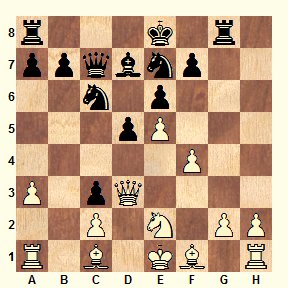
Without knowing it, the kids are introduced to concepts such as exploiting a battery on a file, distraction, intermediate checks, sacrificing for mate (surprisingly difficult for a lot of kids to give up material) and guarding possible escape squares for the enemy king. Here is the homework I'm giving out this week, all taken from recent examples.

 White to play and win
 White to play and win
 Black to play and win
 White to play and win


Answers in the next post :)

Friday, August 3, 2012

No chance for a breather

Following chess tournaments is now an ongoing experience. There is no shortage of events and as soon as one finishes another starts. The super GM event in Biel finished with Wang Hao taking first prize thanks to the 3 points for a win, soccer style scoring system. Under the more traditional 1 point for a win the winner would have been World number 1 Magnus Carlsen. But Magnus can be content with his performance, and the fact that his rating has moved closer to Kasparov's peak of 2851, and further from his rivals.

Rather than taking a breath and working out when the next big event will take place, there is no break as the Russian Championship starts today. Both the men's and women's sections boast excellent fields and National Championships often bring interesting results as the players know each other well. It seems to be a time for national championships with the British about to conclude and the Ukrainian entering the second half. These Championships are run on different levels, with the British being a medium sized swiss and the Ukrainian being an elite round robin.

The British has one round to go and is being led by GM Stephen Gordon who is half a point ahead of ratings favourite GM Gawain Jones, who is himself half a point clear of GM David Howell. But for me the swiss system event is all about players getting a chance to move up and in the British Marcus Osborne has taken his chance. I can't say I know him, but the 2245 rated player has scored 6.5 against a field that includes 3 GM's (and he has to face another in the final round!) and 2 IM's. His performance rating after the first 10 rounds is a whopping 2433 so a big congratulations to him.

Another interesting event that has just started is the World Junior Championship in Turkey. The tournament has a rich history dating back to 1951 when Yugoslav Boris Ivkov took the title. Ivkov went on to become a World Championship Candidate and other famous winners of the World Junior include Spassky, Karpov, Kasparov, Anand, Miles and Aronian. The current event has over 10 GM's, 4 of which are over 2600. again, you'll have to excuse my national pride as I cheer on the Australians (Andrew Brown and Fedja Zulfic, but sadly no players in the girls event) and English (Zhou Yang-Fan, Callum KilPatrick, William Jones, Ravi Haria, Henryk Stepanyan are all in the boys section while the girls section has Lateefah Messam-Sparks and Anna York-Andersen). The tournament started yesterday and hopefully we'll get some first hand experiences. Already in the first round, one of the Australians performed well above his rating. Fedja Zulfic (2135) scored a draw with IM Bajarani (2446) of Azerbaijan. Fedja found a nice resource in his endgame.

Loading embedded chess game...