Wednesday, December 31, 2014

New Year's Chess Resolutions

I wonder if anyone in the chess world makes New Year resolutions to do with chess? I mean, I certainly intend to run more regularly in 2015, hopefully getting fitter and thinner, but what can I intend to do in chess terms that I'm not doing now?

Should I set a goal to reach a rating, and is this even realistic as a resolution? I mean, resolutions are based on what you set yourself to do regardless of others, and a new rating depends very much on who you play against and how they play. Perhaps a more realistic resolution is to set how much to play. These past couple of years have been bad for me in terms of the amount of serious chess I have played. I've probably played less than at any time in the previous 20 years so maybe that would be a good start.

Resolution #1: To regularly play long play competitive chess (let's say at least 80 games in 2015)

What about study? I guess this is somewhat dependent on the amount of time that a working person can put into the game. My time is taken up with work, a life with my wife, chores, and other activities that I enjoy like running and reading. So before looking at what I should be studying, I really need to set an amount of time that I'd like to put into the game each week. Ok, well I think I should be able to put at least 10 hours a week into chess, that is only between 1 and 2 hours per day, and once I get into analysing one of my own games the time just flies past.

Resolution #2: To devote at least 10 hours each week to studying chess

Do I really need to resolve to do anything more than this? Probably not. I have set some realistic goals that will hopefully direct my thoughts and consolidate my play. Where I play and what I study are questions that I'll need to decide, and will be based on how my life shapes up in 2015. In the meantime what I can also resolve to do is stop procrastinating and get on with things. The 31st December is a great day for planning, but from tomorrow I need to be doing.

Resolution #3: No procrastinating

Well, that wasn't too difficult. Funnily enough these chess resolutions are very similar to the resolutions I should be making in life generally. Do more, make better use of my time, and get on with it!

Happy New Year!

Tuesday, December 30, 2014

MCC Youtube Channel

When I joined the Melbourne Chess Club committee some 5 or 6 years ago, little did I believe how the club would be turned around. It hasn't all been plain sailing but the MCC is a vibrant chess hub in Melbourne, Australia, and even further afield.

One of the new strengths of the club is its internet presence. The club website is attractive, easily navigable, and informative. The MCC's use of multimedia to make the club and the game more appealing has been excellent. Check out the club's Youtube Channel here.

The recent series of lectures by IM Guy West and GM Ian Rogers about Greg Hjorth are not surprisingly proving very popular. Meanwhile, here is an interesting tournament report by International Arbiter Gary Bekker about the 2014 Australasian Masters tournament
 

The MCC are determined for this branch of the club to grow and so more videos will be regularly uploaded to the channel. I'm heartened to see that there are contributions from players of all standards. I think it is important for all players to have their say, and while it is great to get the analytical skills of strong titled players like Ian Rogers or Guy West, it is equally important to hear opinions from players of all strengths.

Understanding Compensation

I realise that I am overly materialistic as a chess player, and my understanding of compensation is pretty weak. I'm not sure why this is, as when I was younger I enjoyed sacrificing and attacking chess. I guess that my sacrifices were always based on attacking or tactical ideas, and not on positional ideas. I tend to be a pawn grabber who tries to hold on to material. Is it possible to remedy this situation, or is it even necessary?

Of course it is important to fully understand all aspects of the game, and to be able to apply those ideas in your games, but I really have no problem adopting a style of play. And I suppose I am always going to be taking poisoned pawns, or defending against gambits. One gambit that I've never looked at too deeply is the Evan's Gambit, at least not in terms of working out a black repertoire.

As a lazy...oops, sorry, I mean time constrained player, I'm looking for repertoire choices that are easy to understand and not too complex to learn. The only trouble is, cutting corners and taking easy to learn lines can often mean playing inferior positions.

1.e4 e5 2.Nf3 Nc6 3.Bc4 Bc5 4.b4!?

So white just gives up a pawn? What does white get for it? For the pawn, white will get a lead in development and an attack against some key squares and lines in black's position. The more white wins I see, the harder I find it to choose a line for black to play. When I was young, the Evan's was not considered fully sound and so was not seen around too much. That was changed in the 1990's when Kasparov, among others, started to play it. For players of my generation, it is still difficult to accept it is fully sound, but proving it isn't sound is something else.

4..Bxb4 - It is possible to decline the gambit, though against my nature. 5.c3


The question is, where should the bishop retreat to, a5, c5, e7, d6? Funnily enough, the latter move is the one I have been choosing as a repertoire, 5..Bd6 or the Stoneware Defence. But I have found it difficult to play this system. I have recently seen a game with Nakamura on the white pieces, where black has an extra pawn but can do hardly anything, an excellent example of compensation for a pawn.


Games like this do nothing to inspire me to play this variation. Black grabs a pawn, and then takes a pounding, hoping that white's haymakers don't connect and somehow he emerges a pawn ahead. I think I have to put some work in to find something a little more active.

I recently played games where I underestimated my opponent's compensation, sat back and allowed them to gain more than adequate compensation for a pawn investment.
I was black here against Bill Jordan and expected Bill to take my e4 pawn re-establishing material equality. Instead Bill played 15.Nd5 using his development advantage to create threats. For the rest of the game I was unable to fully develop my queen side, and although we both traded blunders later in the game, I lost the game mainly due to Bill's more active pieces.

Until I understand the concept of compensation for material I will always struggle with positions like this, but playing and thinking about them can only help improve my understanding.

Sunday, December 28, 2014

Senior Moment

At the in between sort of age of 48 I still feel pretty young, except when I've just been for a run when I feel nearly dead. I guess my life has slowed down compared to what I was like in my 20's (playing chess on average 3 times a week is too much for me nowadays!) but I'm still pretty active and positive in my thoughts.

Just before Christmas I was sat in a cafe having my favourite long black and croissant with the radio playing in the background engrossed in a novel. Well, engrossed is a bit strong as the book wasn't particularly good. Let's say I was getting through the book as best I could with a dogged determination to finish it no matter what, typical of the British 'stiff upper lip spirit'. (Since then I've finished the book and I now wish that I'd listened to my reason and stopped reading early on. I'll admit "The Miniaturist' had its moments, but I really didn't enjoy it and essentially that is why I read novels!) Anyway, I had zoned out of the novel for a moment when I thought I heard the words "Bobby Fischer" from somewhere.


My first reaction was to think I was going a bit bonkers and secondly I sniffed my coffee just to make sure there was nothing funny in it. Surprisingly, "The House of Bread and Pastries" on Martin Street in Gardenvale do a very respectable coffee for what is essentially a bakery. I've certainly been to cafes which have served worse coffee. The coffee is smooth with a rich texture and a slightly roasted flavour. It isn't brilliant, but if it was the worse coffee I ever had I would die a happy man. At least in terms of coffee.

Ok, back to my senior moment. Hearing the name of a chess player for no apparent reason was a bit worrying, but then I heard it again, unmistakably on the radio. So I strained my failing hearing and there it was.

I think like Bobby Fischer.

I was so happy that I wasn't going a bit loopy, and that I wasn't going to have to call in work claiming I needed a mental health day off, that it didn't even register how crap the song was. At first. I had no idea who it was or even how to find out, but my smart phone and google were my friends and I now know that the song was "Cosby Sweater" by the Hilltop Hoods. See what you think. Am I getting old?


Saturday, December 27, 2014

Australasian Masters

The Australasian Masters tournaments took place between December 13th-21st. There were 2 events, both 10 player round robin tournaments, one qualifying for GM norms and the other for IM norms. The question was would any of the Aussie hopefuls score the required points for a norm.

Anton Smirnov deep in thought against Vasily Papin

In the GM tournament, things didn't start too well and only 13 year old Anton Smirnov held a realistic chance of scoring a norm. This would have been a remarkable achievement, but saying that, Anton went into the final round joint first with top seed  GM Murtas Kazhgaleyev needing to win his last game against GM Vasily Papin for a GM norm. Unfortunately for Anton and his Australian fans, Papin won the game, thus meaning Anton missed out on a norm and a famous tournament victory. The tournament was won jointly by the 3 visiting Grand Masters, Kazhgaleyev, Papin and Rustam Khusnutdinov. Anton Smirnov finished half a point behind and though he may be disappointed, he has an incredibly bright future ahead of him. The other Australian players were also young with all the home grown players under 25. They all had good moments, but none were firing all the way through.

GM Kazhgaleyev checks out the position of GM Khusnutdinov
The IM event was dominated by Kanan Izzat, who has left his home country of Azerbaijan to study in Australia. For the years he will be here, it will be Australia's gain as besides being a strong player, he is also a very pleasant young man. Kanan finished a point clear of IM Igor Bjelobrk and Yi Liu who had a very good tournament and who will be considered one of the favourites for the Australian Under 18 title in January. Eugene Schon was half a point back on 6/9 and topped the 2300 mark somewhere through the tournament so is now an FM. The rest of the field played averagely, sometimes good and sometimes bad.

Eugene Schon sneaking some refreshment on his way to the FM title
I would just like to point to an experience of mine in the tournament. During the second half of the tournament I had to play the 3 IM's in the event in consecutive rounds. My mind set was not positive going into these games. It was almost as if I gave these players too much respect and made poor choices because of this. I guess we all have a limit as to how well we can perform, and at the present moment I felt that Izzat was out of my league. That is a very defeatist attitude and it caused me to play very badly, make bad choices and play my worst game of the tournament. However, I'd lost this game before I even sat at the board. A similar sort of thing happened against Igor Bjelobrk, though I put up a better fight here. I felt that Igor was right at the limit of my capabilities and gave myself little chance to get a result. Actually, I managed to get an ok position, but then took an eternity trying to come up with plans, and eventually, just played a series of bad moves. I was also apprehensive against Mirko Rujevic and asked for a draw when I was probably a little better.

To be honest, it was a little humbling finding myself so short of confidence, although not to be unexpected after the lack of work or practice I've put into chess. Are there any ways for me to remedy this? Well, actually there are, and quite simple things such as playing a little more, analysing regularly and working on a narrow but solid repertoire. At least then I should be able to maintain my level. So those will be my new year's resolutions, but of course, resolutions are there to be broken, so we'll see how I go with them.

Wednesday, December 17, 2014

Australasian Masters, the Half Way Mark

I have to admit, I started this tournament reluctantly but have begun to warm to it. Playing one game a day, and putting maximum work into that game is excellent and there's a ton of material to be working through, in both preparation and analysis. The tournament's have both just crossed the half way mark with 5 of the 9 rounds having been played. By this stage it is already possible to see who's in form and who is fighting for places and norms.

The GM event has seen Anton Smirnov in great form so far leading the tournament with 4/5. Anton needs 2.5 for a GM norm and is half a point ahead of the field. Russian GM Vasily Papin who is making a return to Australia. The other GM's Kazhagaleyev, and Khunsnutdinov are on 3/5 which is ok, but nothing special. There are still some norm possibilities for some other players, the most likely being an M norm for Luke Li if he scores another 2.5. With 4 more rounds to go, the tournament is still wide open.

The IM event that I'm playing in is tight. There are 3 players on 3.5, IM's Kanan Izzet and Igor Bjelobrk and Yi Liu. This is a great performance from the young Queensland player who by his won admission has not played much chess this year. There are then another 2 players on 3/5, New Zealander Bob Smith and Bill Jordan. With 5 players separated by just half a point, we're in for an exciting finish. The best norm chance lies with Yi Liu, though he still needs 3.5 out of the final 4 games.

Unfortunately, I stopped Eugene Schon's norm ambitions form this tournament today. He is still on 2.5, just a point behind the leaders and could finish on a high score, but the IM norm now eludes him. I am on 1.5 after beating Greg Canfell yesterday and drawing with Eugene today. My play has been generally improving as the tournament moves on. I feel more confident about my play and calculation which bodes well for the future. I am not playing perfectly, or perhaps even as a strong as I have in the past, but I can at least see the possibility of getting back to a former playing strength.

In today's draw with Eugene, the following position was reached.
I was white and fighting for a draw so I thought in these terms.

1. trade queen side pawns
2. sacrifice my knight for black's h-pawn
3. draw the pawnless ending of rook and knight versus rook.

Seeing I had about 2 minutes plus increments, that was fairly good. The move Nc5 came to my mind, but I didn't choose it because I saw a drawing method which involved little risk to my mind.

Another boost to the confidence comes when good players praise your game. Today IM Mirko Rujevic told me he'd been impressed with my win against Greg Canfell the day before. I thought the position played itself, and it became obvious early that I knew more about the opening than Greg. Anyway, here is the game.


9.e5 was a new move on me, and after the game Greg said that he'd completely overlooked 11..Qa5. He spent about 40 minutes on his 12th move. In the final position it will be mate after 23.Bc4 Na4 24.Rb1 Qc3+ 25.Rb2 Qxb2.

Monday, December 15, 2014

Tournament Preparation

Too nice a day in Melbourne to prepare for a chess tournament!
I am currently involved in the 2014 Australian Masters event in Melbourne. There are 2 tournaments running, both 10 player round robins. One is a GM norm tournament, and the other which I'm playing in is an IM norm event. This is the 26th time the Australian Masters has been played since the first tournament in 1987. I've played in a few of these tournaments over the years with mixed results.

In 2005 I had an excellent tournament. I knew about the event a few weeks in advance, was able to put some work into my game, wasn't working at the time, and so could concentrate fully on the tournament. I scored 5.5/9 for a 2370 performance, the best of my career.

The following year, in 2006 I was given the task of running the tournament. With no chess preparation and organisational headaches leading up to the event, I played badly, not winning a game and luckily scraping together a few draws.

In 2008 I finished about par for the course finishing on 4/9. At the time I was quite active in the chess scene and regularly playing. I didn't prepare specifically for this tournament, but my playing strength was enough to maintain an ok score.

The last time I played was 2010 when I scored 3.5/9 but against a stronger field than in 2008. I was pretty happy with my play, had prepared somewhat for the tournament which reflected in my play.

This year has been probably the worst build up to a tournament for me in all that I've played, including 2006. I was working heavily in the past couple of months, and have had little time or energy to prepare for this tournament (I only knew I was going to play about 2 weeks ago anyway!). In fact, I was working on the day it started until about an hour before the games were due to commence. I arrived at the venue with not much time to spare before my first game, which proved to be a pretty painful loss to New Zealander, Robert Smith.

IM tournament favourite Kanan Izzet with Bob Smith sitting in the background
My plan for this tournament is a simple one, and that is to try to play myself back into some form. I have started working on the game, after the first round and already put up a better fight in game 2, though finally succumbing to Bill Jordan in a complicated game. This leaves me on 0/2, not a particularly auspicious start, but I have a feeling that chess is beginning to come back to me. I'll be using this event to kick start my game for 2015 and hopefully to get back to somewhere near 2200 strength. I plan to play a few tournaments next year and put some serious work into some weak parts of my game. Then maybe I'll be a competitive 50 year old from 2016 onwards!

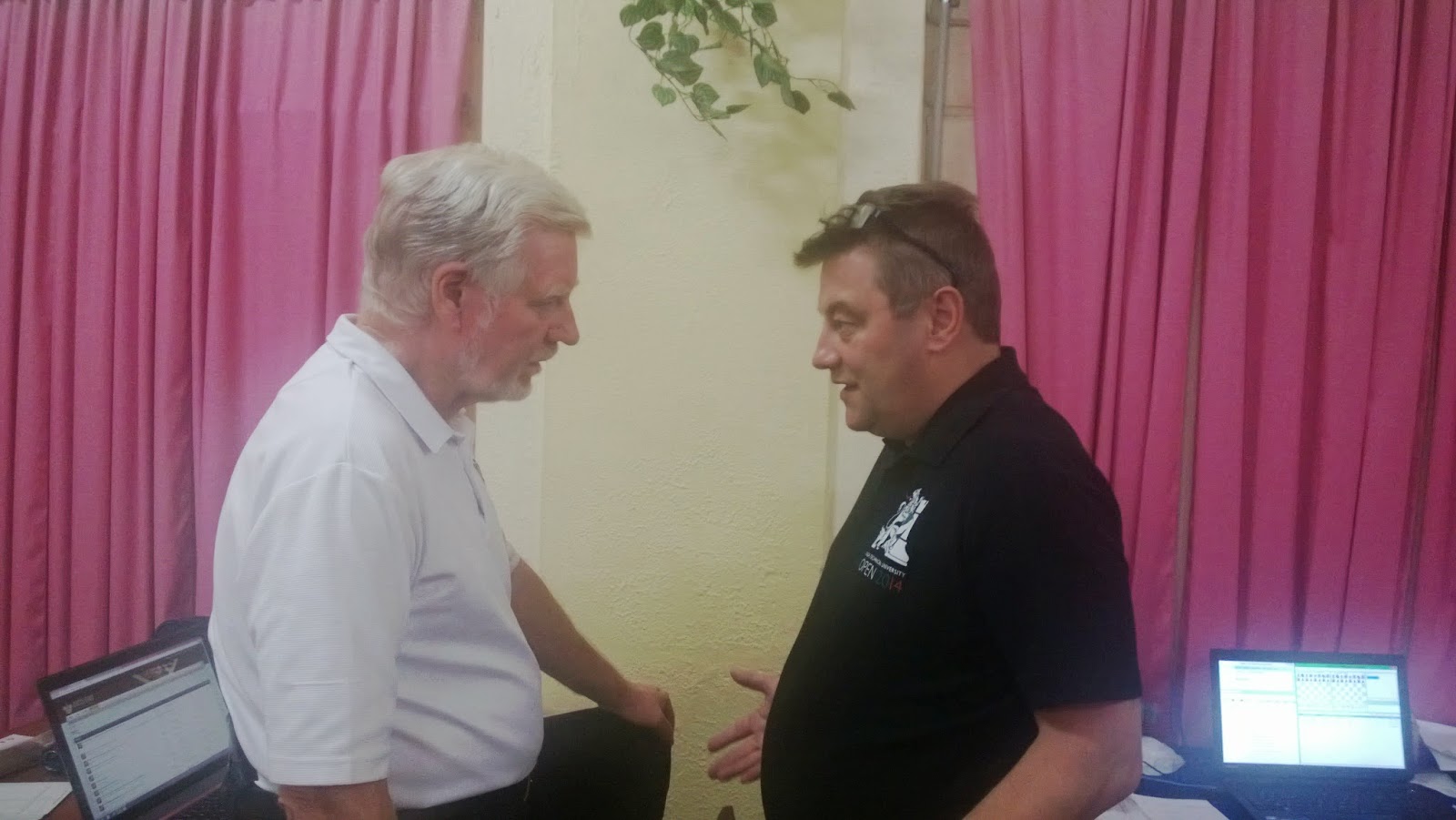
Trevor Stanning (left) with tournament organiser Leonid Sandler

Olympiad team mates, Moulthun Ly (left) and Anton Smirnov