Showing posts with label Hastings. Show all posts

Saturday, August 11, 2018

Game of the Day 7

What makes a game great or important? There are a number of considerations to take into account, but the occasion, the players, the fight and the brilliance of play are all contributing factors. There will also be second hand opinion, by those who witnessed, or have seen and analysed the game. One of my favourite tournaments is Hastings 1895 and I must have looked at most of the games at least once.But a game I never really considered much was the first round game Lasker-Marco. It really isn't a brilliant game, certainly not the best by either player, and not even the best of the round, but it was an historically significant game. It was the first tournament game that Lasker played as World Champion, and as Hastings 1895 was his first International tournament after winning the title, it can be surmised that it wasn't the glorious start he would have hoped for, finishing third behind Pillsbury and Chigorin.

But Lasker isn't the only World Champion who didn't start their tenure with a bang. Euwe could only finish second, behind Reuben Fine at Zandvoort after beating Alekhine, and Botvinnik fared even worse finishing sixth at the super strong 1951 USSR Championship won by Keres. Admittedly, Botvinnik didn't play much after 1948 so would have been rusty, but this must have been a disappointment. In recent times, both Kramnik and Anand could only finish third in their first classical tournaments after winning the title. Then there were Steinitz, Smyslov and Fischer who never played tournaments as World Champions. As far as I can tell, all the other undisputed Classical World Champions started with a tournament win.

In the tournament book of Hastings 1895, the games were annotated by players, though they didn't comment on their own games. The 1st round game of Lasker-Marco was commented by the great German player, Tarrasch who tends towards the critical in his analysis style! Tarrasch was known for his dogmatic opinions on the game, but he was still a brilliant player and a magnificent calculator at the board. His fantastic win against Walbrodt from Hastings 1895 is a great example of his brilliance.

The game has an interesting middle game with black taking hanging pawns from a Queen's Gambit Declined opening. Unfortunately, the game finishes when it is just beginning to get interesting, as Marco made a huge, and somewhat elementary blunder.


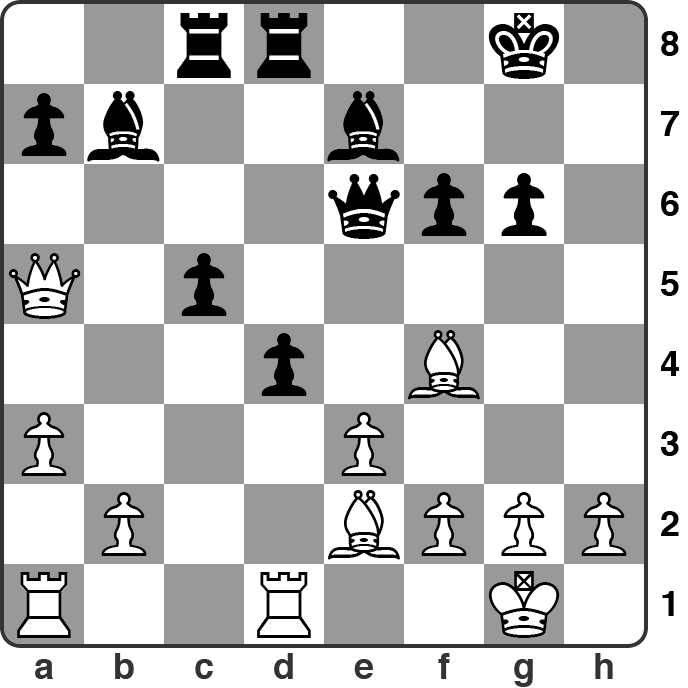
Black here played the shocker 22..Bf6?? allowing 23.Bg4 skewering queen and rook without the possibility of blocking with the f-pawn. The game falls apart quickly after that. Tarrasch's notes to this position are quite interesting and show a lack of regard for dynamics in the position which were not so well understood at the time (strange really, as the idea of gambiting for an attack was still quite prevalent at the time). Tarrasch considers 22..Qb6 as forced, but 22..f6!? keeps the position fluid. It looks as if White wins a pawn by 23.Nxg6 hxg6 24.Qxa5.


However, the position is highly unbalanced with White's forces dispersed. Black has 24..g5 (a move Tarrasch thought about in an earlier position) 25.Bg3 dxe3 26.Rxd8+ Rxd8 27.Re1 Qd5 28.f3 with an absolutely unclear position.


In fact, this crazy dynamic game would have suited Marco who played a game from the same opening position a couple of years earlier against von Scheve at Dresden 1892 where he took an IQP and managed to create all sorts of complications for himself and his opponent, who finally ran out of steam and blundered the game away. Here's that game, and then the Lasker game with notes by Tarrasch (and the f6 line added). Enjoy!


Loading embedded chess game...

Loading embedded chess game...

Saturday, December 30, 2017

Top Seed Loses

The first round of a swiss open almost always produces some shocks. Top players are held to draws, or sometimes even lose to players much lower rated. The biggest upset is when the top seed loses in the first round, and this is exactly what happened at this year's Hastings Congress.

There seemed to be an acceleration of pairings which was presumably used to enhance norm chances. In round 1, top rated Indian GM Deep Sengupta, rated 2586, was paired as black against English FM Adam Taylor, rated 2242. The opening seemed innocuous enough, a king of Reti/English opening where Black chose a Slav set up. The following position was reached:


Black had just played the novelty 10..Qd8-e7. White played the thematic central thrust 11.e4! I wonder if either player realised that this was already very good for White, maybe winning?


Black traded by 11..dxe4 [Not sure this is best, but everything else loses at least a pawn] 12.dxe4 Bg4


So far all seems to be logical, but White now launches an exchanging sequence which wins a piece. And this is the player rated 350 points lower! 13.Nxd7 Qxd7 14.Qxd7+ Kxd7 15.Bxd6 Kxd6

This little sequence was all forced and has brought Black's king into a poor position. White would like to play e5 forking king and knight, and by combining threats to trap black's bishop, he manages it. 16.h3 Bh5 [16..Be2 17.Re1 and after the bishop moves White plays e5+] 17.f4!


This leaves Black the choice of losing a knight to e5+, or losing the bishop to g4 and f5, either way, white nets a winning material advantage which he went on to win, though he missed a chance to win more easily.


It seems Sengupta had given upon this game. He played 23..Rad8?


White here played 24.Raf1, methodical and good enough to win. But he missed a good tactical shot which would have been found if he'd thought about searching for all checks and captures. 24.Nd5+! blocks the d-file interrupting the connection between Black's rooks. The same tactic could have been played on the next move as well, but wasn't. Never mind, white still went on to win and gained a great scalp.

Saturday, July 29, 2017

Favourite Tournament

Do you have a favourite tournament? By that I mean is there any tournament that either you played in that sticks in your mind as being a great event for one reason or another, or one a great event from history. You could have performed amazingly, or the field or conditions were fantastic. And related to this, do you have a favourite tournament to follow? Is it a local event, a national championship, an annual supertournament, or anything else?

Currently, there are so many events happening around the world. This is what brought this question to my mind. The Match of the Millennials in USA sees a US team vs a World team at junior age group levels. Australia's very own prodigious talent, Anton Smirnov represents the World team, as does the Indian 11 year old star Pragga. This event can't help me thinking of the USSR vs Rest of the World matched from the 1970's and 1980's. I'm sure we'll look back at these kids when they become top players in 5-10 years time and reminisce a little, but I can't get too excited by this type of event.

I'm more excited by the British Championship which is starting later today. The national Championships of my birth country and my adopted country, Australia, are very important events for me, and I follow them both. Thankfully they happen at opposite times of the year, with the Australian Championship happening in January, giving me plenty of time to focus on them. In fact the 2016 Australian Championships was one of my better events over the years, and I hope to play in a few more championships in the coming years.

Even more immediate for me are local events, with the Victorian Championship currently in progress as well as many club events around Melbourne and Victoria. I'd have to sat tha my faourite event in the Victorian chess calendar is the MCC Club Championship which takes up the first quarter of the year. Although I haven't won it, I've finished near the top regularly, and it is a tournament where there is almost always IM opposition to face. This year I managed to finish third which was pretty good taking into account that it was a tough field. I also finished third in my most memorable Club Championship in 2008 which was won by Malcolm Pyke who scored a magnificent 8/9 to finish half a point clear of IM Guy West. Malcolm's perennial participation at the MCC will be sorely missed, and it was a great honour for me to win the tournament that was just held as his memorial at the MCC. More of that in a future post.

Of course, International events are great to follow. I have a soft spot for Hastings and Amsterdam having played memorable chess tournaments in both. I think Hastings tops it for me as the greatest,or at least, as my favourite. I remember sitting in the commentary room and being awestruck as Bent Larson just walked in and started talking about his game and the remaining games. This was years before internet coverage which sees this happen regularly, and was a special treat back in the 1980's. Hastings 1895 must go down as my favourite ever tournament. The cream of chess was playing, the games were great, the result was in doubt up till the very end, with the favourites not getting their own way. It had absolutely everything.

Anyway, what is your favourite tournament? One that you played in, one that you enjoy playing in, or International events that you love to watch, or your favourite from history?

Tuesday, January 10, 2017

For The Love Of It


I was fortunate enough to pick up a copy of Chess for the Love of It by ARB Thomas in a second hand bookshop. Thomas was an amateur player, but a good quality amateur. He beat Rubinstein in 1924, Guimard and Najdorf in 1937, Tartakower in 1951 as well as draws with Reti, Unzicker and Euwe!

These games are all in the book, but there is much more. Thomas writes of the chess world fondly. It is not just the moves and games that have meaning for him. For instance, he had 2 outstanding memories from his first Hastings Premier in 1937. One of those was watching his idol, Keres, playing blitz. The other was Alekhine's appearance at the event as a spectator. Alekhine had just regained his World title and brought with him a cake that he'd been given after the World Championship. Thomas fondly remembers Alekhine dividing the cake and sharing it among the competitors at the 1937 Hastings Premier.

The only issue with this beautiful little read is that the games are published in the old descriptive notation. Of course, I started playing using the old descriptive notation so it isn't too hard for me, but the younger generation might find it harder. Then again, working through these older books will do great things for your chess if you have to go through things slowly.

Anyway, in the introduction Thomas gives a nice little game from the 1971 British Counties Correspondence Championship. The 20 move game is nice, but Thomas leaves the reader to work out the 'mate in, at most, 9 moves' for themselves. So I'll leave it for you and give the answer in my next blog post.

White to play and mate in 9 at most. Answers in descriptive notation please!

Sunday, June 12, 2016

Answer Time

Last week I put up some problems, and now here are the answers!

First the 3 problems that made up the Hastings 1895 solving competition which I posted here. If you got the correct answers in less than 2 hours, you were doing well!

White to play and mate in 3


1.Kb2 [intending Kc2 and e3#] eg. 1..Bxf7 [1..h5 2.Ng5 intending Ne6 mate; 2..e5 3.Qc2 with e3# to follow] 2.Kc2 and whatever black plays, 3.e3 is mate. The puzzle was set by Berger, but apparently there was a cook so it was changed to this puzzle here.
White to play and mate in 3

Mate is to be delivered along the a1-h8 diagonal. 1.Rb2 [threatening e5#] 1..Bxb2 [1..Rxe4 2.Qc3+ Re5 Rxf2# Or 2..e5 3.Rxb6#] 2.Qa3 [Threatening Qf8#] 2..Bxa3 3.e5# Absolutely beautiful puzzle by Gold. Apparently, the tries 1.Rxb6 and Rd4 are both defeated by 1..Rf5. 1.Rb2! Rf5 on the otherhand still allows 2..Qc3+ with mate to follow

White to play and mate in 4

This is fiendishly difficult! 1.Ke7 [with the idea Kf8, Qe8 and Rf4#] 1..Bb3 [black's bishop is the only piece that can move and it must stay on the a2-g8 diagonal defending the rook] 2.Kf8 Bc4 [2..Ba2 allows the alt. 3.Qc3+ Rd4 Qxd4#] 3.Qe8 and whatever move black plays, white has 4.Rf4# This puzzle by D.P is one which requires vision of the mating pattern rather than calculation, as do all of these to an extent.


I then posted this study which I saw in an old BCM.

White to play and draw

This is a stalemate puzzle set by F. Simkovitch. 1.b7 [gets rid on one piece] 1..Nxb7 2.Bc6 [Forking the knights, which looks like the end of the puzzle. However, the bishop will also get forked in return!] 2..Nd6! 3.Bxd5 Nf5+


Now, wherever the white king moves, a knight fork can be created. 4.Kh5 Be2+ 5.Kg6 Ne7+ 6.Kf7 Nxd5


7.g6! [white in turn threatens to promote] 7..Bh5 [ pinning the pawn] 8.Kf8 Nf6! [The last trick! 8..Bxg6 is already stalemate]


9.g7+ Kh7 10.g8=Q+ 10..Nxg8 stalemate, a beautiful final position with white's king not in a corner while all the black pieces are to the short side, and a nice theme allowing the pawn to promote.


Saturday, June 4, 2016

The Value of Old Material 1

Aspiring chess players spend so much time looking at modern openings and searching for the most up to date analysis and information. However, a good book is timeless, and one should always be able to get something from old publications. As I've mentioned recently, I've been trawling through a book of the Hastings 1895 tournament, and I've seen plenty of games and positions that have been of interest. A lot of old publications have materials that are otherwise lost, and it is good that some obscure games and positions are kept alive, as well as stories and records of historical interest. For instance, at Hastings 1895 besides the great tournament, there was a problem solving tournament which was won by Georg Marco who took 1 hour 35 minutes to solve the following problems:

White to play and mate in 3

White to play and mate in 3

White to play and mate in 4
See if you solve these in less than 2 hours! Of around forty competitors, Marco narrowly won ahead of Schlechter (1 hour 40) and Miesis (1 hour 55) with Steinitz, Pillsbury, Teichmann, Albin and Pollock among the competitors!

Wednesday, May 18, 2016

What was the Greatest Endgame?

Imagine you're playing in a tournament with the World Champion, and all the best players in the world, and if you win your final round game, then you win the tournament. That was the situation that faced a young American player called Harry Pillsbury in the last round of one of the most famous tournaments of all time, Hastings 1895. Looking back in hindsight it is easy to say that Pillsbury was in fact a great player, but before the tournament started in August 1895, Pillsbury was considered an outsider, given little chance of success. A poor start in the tournament against Chigorin probably didn't help him gain favour among the pundits, though his defence was praised, even though he did lose the game. But then a win against Tarrasch brought him to the attention of the chess world. His victory over Tarrasch wasn't 100% convincing and followed by a draw with one of the outsiders, Georg Marco still would have led nobody to believe that he was a chance for tournament victory. But then a run of 9 wins, including a victory against Steinitz, catapulted him into the leading group which he didn't leave.

In the final round, Pillsbury was half a point ahead of Chigorin, and a point ahead of Lasker. Unfortunately for Pillsbury, the pressure mounted as both of these won quickly in the last round, and he was facing a level position against an ex-World Champion contender, Isidor Gunsberg.


The question is, how as white would you go ahead winning this position to take clear first in your first elite chess tournament. Look and watch, at one of the greatest endgame's ever played, not only because of the quality of white's play, but because of the pressure of the tournament situation.

23.Bc5 a6 [23..a5 would have been better, but things still don't look bad for black] 24.b4 [This space gainer builds pressure, but black should still be ok] 24..f6 25.g4 Bxc5 [This trade giving white a passed pawn is dangerous, but still ok] 26.bxc5


The passed c-pawn looks a bit scary, but does black really have anything to worry about? At this point Pillsbury got the break he needed with a blunder from Gunsberg, an understandable blunder, but a blunder nevertheless. One of the main ideas of the endgame is to stay active, whether it be the king, pieces, or advancing pawns. Gunsberg decided to prevent the advance of white's c-pawn with 26..Nb8?


Again, this looks innocuous enough, but from here on, white plays the endgame masterfully. 27.f5! An excellent breakthrough in the centre of the board, probably not what black was expecting. 27..g5 [Taking is not an option, as analysis has shown] 28.Nb4 a5


So white's knight has to retreat, right? 29.c6! [White's knight stays on b4 where it can't be taken or the c-pawn promotes] 29..Kd6 30.fxe6! [Again, leaving his knight en prise as if black captures the minor piece, white will promote]


Although white has 2 passed pawns, they look to be easily dealt with. 30..Nxc6 31.Nxc6 Kxc6 and now the king can just run back and catch white's e-pawn.


32.e4!! This is the move that Pillsbury must have seen way back when playing 28.Nb4, and he had to judge that the position was winning for him, no mean feat back in the days when endgames were a mystery to most players. 32..dxe4 33.d5+


Now that white's e-pawn is protected it just remains for the king to round up black's dangerous queen side, which he managed without problem, black resigning just 7 moves later.

An immortal endgame played under the most intense pressure, by one of the greats of the game, Harry Pillsbury! Here's the endgame with a few extra notes, well worth playing through again, and again. I've been using it recently to show kids the importance of making passed pawns, and of the importance of thinking about promoting pawns in the endgame.


Saturday, April 30, 2016

Studying Boring Games

How often do you look at some games, perhaps the games from a tournament or of a player, and draws, or long games are glossed over as being not as interesting, or brilliant. But one thing can lead to another, so even looking at seemingly boring games can lead to some interesting finds.

I've been looking through games from Hastings 1895 (not for the first time) but this time I intend to look through all the games, the good, the bad and the ugly. Round 1 of the great tournament saw only 1 draw and some great games already. The draw was between Schlechter and Pollock. Schlechter was a bit of a drawing expert, the Giri of the late 1800's and still and up and coming player. Pollock, on the other hand, was not one of the strongest in the tournament, and fell ill soon after the event, and may have been suffering through it. so a draw would not have been objectionable to either of them. As the only draw of the first round I've never really paid it too much attention before. I mean, there were queen sac's, piece sac's, some amazing attacks and tactics, and the most terrible blunders to get one's chops around.

Well, there were still some interesting moments in this 24 move draw. The game started as a Spanish with one of the popular lines of the time (more n that later) and reached this position.


Pollock, as black, played 10..Be6, an ok looking move, but a blunder. The game continued 11.Nxf6+ Qxf6


The open f-file is crying out to be exploited but how? 12.Nd4 (12.d4 was also promising) 12..Qg5


White's knight can take on c6 or e6, and again, both moves are promising. Schlechter chose 13.Nxc6 and Pollock chucked in the check 13..Qxe3+ 14.Kh1 before dropping back with 14..Bd7


Schlechter played 15.Nxe5 regaining his pawn, and even winning a pawn after 15..Bxa4 16.Nxf7. It wasn't enough to win, as black had the excellent response 16..0-0!

But in the position above there was another possibility 15.Nb4. This will leave white a pawn behind, but black will have virtually nothing to do but wait for white to break through.


To regain the piece 15..Bxa4 is forced, and then 16.Nd5 forks black's queen and c7, so 16..Qc5 seems necessary.


In the tournament book, Schiffers analysed this game and considered this position to be no great shakes for white. I'd have to disagree. 17.b4 Qc6 18.Qg4 and black is struggling to find a useful move. g7 is attacked, and white' missing pawn allows the f-file to be used to great effect.


Defending g7 is not easy Rg8 allows Nf6+ winning an exchange, Kf8 lets white sac a rook on f7 for a devastating attack, and 0-0 loses the queen to a knight fork on e7, so it has to be 18..g6. But if white doubles rooks on the f-file, then black can basically resign. There is nothing black can do.

Now look, I'm not one for giving up material, but seeing positions like this helps with my understanding of compensation. Will it help me to bring these types of ideas into my games? I don't know, I'm very materialistic usually, but at least I'll think about these types of things now.


What's more, I learned a bit about an interesting opening, a variation of the Spanish played by among others World Champions Alekhine, and Spassky. More on this next time, because I've seen some amazing games. And I've leraned not to ignore the most boring game of the round!

Saturday, April 23, 2016

Studying Chess


A friend of mine on Facebook asked this question:

"Is it better to work on one part of your game (say tactics) for a month and then move on or is better to work on tactics on Monday and endings on Tuesday for example?"

I don't claim to be a strong player but as a 2200 ish player, perhaps my opinion, or work regime might provide some ideas for others. One proviso: I have no ambition, so the work I do isn't designed to help me improve, but it maintains my level, roughly.

The simple answer to the question is that I do what I want, when I want, but the work I do is done totally by me. That is, I don't give up on puzzles, I don't guess, I don't use a computer engine. I break the work into 2 distinct types.


- analysis


- calculation

Analysis involves me looking at games, and trying to discover the truth about those games or just some positions. It can be any games, there's no shortage of them. Like the games from the recent Candidates tournament in Moscow were quite interesting at times, but I'm also looking at games from the famous Hastings 1895 tournament.

Thinking nostalgically, a big improvement in my game came in the early 1980's, after I worked through all the games from the 1981 Linares tournament. I had the bare game scores in a little booklet and just worked through the games. It was just 66 games, but I studied them over and over until I found things in the games that I hadn't seen before.


Here's a position from that tournament. It's white to move. White's in a good position, but what's the best way to proceed? I'm guessing that anyone looking at this position for the first time will be able to see a whole bunch of promising moves for white. Finding different plans and ideas, as many as you can is good. Try looking for moves, then black's best replies, seeing if you can come up with a line that you like. It doesn't have to be too deep. Take a break, and then look at it again and see if anything new appears. Do it as many times as you like, either trying to find new ideas, or seeing further down variations. I'll post the game, and some good ideas for white tomorrow.

As I said, I'm currently working through the games from Hastings 1895 and using some games and positions in my lessons. There are some amazing games, some wild positions, some crazy old openings, and some terrible blunders. The strategic considerations aren't as deep as games are now, but the calculation is at times excellent. I've seen most of the games before, but I still enjoy looking through them again and again, and find new things, a bit like someone reading a favourite book many times, or watching a favourite film loads of times.


This is from the game Schiffers-Chigorin that I've been showing kids this week. White had just played Bg5, and to block the diagonal to d8, black has just played ..f6.

The question is, what is white's best move? And just how many plausible options does white have?

Analysing games and interesting positions is unbelievably good for your chess. And looking through analysed games is also good. It teaches you to think of options, and to use your imagination. You have to think of most plausible, and less plausible options, and calculate those moves to see wheich is the best, and why your favourite option doesn't work, or whether it would have been better than the move the GM played. Of course, analysing your own games is important, but studying analysed game collections, and practising analysing GM games is obviously great practice for when you start analysing your own games.

There are other things that one can do to work on one's game. Solving tactical puzzles on a site like chesstempo, working on endgames or openings to improve your technical knowledge. I personally think that help from a strong player, or even employing a coach is good for this. (I'm not looking for clients here, but I'll keep trying to post material on this blog that might make people think)

The last thing. Do I stick to a program or just randomly work when I feel like it, doing whatever I want? Actually, I do more of the latter. I'm of the opinion that if you're looking at different positions, honing your analysis skills and trying to develop and extend your calculation skills, you're already doing more than most players are who are just ploughing through tactics and trying to learn openings in great depth. Sure, I do some tactical puzzles, and when I see a problem that interests me I can't help but try to solve it. And sure, I work a bit on openings, but not that much!

Most adults are hobby players, and as such, they should be playing and studying because they enjoy what they're doing. We all get afflicted by ambitions, and if this ever happens to you, I suggest investing in a coach for a bit (make it a good coach, and one that can work face to face rather than by online instruction; you might need to try out more than one coach before you find the right one for you). Otherwise, work at the game when you can, and if you don't feel like studying, then don't push yourself because you're meant to be enjoying this! Wait until you feel like it, and then start up again. If you play hard and work hard when you feel like it, your game will make jumps at those times. You may quickly plateau out, but it will be at a higher level than when you started.

And please remember! More knowledge won't help necessarily. The most important thing is to be able to put ideas into practice. Therefore, learning to analyse positions, and to calculate variations are the 2 most valuable skills a player can have. Adult club players should leave the latest theory on the Anti-Moscow Gambit to Masters, and promising juniors who have the chess memory to cope with these things.

This advice might not be right for everyone, but it is my view on the game and how an adult should approach it and I guess it explains the way I think about the game, study the game, and play the game.

Monday, January 12, 2015

An Upset

As neutral spectators we all seem to enjoy watching an underdog come good against a higher rated opponent. Over the past few weeks I've been trying to keep abreast of some of my favourite tournaments of the year, the Australian Open (lack of games has been a bit disappointing), Wijk aan Zee, Australian Juniors which will start next week and Hastings. In fact, it's fair to say that most of my current chess work stems from this part of the year, and after January I move back to getting inspiration from the classics!

Anyway, I've been working my way through games from Hastings when I came up with Othman-Haussernot from round 2. To be honest, I know neither of these players but black was the higher rated by about 200 points. White's strategy was perfect playing a double edged system against a higher rated opponent who would probably prevail in a technical battle, or a long, slow game. The game was an open Sicilian which also adds another random factor as nobody can know everything about these crazy systems, and there are always some interesting sacrifices for white which can unbalance the situation so much that the chess engine verdict has little meaning in a game between players below master standard.

The shit hit the fan in the following position.


Black has kept his king in the centre a fraction too long which allows white to strike. Amazingly, this isn't the first time this position has been reached, but hopefully, black players will not seek it out again. Othman (1978) played 12.Nd5!! and black is already in big trouble 12..exd5 13.exd6!

The unfortunate position of black's king is now coming into play. This is the best kind of sacrifice, a temporary one that will win material! 13..Qxd6 14.Nf5 Qb6 15.Nxe7 [There was something to be said for 15.Rxe7+] 
Materially, the position is level but black's king is a real target, and black has no development to talk about, and black's d-pawn is falling. A black discovered check by 15..Nxb3 is easily handled by 16.Kh1 when white threatens their own discovered check, Nxc8 winning the house. The game continued for another 10 or so moves, but the outcome wasn't in any doubt.

It's nice to have games where it all falls in to place, especially when you're playing a higher rated opponent. Here's the game in full, enjoy :)


Monday, December 30, 2013

Hastings

Around the Christmas and New Year time, the thoughts of most British chess players turn towards the traditional Hastings event. In the past Hastings has produced some memorable tournaments, and a who's who list of winners from the greats of chess. Like many other chess festivals the tournament has a number of sections with the top section having been traditionally a round robin event. Things have changed a bit, and the top section is now a swiss event, but a pretty strong one nevertheless. There have only been 2 rounds so far, which means that the top players haven't really come into contact yet. That doesn't mean there haven't been some interesting moments.

Harvey-Gordon from round 1 where black is definitely in the driving seat. However, I'm guessing most of us below master strength would be thinking of how to attack white's weak pawns and a plan of 1..Nc5 2.Kc2 Rf1 might come to mind. GM Stephen Gordon preferred to create a mating net in the endgame. 1..Nb4! 2.Kc3 Kc5! [with the threat of Rd1-d3] 3.Bxe6? Rd1 and now mate is unstoppable.

Apparently all the World Champions from Steinitz to Karpov (except Fischer) played at Hastings over the years. I seem to remember Bent Larsen as a star attraction one year I was playing back in the 1980's. It was great as the main tournament was held in the afternoon while the other events (like the one I was playing in) happened in the morning. That meant players like me could play and then watch the top players and follow the commentary. It was a great inspiration, and I hope that one day Hastings returns to its former glory. Still, there are a fair number of Grand Masters and strong players in the tournament, and plenty of interesting games, and upsets, like Martin Schuster's (2209) first round victory over IM Joerg Wegerle (2431) in a rook ending that looked drawish to me. I'll talk about this ending, and a couple of others in a future blog post (see, I haven't lost my procrastinating skills).
But how about this first round effort? In a wild game, Jens Kipper as white saw a way to mate against Francis Rayner. White played the stunning 1.Rb1!! and won after 1..Qxb1 [allowing mate, but nothing else is good anyway] 2.Bxf6+ gxf6 3.Qxf6+ Ke8 4.Nd6+ and black resigned before getting mated on f7.

This position (Burnett-Halfhide) arose from a Queen's Gambit Declined Exchange Variation. I personally like playing the black side of this opening as often black gets the chance to attack on the king side which suits the way I play. Here, Black has sacrificed a piece and hasn't got nearly enough for it. Black has just played..f5 and the question is, should white take the pawn? Unfortunately Burnett saw nothing wrong with the capture: 1.gxf5? [1.Rc3 holds things together, but maybe white had little time] 1..Rg3+ [This must have come as a shock, though we should be on the lookout for checks] 2.Kh2 [2.Rxg3 is obviously met by 2..Qg3#, while 2.Kxh4 is mate in 2 after 2..Qf4+, so white's move was the best except now a discovered check picks up the queen]
2..Re3+ [with an amazing turn around. Black is winning and won after] 3.Kh1 Rxe2+ 4.Rxe2 e3 5.Nf3 Qd1+ picking up more material.

I haven't looked at much of the second round yet, but a 300 point upset victory caught my eye. White just gains a bit of space, develops quickly, letting his higher rated opponent take a poisoned pawn, and then goes for it. Enjoy :)

Monday, August 5, 2013

Rest Day at the British

The British Championship is a 2 week marathon tournament with a rich history. The series of Championships goes back to 1904 when William Napier became the first champion. Since then, the event has been a showcase for British talent, and at times Commonwealth talent. Traditionally (though I'm not sure how far back this tradition began) the middle Sunday of the British Championship has been a rest day, or at least a day with no Championship games. This year, extra events included a weekender, a team blitz tournament, and a cricket match against a local team. It gives the Championships a social feel as well as the tough competition that is the main event.

However, just how tough is the British Championship this year? Certainly at the top it looks pretty good with over 10 Grand Masters, but it has been suggested that the event has become one of quantity rather than quality. I remember trying to qualify for the British back in the 1990's and early 2000's and it was a tough job. Automatic qualification went to anyone over 2320 (if my memory is correct) and the rest of us had to qualify through one of the weekend tournaments. This meant that the tournaments tended to be top heavy, with the majority of players over that 2320 threshold and some under that who qualified. As an example, lets compare the current event with the first event to feature Michael Adams, the 1985 Championship. First a big congratulations to Michael for winning the Dortmund Super Tournament ahead of Kramnik among others. Michael raced to an early lead which he didn't relinquish, and his play in the early rounds seemed remarkably easy, yet deadly effective.

Anyway, in 1985 there were 76 players though one had to withdraw after 5 rounds. The 2013 event has 106, though that in itself is not an issue in my mind so long as the standard is upheld. Naturally, you'd expect more players to be achieving greater standards. So players above 2320: 42 in 1985, compared to 21 in 2013. (the 1985 figure doesn't include Guy West, now an IM but 2310 at the time, or Joe Gallagher, 2305 then, and a GM now). However, at the top level 1985 looks weak compared to 2013, with the highest rated being only 2560. But when one realises that this mere 2560 player was Tony Miles, and other players of the quality of Chandler, Rogers, Speelman, Hodgson, King, Hebden etc were playing, it would be foolish to merely look at the top ratings and assign quality because of it. In my mind, the 1985 event was far superior in terms of overall quality than the 2013 event, it was an elite closed swiss event. The 2013 is also closed to an extent, but with so many players below FM standard, it can barely be called elite.

So the question I suppose must be is this what is really wanted? I mean, I tried hard to qualify for the British, and eventually managed it in 2003, though I emigrated to Australia a few months before the 2003 tournament, so have never played. And here in Australia, a similar debate happens over our Championship, though the ACF have stuck to their guns, and kept it at an elite level, ensuring that only the top 50 or so players in the country will be eligible to enter. Personally, I believe that the National Championship should be an elite event, and whatever needs to be done to make it so should be undertaken. To me, the British Championship has become a fairly decent swiss event, but without the international flavour. Compared to the annual events on the Isle of Man (unfortunately not happening any more) and Gibraltar, the British is a bit of a joke. But I think that the British has evolved to become this tournament, and nothing is going to change it from its current trend.

What could happen, and perhaps should, is the ECF (important now it isn't the British Chess Federation) could organise an elite English Championships. The British could continue in its format and no one would worry about the drop of standard because that is how the tournament has developed. But the real Championship for English players should be an elite event, perhaps going back to the rating limit cut off and allowing for a few qualifiers and wild cards, such as talented and perhaps under rated juniors. Or even a round robin format with a swiss qulifier for the following year, like what happened at Hastings. Ok, let's go the whole distance. Why doesn't the ECF work alongside the Hastings organisers and turn the dwindling New Year tournament into an English Championship? And before anyone starts shouting that Hastings isn't dwindling, I suggest they compare Michael Admas first appearance in the Premier in 1989/90, a category 14, 8-player double round robin event where Candidate Arthur Yusupov could only finish 5th, to the latest tournament over New Year 2012/13 which was a swiss with about 20 players above 2400, another run of the mill event. I hate to point it out, but the 1989/90 challengers event was probably stronger than the 2012/13 Masters!

But to be honest, I don't know why I'm grouching so much here. It's only 42 days till I go on holiday!! And at the top level of the 2013 British, the competition is genuine. David Howell leads the event by half a point, but there is a big pack of elite players close behind. In fact, the first 26 players are separated by just 1.5 points, and another half point behind are Emms, Lane and Bates who are all capable of making a charge in the second week. The fun starts again tonight, and this week there are 5 more rounds to sort things out.

Sunday, January 15, 2012

I'm back...

I have been in New Zealand for the past week and missed some action.

The Australian Championship was won by GM Darryl Johansen for a record 6th time! He took the lead before I left and never relinquished it winning the event by a full point from an elite group of players consisting of  GM Zhao, IM's Xie, Solomon and Smirnov. The contingent of younger players failed to breach this experienced group, and FM Junta Ikeda and IM Moulton Ly led the younger challenge a further point behind, and alongside IM Wohl.

The Reserves tournament was won by MCC member Justin Penrose. I have never played Justin but my impression is a tough fighter who is happy to play difficult positions with a dogged determination. He will cause problems for his opponents at any turn and does not give up on positions which others might think too troublesome to continue the effort. Another MCC member came second, and pleasingly a junior. Like most juniors, Ari Dale has good days and bad days, but he is generally moving forward at an alarming rate. This result confirms that the MCC has another young player of 2000+ strength. Joint third were Omar Bashar, David Spuler, and another MCC member, Frank Lekkas.

All the games from the Championship are available in pgn format and the latter rounds of the Reserves have been made available as well. This is a pretty good effort seeing there was such a small staff on duty. I haven't been able to go through these games yet, but I will see if any interesting things show up over the next couple of weeks.

Unfortunately, the Hastings Congress reverted back to the days when the foreign visitors dominated. The event was won by top seed GM Wang Yue of China half a point clear of GM Istracescu of France and IM's Lalith and Shyam from India. The top English players were a further point behind in joint 8th, the GM group of Howell, Hebden, Flear, Williams and Nick Pert. This group on 6 points also included Icelandic IM G Kjartansson who seems to have had a very good tournament, scoring 2/3 in the final rounds against GM's Howell, Hebden and Istratescu!

So I have got back just in time for the start of 3 tournaments of interest to me. There is the SuperGM event in Holland, the Tatasteel Wijk aan Zee starring World number 1 Magnus Carlsen. The Australian Junior Championship started yesterday as well and runs until next weekend. And the Queenstown Classic started today and runs until next weekend. This last tournament is especially interesting to me as I've just been on holiday in Queenstown. This beautiful new Zealand town is a perfect holiday destination and I hope that the players will get some chance to experience some of the beauty of their surroundings!

Bob's Peak from Queenstown beach

OK, I suppose I better put my head on the block and throw out some tips for these tournaments:

Wijk A: Aronian
Wijk B: Potkin
Wijk C: Sadler
Aus Junior: Justin Tan
Queenstown: Jones


But good luck to all, and great to have so much interesting chess around!

Saturday, December 31, 2011

Last post of 2011

I hope 2011 has been a good year of chess for you. I'm sure Alexander Morozevich will be happy with his year. He reappeared earlier this year to win the Higher League of the Russian Champs, finished second in Biel just half a point behind Carlsen, came second in the Russian Championship just half a point behind Svidler, won the category 19 Governor's Cup in Russia and should reappear in the top 10 in the World in tomorrow's FIDE rating list. He is currently playing in Reggio Emilia where he won his first 2 games to take a lead in the tournament. Among these was a textbook attack against a king in the centre against Anish Giri

Morozevich as black senses an attack against a centralised king, but must open lines of attack. 22..e5! 23.fxe5 fxe5 24.Rg5 pinning the e-pawn

and after lines are open the attacker shouldn't be afraid to sacrifice. 24..exd4! 25.Rxa5 Rhe8 26.Bg2 dxe3
and the final picture is an exposed king with black's major pieces all aiming at it.


Since those first 2 wins, Morozevich has drawn with Nakamura and lost to Ivanchuk, this final game I've only briefly looked at but it appears to be a very complicated Spanish where Ivanchuk won 2 pieces for a rook and pawn and created dangerous threats around Morozevich's king. Morozevich was unable to defend, and Ivanchuk takes the lead in the tournament equally with Nakamura.

The San Sebastian Centenary tournament in Donostia has a great new format where players play 2 games against the same opponent with different colours simultaneously! The tournamnet is a knock out, where losing players can join a swiss tournament that is running alongside. Players joining the swiss are put on the same points as the leader in that tournament. All in all, it is a refreshing change from the usual events of swiss or round robin, and the games are not FIDE rated so no one is playing to defend or gain points. While there have been some upsets, I think it's a bit rich to claim a victory by a 2600+GM is much of an upset. The field is very strong with the top 5 players:

Gashimov 2757
Mamedyarov 2733
Ponomariov 2723
Moiseenko 2715
Bacrot 2714

All these players got through their first round simuls and we are now at the last 16 stage, so we're soon going to get some 2700-2700 clashes!

At Hastings the preliminaries are over and the tournament is settling into a rhythm. There are all GM clashes and each game is important in this 9-round swiss. Only 2 players are on a perfect 3/3. Istracescu of Romania and Howell of England will meet in round 4 at the top of the table. 2697 rated Wang Yue was held to a draw in the third round by Indian GM Sengupta Deep, but Wang heads a group of 8 players on 2.5 just half a point behind the 2 leaders. In this group are 2 interesting players. Sam Franklin is 17, close to 2200 and playing well above it here. He has just beaten one GM in Glenn Flear and has to face another now. That  GM is none other than the ginger Simon Williams, champion of the Dutch Defence and an all out aggressive styled player.

Like Morozevich, David Howell also knows how to attack a king in the centre. Here is his first round game against FM Ryan Griffiths from Ireland. Howell as white makes it as difficult as possible for black's king to find safety. When he eventually castles, he castles into an attack. 16. g4 Nfd4 17. Qe4+ Be6 18. Be3 f5 [18..O-O loses material to 19.Bxd4 Nxd4 20.Rxd4 Bxd4 21.Qxd4] 19. gxf5 gxf5 20. Qg2 Qd7 [20..O-O defends the Bg7, but also pins it, so it isn't defending d4] 21. Nf4

O-O-O [Finally black feels he can hide his king away, but..] 22. Bxd4! [Wins material] Nxd4 [22..Bxd4 23.Nxe6 Qxe6 24.Qxc6+] 23. Qa8+ Kc7 24. Qxa7+ Kc8 25. Qxb6 1-0