Studying and teaching chess is not a very exact science. There seems to be no hard and fast rules as to what to study, how much to study, how to study, when to study, ratio of study to practice, and even goal setting to direct study. Everyone seems to have their own way, which reflects in the fact that there is no universal style to chess.
Some players devour opening theory, which can help with tactical knowledge and plan creation in complicated positions, but usually does little to help with technical play. Studying openings can also lead to psychological weaknesses, as gaps in opening knowledge become apparent and worried about, while reactions to non theoretical moves can be poor.
Some players solve thousands of tactical exercises, which can help with their pattern recognition. While tactical vision is a key element of a successful chess player, it is only one factor, and a danger in working solely on tactics can be a reliance on them, and a need to make certain tactics work in positions where they may not be justified.
Some players study endgames (I might be guilty of this), following in the footsteps of Capablanca. This study of simpler positions and technical precision can help a player earlier in the game to understand weaknesses, relative piece strengths and the transition to the endgame stage. But exclusive endgame training can dull creative and tactical vision, and lead players to search for simple solutions in the middlegame, where a may forceful, or dynamic approach may be necessary.
Of course, the best answer is to mix up that which is studied. Try to solve some tactical puzzles regularly, keep working on openings that you play, or that interest you, and look at theoretical and technical endgames. How much a player studies will depend on that player's time commitments. A working adult, who is very keen on improving might be able to devote 5-10 hours a week on chess study, but then again, they might only be able to put in an hour a week, especially if they have family commitments. So what should these precious hours be spent on?
Playing chess is of paramount importance, and studying your own games is the next most important things. Being extremely self critical in your analysis is key, and analysing without a computer is important as you then simulate analysis that will be used in a game. Checking your analysis with an engine is fine. Much of the opening work you undertake can come from post mortem analysis, when you check to see how your play in the opening went, and then look to improve your knowledge of that opening. If you prepare for games, then some opening analysis will also happen. But beyond this what should you do?
I read an interview with American women's super star, Jennifer Shahade, where she was asked this question. She suggested that 40% of your time should be spent on the middlegame, 30% on the opening, and 30% on the endgame, at least for non master players. I found this interesting as so many Grand Masters have suggested opening study as relatively unimportant compared to tactical study or endgame thinking, and this balanced approach seems to make more sense to me, especially as some players find certain elements of the game more interesting. I would also add that players who are self studying should be happy with whatever they are doing, as any study is better than none. So if a player loves attacking chess, then I see nothing wrong with them looking at lots of classic games with elegant mates, and solving tactical puzzles. At some stage they should find out that a one sided attacking game alone will not suffice at a certain level, and they can then feel the need to study other parts of the game.
In my opinion, the best way to study a balanced, all round game is to look at annotated games. These will probably give some basic thoughts to the openings played, will examine the thinking processes of the players, especially if the author is playing, and will consider both tactical and technical aspects of the game. A good book of a games collection is invaluable in any players library, and should be worked through deeply, and critically. The ideas and general advice that can be gained is invaluable and can lead on to other areas of study. Seeing a great player handle an opening that we don't know too well can inspire us to explore that opening. Likewise, finding analysis of classic endgames can engage us in that subject and make us inquire more deeply about certain types of technical position.
So I intend to post classic games here from the books in my collection, which isn't extensive, but still has quite a number of titles. I'll try to post a game per day, though there might be times that I'm too busy for this. In the meantime, I'd be interested to hear form both payers and coaches how they feel players should study the game.
Showing posts with label shahade. Show all posts
Showing posts with label shahade. Show all posts
Monday, July 2, 2018

Thursday, March 7, 2013
Chess on a Thursday
Time to catch up on what I've been looking at recently. I'm still lapping up anything to do with the upcoming Candidates tournament and it looks like Chessbase is running some regular columns profiling the players in the build up to the start of the event next week. By the way, is Chessbase's new look better than the old one? That's not a rhetorical question, I am personally not sure which one I prefer and wonder how others feel.
The first moment of Candidate excitement came when the pairings for the tournament were announced. The first I saw of it was on twitter from the Chessvibes website. The more I think about this tournament, the more trouble I'm having picking a winner and much will do with the form of the players. Of course, it would be easy to just say Carlsen is in a class of his own, but I'm not so sure. So rather than claiming that I'm hoping one player or another wins, I'll just say, may the best man win and I hope the tournament lives up to the billing of the highest rated tournament in history. Somehow last time's candidates finalists, Gelfand and Grischuk are complete outsiders which seems pretty unfair to me. Dennis Monokroussos agrees and points to an interview with Alexander Grischuk.
In the meantime I've been watching some games from the Women's World Teams Championship. There are some high profile names missing from the event, but it's still pretty strong with Russia and China the favourites to take gold. In fact, it is difficult to split these 2 teams who have won all their games so far except the match between the two which ended in a draw. I was watching a fascinating game a couple of nights back which unfortunately ended with a horrible blunder. The round 2 game Dzaganidze-Ju Wenjun started out life as a Staunton Gambit in the Dutch, a line that was played a long time ago by Jacques Mieses (he even managed to win a game against Rubinstein with black). White was doing good until the following position was reached:
 Dzaganidze, rated 2554 played the unbelievably shocking 39.Kxe5 losing an exchange to the simple to spot 39..Bf6+. White played on for a few moves before resigning. There is hope for us all!
I've also checked out some other interesting chess sites this week. Trowbridge Chess Club in the West of England were voted the English small club of the year lat year. Their blog is an excellent combination of local chess news and regional reporting which is what all clubs should be striving for. I also went to the USCF for the first time, and was mildly impressed. The blog section has some interesting articles and I'm kind of surprised that it doesn't show up higher on google searches for chess blogs. Jennifer Shahade is the editor of online blog, but there are numerous contributors. Actually, I think this is a really good idea. It gives a website more diversity and differing opinions. In fact, if anyone wants to regularly write for this blog, then feel free to contact me on carl.coffehousechess@gmail.com. I'm happy for anyone who wants to regularly write about chess or coffee or preferably both!
The first moment of Candidate excitement came when the pairings for the tournament were announced. The first I saw of it was on twitter from the Chessvibes website. The more I think about this tournament, the more trouble I'm having picking a winner and much will do with the form of the players. Of course, it would be easy to just say Carlsen is in a class of his own, but I'm not so sure. So rather than claiming that I'm hoping one player or another wins, I'll just say, may the best man win and I hope the tournament lives up to the billing of the highest rated tournament in history. Somehow last time's candidates finalists, Gelfand and Grischuk are complete outsiders which seems pretty unfair to me. Dennis Monokroussos agrees and points to an interview with Alexander Grischuk.
In the meantime I've been watching some games from the Women's World Teams Championship. There are some high profile names missing from the event, but it's still pretty strong with Russia and China the favourites to take gold. In fact, it is difficult to split these 2 teams who have won all their games so far except the match between the two which ended in a draw. I was watching a fascinating game a couple of nights back which unfortunately ended with a horrible blunder. The round 2 game Dzaganidze-Ju Wenjun started out life as a Staunton Gambit in the Dutch, a line that was played a long time ago by Jacques Mieses (he even managed to win a game against Rubinstein with black). White was doing good until the following position was reached:
I've also checked out some other interesting chess sites this week. Trowbridge Chess Club in the West of England were voted the English small club of the year lat year. Their blog is an excellent combination of local chess news and regional reporting which is what all clubs should be striving for. I also went to the USCF for the first time, and was mildly impressed. The blog section has some interesting articles and I'm kind of surprised that it doesn't show up higher on google searches for chess blogs. Jennifer Shahade is the editor of online blog, but there are numerous contributors. Actually, I think this is a really good idea. It gives a website more diversity and differing opinions. In fact, if anyone wants to regularly write for this blog, then feel free to contact me on carl.coffehousechess@gmail.com. I'm happy for anyone who wants to regularly write about chess or coffee or preferably both!
Wednesday, January 16, 2013
Women's Chess
Today I went to the Melbourne Chess Club where the inaugural Australian Women's Master's tournament is being staged. It is an 8 player round robin with the hope to grow it to a full tournament with norm potential in the future. In fact, arbiter, Jamie Kenmure has ideas not only to grow this event, but to resurrect the Australian Women's Championship.

In her excellent book "How I Beat Bobby Fischer's Record" Judit Polgar recalls the Novi Sad Olympiad in 1990 as the time when she decided to not participate in exclusively women's only events any longer, setting herself the goal of breaking into the Hungarian men's (open) team, a feat that she managed, of course. This first volume deals with her performance up to that point so I guess we'll have to wait for the next volume until we hear her true feelings about women's only chess, although her wikipedia page gives an illuminating quote:
"I always say that women should have the self-confidence that they are as good as male players, but only if they are willing to work and take it seriously as much as male players"
It is this point of view that I also subscribe to, and for that reason I prefer to see all players in open's. Of course, there is an alternative side of the argument that US GM Jennifer Shahade eloquently expresses:
"If there were a 1:1 ratio of women and men in the chess world I would agree that all tournaments should be integrated. But a lot of women feel alienated at these mixed events, so it’s positive to have occasional all women’s events."
These ideas are all very laudable, but to be honest I'm not sure that having women's only events is anything other than demeaning and patronising. We had a little discussion on this theme at the MCC today, and it seemed to sit a little uncomfortably with the players who I discussed it with. So I'll put my neck on the block as a player and coach. In my opinion women (and girls for that matter) shouldn't be treated any differently to men. I can't see why women should be considered as second class citizens in the chess world, nor why they shouldn't aspire to the very top of the World's game. Of course, if women are directed to a certain level, then it is unlikely they will progress much beyond that, just like anyone in any activity.

"I always say that women should have the self-confidence that they are as good as male players, but only if they are willing to work and take it seriously as much as male players"
It is this point of view that I also subscribe to, and for that reason I prefer to see all players in open's. Of course, there is an alternative side of the argument that US GM Jennifer Shahade eloquently expresses:
"If there were a 1:1 ratio of women and men in the chess world I would agree that all tournaments should be integrated. But a lot of women feel alienated at these mixed events, so it’s positive to have occasional all women’s events."
Ok, I have little trouble with this, as with junior, senior, or geographically closed events. However, when the standard for titles is dropped by 200-300 FIDE rating points (compared to men's titles) it seems that women are being encouraged to be content with a mediocre game. Yet we currently see Hou Yifan playing in the top section of Wijk aan Zee, more women are attaining the male GM title than ever before, and the most successful chess bloggers are both women, Susan Polgar and Alexandra Kosteniuk. Both have proved interesting and informative writers and their sites are visited by thousands of chess enthusiasts on a daily basis.
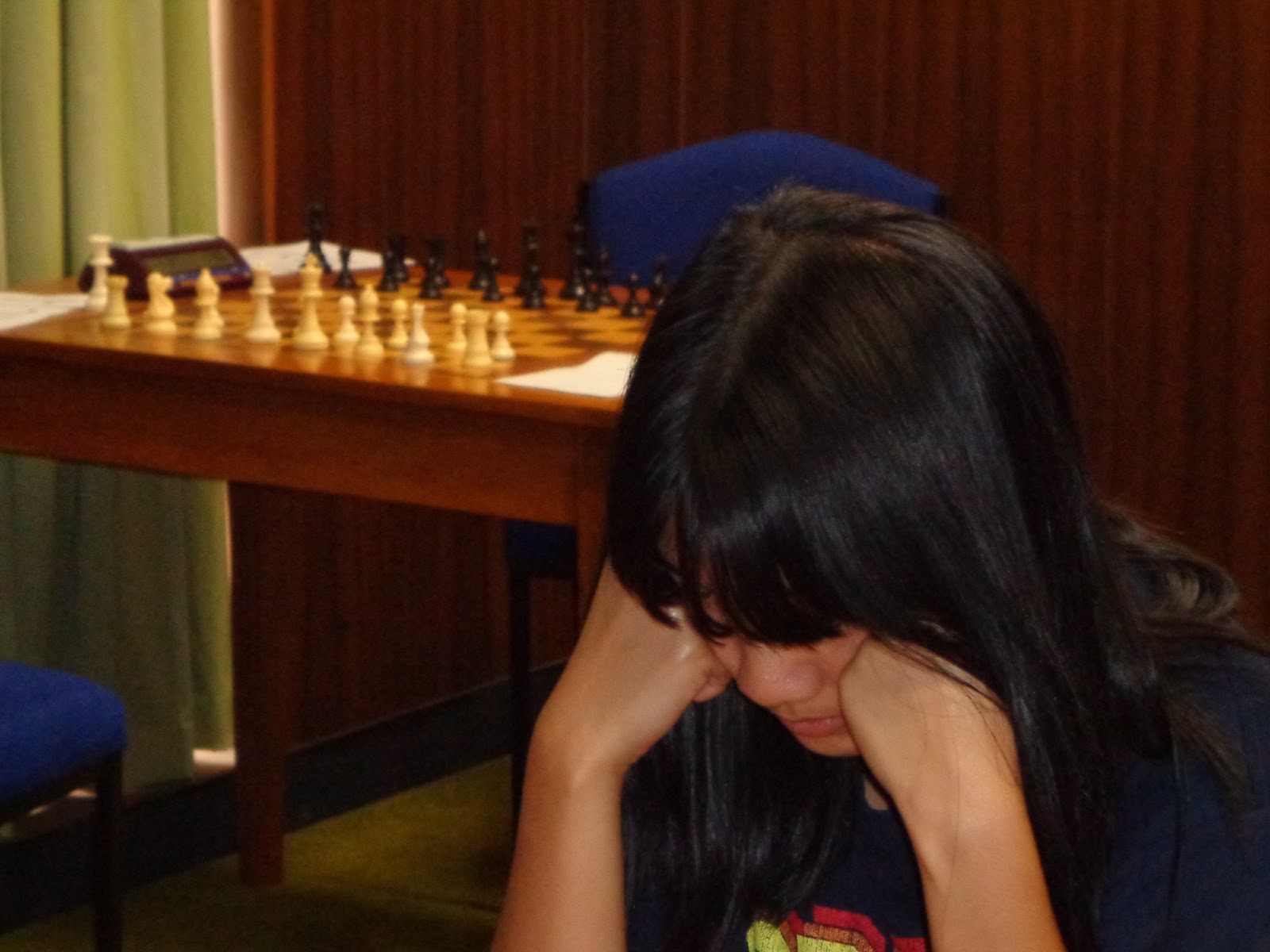
So that's a rant off my chest and I would be happy to get feedback about this as I'm not often opinionated on this blog. Anyway, back to the MCC Women's Master's. The tournament has only reached round 3 though 3 players are on a perfect 2/2, Megan Setiabudi, top seed Katherine Jarek, and Leteisha Simmonds (who won her game today while all the rest were still playing when I left, leaving Leteisha clear first). Good luck to all the players in the remaining rounds. Here are the players who were present at the start of the round when I was allowed to take a few snaps.
 |
| Tanya Kolak |
 |
| Alana Chibnall |
 |
| Megan Setiabudi |
 |
| Katherine Jarek |
Subscribe to:
Posts (Atom)