Showing posts with label kuzmin. Show all posts

Thursday, April 4, 2013

Chess again...

After the shock of the past few days, I'm bringing this blog back to it's chess and coffee content. I'm still a little dazed as I'm sure most of the Melbourne chess community are, and so this blog might not move too fast for a while yet. Hopefully you'll understand and be patient with me.

I did leave some tactics and endgames on Monday and never got back with the answers. Well, the endgames are going to be serialized here, but I can look at the tactics now.

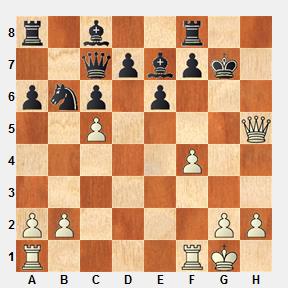
It was white to play and win here. Ukrainian GM Gennadi Kuzmin played 22.Nxd6! pinning his own knight and after 22..Ne8 he unpinned with the amazing 23.Nxf7!! leaving the following position
The point is that 23..Rxd4 loses to the double check 24.Nh6+ Kh8 25.Rxf8# Ftacnik tried to close the f-file with 23..Bf6 but resigned after 24.Ne5+!! when the bishop on f6 becomes pinned so after 24..Kh8 white can take the exchange 25.Nxd7 as 25..Bxd4 loses immediately to 26.Rxf8#

The other position led to a classic tactical shot.

Kuzmin-Sveshnikov USSR ch 1973 it is white to play and win. Kuzmin came out with the double bishop sacrifice 17.Bxh7+!! Kxh7 18.Qh5+ Kg8 19.Bxg7!! [threatening 20.Qh8#] 19..Kxg7
White has sacrificed both bishops to destroy black's king cover. After 20.Qg4+ Kh7 21.Rf3 black resigned as he will have to give up his queen to avoid immediate mate.

This is, of course, an excellent tactic to bring off in a tournament game, but Kuzmin would have been fully aware of the double bishop sacrifice, as should all chess players. The famous Lasker-Bauer game is the classic early version of this great attack:

Here's the famous position after black's 14th move, and it is probably easy to spot what the second World Champion did as white in this position now that you already know the theme. Here's the game:


Monday, April 1, 2013

Gennadi Kuzmin

This is a kind of "degrees of separation" type post. I was playing a game on chess.com and I looked at my opponent's profile. My opponent was an FM called Dirk Paulsen, so I thought I'd have a look at some of his games in my database. I found that among other tournaments he had played in an edition of the prestigious Dortmund event back in 1981. Wow, I have never played in anything so prestigious, and back in 1981 I was  probably about 140BCF strength. Unfortunately Mr Paulsen came in last, but he still scored 2 points against a field that was averagely 200 ratings point higher than him! The winner of the tournament was a Soviet GM called Gennadi Kuzmin, a player that I don't really know much about. So I had a look, and found out some about him.

He was certainly one of the strongest Soviet players for a short time in the 1970's. He was good enough to represent the USSR at an Olympiad in Nice 1974 (more connections as the book on Nice 1974 was my first ever book, won at a tournament) and played in 2 interzonals. He finished equal second in a pretty strong USSR champs in 1973 behind Spassky (who had a point to prove after losing the World title in 1972), and and alongside Karpov, Petrosian, Korchnoi and Polugaevsky. If that isn't good enough, Tal, Keres, Smyslov, Geller and Taimanov (among others) were behind him. In the Dortmund tournament that I was looking at, he showed that he was a strong combinational player in the following positions. See if you can guess white's winning moves

Kuzmin-Ftacnik Dortmund 1981
White played the fantastic distraction 20.Qc4!. There followed 20..Rd7 21.Qd4 Bd8.


White to play and win

But his most famous combination is probably this one:

Kuzmin-Sveshnikov USSR ch 1973
White to play and win

Answers tomorrow :)