Well, it was about a year ago that I wrote my last blog post about gender bias in chess so it's about time I wrote another. First, congratulations to the new Women's World Champion! Of course, you all know who I'm talking about....no? Well, I guess that's because no one takes the Women's World Championship seriously. But a big congratulations to Ju Wenjun of China for winning. She takes home a not unreasonable 120,000 Euros and the title for the next....well, we're not exactly sure how long she'll keep the title for, but at least 6 months, probably! Compared to the Open World Championship, however, this is rather pathetic. Carlsen and Caruana will compete for the rock bottom prize fund of 1,000,000 Euros with the winner getting somewhat more than half, and keeping the title for the next 2 years.
So where is the equity? At the present moment, the World of tennis is seeing Wimbledon being played where the men's and women's champions will receive the same prize money, as they have since 2007. Of course, men and women aren't allowed to play against each other in tennis, where in chess women can play in men's events and in their own separate women only events. But why? Either women aren't as good as men naturally, so they shouldn't be allowed to play together, or there is no difference naturally, so there should be just one title, or at least parity in prize money.
Perhaps if we had more women in positions of leadership in the chess world that might have an impact on retention of girls in chess and promotion of the game among girls and women. Alas, women aren't being admitted to these positions for one reason or another. Take the recent case of the English Chess Federation abolishing the position of director of women's chess. After complaints, they reissued the job, rejected 2 reasonable looking female candidates, and gave it to a man. I'm not saying that the man isn't also a reasonable candidate, but this is a perfect opportunity to entitle women to participate in leadership roles over an issue that they will be passionate about, more so probably, than any man! From what I've heard, the best man might have got the job, but the female candidates weren't given a particularly fair chance. Read about it here.
So without going into too much detail about the upcoming FIDE elections, how well will women be represented on the new Presidential team? Yes, it will be a new team as Ilyumzhinov isn't standing (cue a bunch of munchkins coming out of hiding breaking into song about the death of a witch!). All three candidates, Dvorkovich, Makropoulos and Short have female representation in their teams which is a good thing. The more women in leadership positions throughout the chess world, will surely encourage more girls and women into the game and give them a voice in a position of power.
Finally, this is a subject I won't let go. As long as I am writing this blog, and there is sexism, blatant or hidden, in the chess world, then I'll be writing about it. It's something we shouldn't tolerate in life generally speaking, and in our little corner of society as a chess community. Hopefully I'll get through to a few people and if I do it will be worth it.
Showing posts with label women. Show all posts
Showing posts with label women. Show all posts
Tuesday, July 3, 2018

Sunday, July 16, 2017
Out Of Retirement
It is time to bring this blog back out of retirement. I mean, if Kasparov can come out of retirement to play in the Grand Chess Tour, then chess lovers of the world should all be excited. And that isn't the only exciting thing in the chess world. Magnus Carlsen has become less dominant so we have a great situation at the top of the game where there are a whole bunch of players challenging to take the number 1 spot on the FIDE rating list. Magnus has a small 10 point lead over Kramnik with Wesley So only 12 behind, Aronin 13 behind, Caruana 15 behind and Mamedyarov 22 off the top spot. I'm not sure I ever remember such a tightly packed group at the top and it makes it an exciting time at the top of the game.
While the elite side of the game intrigues me, it is difficult to get to grips with their ability and I therefore tend to concentrate more on other things when I'm studying chess. I love the history of the game and I've ordered a book of the 1922 London International tournament. This was a great event won by Capablanca ahead of Alekhine, Rubinstein etc. The tournament book was written by Maroczy who was competing in the event, and I'm quite excited to read this book as I've never read any of Maroczy's writings before.
As a chess coach I'm also interested in junior chess, and it is an exciting time with Chinese superstar Wei Yi heading towards the top 10 in the world, and Indian super kid, Praggnanandaa trying hard to beat Sergey Karjakin's 15 year old record of being the youngest Grand Master in history. Pragga is not yet 12, and has come close to scoring GM norms already. His rating is sitting at 2479 which is absolutely amazing. If you want to know more about Pragga, then follow Chessbase India, which I've recently discovered, and which I find excellent. There's plenty of information about the players making these super players more accessible.
We in Australia might not have a talent quite like Pragga, but we do have some great juniors and I obviously find Australian chess interesting. I'll be following it as best I can. I've been playing lots of chess and have some things to write. My club, the Melbourne Chess Club, is as active as always and I'm currently playing in the Victorian Championships.
I'll also be writing about women's chess, or at least my take on women's chess. I've written here before that I don't like the way that women are treated in our chess community and I'll continue to write about it until things change! I've worked with a number of girls in Australia and I have listened to their concerns about the game of chess and their place in it.
I was recently coaching on a camp and I showed a game from London 1922, the fantastic Alekhine-Yates game. If you haven't seen it, then take a look. It is a strategic masterpiece with a beautiful finish. Yates weakens his e5 square and Alekhine uses it as an outpost for his knight as well as dominating the c-file. He skillfully transfers his rooks from the c-file to the seventh rank and then brings up his last reinforcement, his king as an attacking piece in the middlegame. The final position is wonderful!

Alekhine as white has just played Ke5 trapping black's rook, while mate will follow soon. Here's the full game which I look forward to analysing in some depth with Maroczy's guidance.
While the elite side of the game intrigues me, it is difficult to get to grips with their ability and I therefore tend to concentrate more on other things when I'm studying chess. I love the history of the game and I've ordered a book of the 1922 London International tournament. This was a great event won by Capablanca ahead of Alekhine, Rubinstein etc. The tournament book was written by Maroczy who was competing in the event, and I'm quite excited to read this book as I've never read any of Maroczy's writings before.
As a chess coach I'm also interested in junior chess, and it is an exciting time with Chinese superstar Wei Yi heading towards the top 10 in the world, and Indian super kid, Praggnanandaa trying hard to beat Sergey Karjakin's 15 year old record of being the youngest Grand Master in history. Pragga is not yet 12, and has come close to scoring GM norms already. His rating is sitting at 2479 which is absolutely amazing. If you want to know more about Pragga, then follow Chessbase India, which I've recently discovered, and which I find excellent. There's plenty of information about the players making these super players more accessible.
We in Australia might not have a talent quite like Pragga, but we do have some great juniors and I obviously find Australian chess interesting. I'll be following it as best I can. I've been playing lots of chess and have some things to write. My club, the Melbourne Chess Club, is as active as always and I'm currently playing in the Victorian Championships.
I'll also be writing about women's chess, or at least my take on women's chess. I've written here before that I don't like the way that women are treated in our chess community and I'll continue to write about it until things change! I've worked with a number of girls in Australia and I have listened to their concerns about the game of chess and their place in it.
I was recently coaching on a camp and I showed a game from London 1922, the fantastic Alekhine-Yates game. If you haven't seen it, then take a look. It is a strategic masterpiece with a beautiful finish. Yates weakens his e5 square and Alekhine uses it as an outpost for his knight as well as dominating the c-file. He skillfully transfers his rooks from the c-file to the seventh rank and then brings up his last reinforcement, his king as an attacking piece in the middlegame. The final position is wonderful!
Alekhine as white has just played Ke5 trapping black's rook, while mate will follow soon. Here's the full game which I look forward to analysing in some depth with Maroczy's guidance.
Loading embedded chess game...
Saturday, July 9, 2016
Problems
Last post, I left a problem to solve.
This was composed in 1966, my birth year, by Ukrainian composer Tigran Gorgiev. It's an amusing puzzle with a number of forced moves.
1.Nc7 [Threatens Nb5# so black must make space for his king] 1..Qc1 2.Nb5+ Kb2

All fairly obvious so far. 3.Nd6 [Threatens mate on c4, so again, space must be made for black's king] 3..Qd1 4.Nc4+ Kc1

Again, all has been forced 5.Ne5! [Again mate is threatened, and this one is important as there is only one way to stop mate which blocks black's position even more] 5..Nf2

Well, it's all been forced up to now, but what now? 6.h7 Nh2!

Black's defence involves playing Nhg4 to get rid of white's annoying knight 7.h8=N!! [A fabulous underpromotion. From h8 the new knight will be able to support white's e5 monster] 7..Nhg4

8.Nhg6! [Apparently, 8.Nhf7 would lose to 8..Nf6 when the threat of Nd7+ means that white's king has to move, but it doesn't have a good square, and the black king will eventually get to b2 allowing the c-pawn to promote] 8..Kb2

9.Nc4+ [Closes the door to black's king] 9..Kc1 [Only move] 10.Nge5!

10..Nxe5 [10..b2?? leads to a white win. White takes the a4 pawn with his king and plays Na5-b3 mate] 11.Nxe5

Notice that black can't move the knight or it allows white to play Nd3# So, 11..a3 12.Kb4 and now white has run out of moves, except for 12..Kb2 [12..b2 still leads to a white win Nd7-c5-b3/d3mate]
 And now the game must end in a perpetual after 13.Nc4+ Kc1 14.Ne5 Kb2 15.Nc4+ etc
A fun study!
Less fun was an article I saw in the NY Times about the gender gap in chess. I haven't written about this in a while, but it's a problem that keeps surfacing and no one seems to do anything about it. Funnily enough, although there was no Australian Championship in 1966, there was a women's championship with Marion McGrath becoming the first Australian Women's Champion. Not surprisingly in a male dominated game, Ozbase has no record of any games played in this event. But in defence of Ozbase, there are no games of any event in Australia in 1966.
Anyway, the article in the NY Times can be read here.
 |
| White to play and draw |
1.Nc7 [Threatens Nb5# so black must make space for his king] 1..Qc1 2.Nb5+ Kb2
All fairly obvious so far. 3.Nd6 [Threatens mate on c4, so again, space must be made for black's king] 3..Qd1 4.Nc4+ Kc1
Again, all has been forced 5.Ne5! [Again mate is threatened, and this one is important as there is only one way to stop mate which blocks black's position even more] 5..Nf2
Well, it's all been forced up to now, but what now? 6.h7 Nh2!
Black's defence involves playing Nhg4 to get rid of white's annoying knight 7.h8=N!! [A fabulous underpromotion. From h8 the new knight will be able to support white's e5 monster] 7..Nhg4
8.Nhg6! [Apparently, 8.Nhf7 would lose to 8..Nf6 when the threat of Nd7+ means that white's king has to move, but it doesn't have a good square, and the black king will eventually get to b2 allowing the c-pawn to promote] 8..Kb2
9.Nc4+ [Closes the door to black's king] 9..Kc1 [Only move] 10.Nge5!
10..Nxe5 [10..b2?? leads to a white win. White takes the a4 pawn with his king and plays Na5-b3 mate] 11.Nxe5
Notice that black can't move the knight or it allows white to play Nd3# So, 11..a3 12.Kb4 and now white has run out of moves, except for 12..Kb2 [12..b2 still leads to a white win Nd7-c5-b3/d3mate]
A fun study!
Less fun was an article I saw in the NY Times about the gender gap in chess. I haven't written about this in a while, but it's a problem that keeps surfacing and no one seems to do anything about it. Funnily enough, although there was no Australian Championship in 1966, there was a women's championship with Marion McGrath becoming the first Australian Women's Champion. Not surprisingly in a male dominated game, Ozbase has no record of any games played in this event. But in defence of Ozbase, there are no games of any event in Australia in 1966.
Anyway, the article in the NY Times can be read here.
Saturday, January 16, 2016
After the Australian Championship
The Australian Championship has been finished less than a week, and we're already moving onto other events. The Melbourne Chess Club is hosting The 2016 Australian Women's Masters, South Australia is the host state for the Australian Junior Championship, and in the big, wide world of chess, Wijk aan Zee starts in a couple of hours.
Let me start with the Women's Masters. I have to say that I have genuine problems with this tournament for a few reasons.
- Women shouldn't have separate events, and lower expectations in chess. It is degrading, and somewhat discriminatory to set the standard of women's titles lower then that of men.
- The general attitude towards women in chess makes many feel unwelcome, and second class chess citizens. Like, for instance, withdrawing from a tournament after losing to a girl, like happened in the Australian Reserves.
- By treating women as inferior, the chess community reinforces this and continues to keep women as inferior.
It really is little surprise that the one woman who competed on an even level with men, Judit Polgar, denounced women's only events, and competed with the best players she could find.
Anyway, taking away the fact that it is a women's only event, the organisers, Gary Bekker and Jamie Kenmure have put together a very good field of players, but with only 1 Australian in the top section, but a second section is taking place, and the winner will apparently be given entry to next year's event. There hasn't been particularly good coverage of the event, so I haven't seen any games or even the results, though IM Leonid Sandler posted an article to the Russian news site with the first round games.
The Australian Junior Championship started today in Adelaide. There are 4 live boards showing the top games from the Under 18 and Under 16 Championship. The under 18 will be a fascinating affair with IM Ari Dale the top seed, but Australian Reserves Champion, Patrick Gong also in the tournament. Both came through the first round unscathed.
Meanwhile, the traditional year opener in the elite chess world, Wijk aan Zee starts tonight. As always, Wijk puts together a strong but interesting field. As well as Carlsen, Giri, Caruana and So from the top 10, there are a group of exciting players. Eljanov was the biggest mover in 2015 moving up to 13 in the world; China has 3 players in Liren Ding (12 in the world) Yi Wei (16 year old Chinese Champion) Hou Yifan (top female player ranked 68th in the world); 2015 World Cup winner, Sergey Karjakin plays; and last year's winner of the B tournament, David Navara has the honour of playing Carlsen in the first round!
It will be a tough first round for Carlsen. According to Chessbase readers, Navara's win against Wojtaszek was the best game of 2015!
Tuesday, November 24, 2015
Melbourne's Big Summer of Chess
There's going to be a mass of good quality chess in Melbourne, both to play in, or to spectate or follow this summer.
The fun starts this weekend, when Chess Kids, the company I work for hosts their National Interschool Finals. Actually, it's a huge junior chess festival starting on Sunday 29th November with a set of individual 7-round 15-0 allegro events. Then on the Monday and Tuesday the Chess Kids National Interschool Championship will take place. It is a 7-round 25-10 format with close to 300 players expected over both primary and secondary divisions.
All these junior events are being held at Queen's College, Melbourne University near the centre of Melbourne.
The weekend after this (5th-6th December) sees Melbourne Chess Club's amazing summer schedule start with the traditional Christmas Swiss. Perhaps the publicity for this has been overshadowed by other events coming to the club, but make no mistake that this tournament looks likely to be a good one. Visiting GM Arturs Neiksans from Latvia will be playing in the weekender. He is currently rated 2602, but might be even higher after his performance at the European Team Championship where he scored 4.5/7 including a draw with Arkadij Naiditsch. There are currently over 20 players entered, and this is a good opportunity to get some practice for the Australian Championships.
The MCC then hosts the Australasian Masters which will consist of two 10-player round robins. Chess Victoria President, Leonid Sandler has worked hard to get a GM norm event, and an IM norm event happening, and according to Leonid, this GM tournament might be the strongest ever in Australia. It certainly looks to be one of the strongest, with foreign GM's Neiksans, and Papin competing, and a strong local field including Melbourne based GM Darryl Johansen. I'll be playing in the IM event, so I should be able to bring some first hand reports of the goings on. The tournament runs from 12th-20th December
The Masters then goes out with a bang as it is immediately followed by the Victorian Blitz Championship which will also be hosted by the MCC. In recent years this tournament has proved very strong as players from the Masters join in with the best local players. I don't have details of this event, but it will probably be held Monday 21st December, a good lead in to Christmas.
The Christmas break will bring only a short relief to the summer of chess, as Box Hill Chess Club hold their traditional Australian Championship warm up event, the Canterbury Summer Swiss. After their move to Waverley/Essex Hills last year, Box Hill Chess Club have had to reinvent themselves a bit. One issue is that the club cannot hold weekend events at their current venue, but thanks to their strong organisational background, they have managed to find a venue for their summer event, the German Club in Windsor. For anyone who is short on practice before the Australian Championships, this is a must! It runs from the 27th December through to 30th December, and you can follow details here.
Then comes the big one, the Australian Championships and Reserves. Hosted by the Melbourne Chess Club in their 150th anniversary year, this is already shaping up to be an amazing tournament. Defending Champion, IM Max Illingworth entered early making it clear he intends to defend his title. But with 2 GM's and another 5 IM's already entered, Max will have to work hard to take the title again. I also intend to play in this event, running from January 2nd-January 12th 2016 at Fitzroy Town Hall. There is a rest day on 8th January when the Australian Blitz Championship will be held.
Phew...that's an unbelievable amount of chess this summer. But that's not all!!! (I've always wanted to say that, like in the adverts on the shopping channels). The MCC continues as Australia's premier chess venue to host the Australian Women's Masters event. Starting on 14th January, this will be 10-player round robin event and is shaping up to be the strongest ever women's event in Australia.
The Women's Masters finishes on the 22nd January, which leads nicely into the last event of the summer, Melbourne Chess Club's Australia Day Weekender. The Australia Day Weekender is, and has traditionally been, the first weekender of the year, even though it will seem like the last in a long line of chess events. Another great field is promised by the very first entry, hanging around after the Women's Masters, WGM Julis Ryjanova of Russia rated currently 2387!
That is an amazing amount of quality chess in Melbourne for players of all standards of players, and at various time limits. Long play chess fanatics have a dream summer coming up. And with the Victorian and Australian Blitz Championships being held here, the fast players should also be satisfied. And even if you are not a fan of long chess, nor the very fast chess, the MCC holds it weekly allegro 15-0 chess tournaments, and these will continue over the summer of chess! I'll be trying to follow as many of these as possible, so stay tuned :)
Sunday, May 31, 2015
We All Love An Underdog?
One of the great things about watching competitive events is seeing the occasional upset result. Of course, the best prevail overall, but once in a while, it is most gratifying to see the Gods of their fields brought back down to human level.
In terms of chess, every tournament has some such upset. We have amazingly talented juniors playing well above their level for a game or 2, and well below their level at times too. Likewise, older players with years of experience can sometimes hold, or even frustratingly beat, younger players who may take a risk too much in their attempts to win. We expect Grand Masters to win the majority of their games, and finish at, or near the top of tournament tables, with a promising master possibly giving them a good run for their money.
When an untitled player upsets the cart, and wins a game against one of the elite it makes tournaments that little more interesting. Unfortunately, the day of the underdog is being threatened at the European Women's Championship in Georgia. Romanian Woman Grand Master Mihaela Sandu wasn't expected to be high placed finisher in the tournament, but she is still a WGM with a rating of 2300. She has performed at over 2500 for the tournament, and has beaten some players higher rated than her which has caused a number of competitors to become suspicious and to overtly accuse her of cheating.
The full story can be found on the chess24 website, but it's ugly reading. A letter was sent by a group of players expressing concern at her performance, and amazingly, 3 of the signatories were players who beat Sandu in their games! What is also interesting is not the players who lost to Sandu signed the letters of complaint, and good for them is my opinion.
I realise that there have been some high profile cheating cases in the chess world recently, but this doesn't mean we have to go pointing the finger at anyone and everyone who over performs or causes an upset. Even as I approach 50 years of age, I still dream of good tournament performances. I'm planning on entering the Australian Championships in January, where I would expect to finish in the lower half of the field. But let's just say that I have a stellar tournament and take out a couple of high rated players. Will this raise suspicions, and am I likely to come under the scrutiny of cheating commissions, and feel the wrath of my fellow competitors? If so, then what is the point of me playing?
I'm sure that many people reading this blog will find themselves as underdogs relatively frequently. How would you feel about having played the game of your life, the tournament of your life, and then be accused of cheating?
Tuesday, January 13, 2015
#HeforShe in Chess
I popped into the Melbourne Chess Club today to check out the Australian Women's Master's that is currently taking place, and to touch base with my favourite club. I haven't been to the Melbourne Chess Club for probably over 6 months, and have missed the place somewhat. When I walked in the door, the first person I saw was Elizabeth Warren who used to be vice-President of MCC when I was on the committee a few years back. She doesn't live that far from me and I've always found her easy to talk to and get along with.
Elizabeth told me that she had taken some time off the committee, but she still regularly hangs around the club helping out and playing at Saturday Allegro tournaments, and on a Tuesday night. We had a chat, a laugh about times gone by, and then she dropped that she was standing for President of the MCC, and if elected, the first female President of the MCC in it's glorious 149 years history. Although this doesn't surprise me, the fact that women have been so under represented in positions of authority in Australian chess (and World chess, for that matter) is, when you think about it, quite appalling.
The ACF has no women represented at all in it's staff. I am fairly new to Australia, but I'm guessing that the ACF's history won't be filled with female Presidents, and a look through the archives will probably show that there has been a general lack of representation for women at the administrative level. Chess Victoria does a little better, with Elsa Yueh on the executive, and Katrin Aladjova-Kusznirczuk as ambassador and former President. I have no idea again, if there has been much in the way of representation for women in the history of Chess Victoria, but I would guess not.
While these trends aren't particular to Australia, I've used these organisations as examples because that is where I'm based. Chess is a game organised in a non inclusive way, to the detriment of women, among others. Just the fact that there is a an Australian Women's Championship, and exclusive women's events are organised in this country, but there is no department for women's chess, no officer in charge of promoting or organising this, regardless of gender, is somewhat of an anomaly. But here's a list off the top of my head of some issues which make chess a male dominated game:
- lack of female representation in chess organisations
- lower expectation's of performance, for example the significantly lower norm requirements for women
- lower numbers of girls playing the game, and encouraged to play the game at a lower level. There is a well reasoned article by Greg Shahade on the benefits of girls only tournaments, but why strong girls shouldn't play in them published in 2014.
- women only events (I'm actually rather creeped out by this, it has somewhat the feeling of segregation about it)
- BUT, if women's only events are so important, why was the women's World Championship delayed last year, and still has not been played? There was no such problem for the men's event, even after some difficult negotiating by the parties involved.
- AND, inequity of prizes for men and women. I mean, if they are to be separated, then at least make the prizes similar for men's and women's tournaments, or even girls/boys events where the inequity even exists!
Currently, WIM Anne Haast is playing in the B-section of the Tata Steel event and is on 1.5/3. If she scores 5/13, she qualifies for an IM norm and 7/13 should get her a GM norm. She can also qualify for WGM/WIM norms from this event if I correctly understand rule 1.45 of the FIDE handbook section on Title Regulations. So I guess what I'm saying is what is the need of round robin women's only events? Shouldn't strong female players be encouraged to participate with strong male players, and then we can drop the gender issue and just call anyone and everyone a player of their level? Because even saying things such as a "strong female player" has a bias to it. No women played in either section of the Australasian Masters tournament held in December, round robin tournaments held to offer norm opportunities to players.
I won't be going to the MCC AGM, but I left my vote with Elizabeth as a proxy for her to cast for me. Essentially, I have cast my vote for Elizabeth in the election, and I hope she becomes the next President of the MCC. I personally would like to see more encouragement for women to participate in our great game, at a player level, an administrative level, and as an equal to their male opponents.
For those of you not sure about gender equality issues and why men should take a part in gender equality and feminist issues, then take a look at this video, which helped to kick start the HeforShe campaign that took shape last year. It will give a good introduction to the subject, and listening to Emma Watson's speech, you can hear things which definitely apply in the world of chess, marking us as acting in unequal ways.
Monday, August 25, 2014
Post Olympiad Chess Round Up
The recently finished Olympiad in Norway will no doubt be one long talked about. It was China's first victory in the open event, and probably not their last. With India coming in third without superstars Anand and Harikrishna, the focus of world chess certainly shifted away from Europe to Asia. There were category prize golds for Krygyzstan, Sri Lanka and Pakistan, making the event a big haul for Asian countires. Australia competes in Asian events, and the continental success came here too. Australia were one of the big achievers gaining 29 places on their initial ranking and moving from a starting rank of 60th through to 31st (equal 24th). While all the Australian team contributed, our stars were undoubtedly current Australian Champion Max Illingworth and 13 year old Anton Smirnov. To be honest, the future looks good for Australian chess with a group of young and ambitious players who should soon be making their breakthroughs for Australia. In the current top 20 by FIDE rating, there are 9 players born 1990 or after, and 4 of these are born after 1994. Australia has every opportunity to be looking at an all GM team representing us at an Olympiad in the not too distant future!
The women's event was equally successful for Asia. China came in second (a slight disappointment for the tournament favourites) and category gold medallists include Mongolia, Tajikistan and Thailand. Australia's women also performed excellently, like the men moving up from an initial ranking of 51st to 32nd (equal 27th). For the girls it was a real team effort with no stand out results, though maybe it should be said that Berezina's performance on board 1 was very good. Australia's women don't have the same promise of youth that the men have, though there are 6 players in the top 20 born 1990 or after. However, of the remaining 23 players, 17 are born 1990 or after, so hopefully some of these will achieve their full potential and push into the top places.
Unfortunately, while the play seemed excellent, the Olympiad will also be remembered for some not so nice things. On the final day 2 players died. The official site of the Olympiad confirms the deaths of Kurt Meier of the Seychelles and Alisher Anarkulov of Uzbekistan. These are both very sad losses.
Hot on the heels of the end of the Olympiad there came more fall out. Another sad loss for chess will be the retirement of Judit Polgar. When announcing her retirement, Polgar in the Times took a dig at sexism in the game. Having coached a number of girls, I've seen this first hand and part of coaching girls in this male dominated game is to constantly help them to cope with the institutionalised sexism that is rife in chess clubs.
The other news from the women's game that interested me was Ukrainian GM Natalia Zhukova's swipe at turncoat Kateryna Lagno. Lagno switched federations from Ukraine to Russia at a politically volatile time. Added to this, the Russian team entered their player list late so that Lagno could represent her new country. When asked about her ex teammate Zhukova said:
"Getting rid of the parasites is always painless. Well, love cannot be forced. If she doesn't want to play for Ukraine, why do we need such people? We didn't communicate at the Olympiad, she avoided it. Cleansing is always for the better"
Tromso was also host to a FIDE election where Garry Kasparov lost to Kirsan Ilyumshinov, who stays as FIDE President for another 4 years. There has been mixed emotions about this, but one of the first big things to come up was Magnus Carlsen's participation in November's scheduled World Championship match. The Carlsen camp have asked for a postponement to the match which has been rejected by FIDE. It is getting like the Olympiad all over again!
Anyway, I intend to get lost in analysing many games from the Olympiad, stick my head in the sand and hope that all the politics and nastiness in chess sorts itself out. Fat chance!
Friday, January 24, 2014
WOM Women's Masters
 |
| Girl Power at the MCC |
 |
| Graffiti opposite MCC. Is this how the critics of the Women's Masters see the organisers? |
So far, before today's games, English WIM Heather Richards was leading the event with 3/4 points, though 6 players are just half a point behind, WGM Sukander (top seed, Indonesia), WFM Sengeravdan (Mongolia), WFM Vahtra (Estonia), WFM Brokko, and Aussie WIM's Alex Jule and Katherine Jarek (last year's winner). However, there is a long way to go and anything can happen, as top seed Irine Sukander found out in the last round when she was held to a draw by the lowest rated player in the tournament, WFM Savithri Narenthran, the 2011 Australian Girls Champion.
The MCC are doubling up tournaments over the weekend with the annual Australia Day Weekender taking place (but I'll be blogging about that in a couple of days time) so the women are moving their games from the afternoon session to a morning session for the next few games. Now while I'm pretty happy to see such a strong women's event being played in Australia (I have reservations about women's only events, as regular readers of this blog will probably know), but I find it infuriating that women should have to play second fiddle to men in chess. As a norm providing round robin, this should be seen as one of the most important events in Australia this year, not a aside to a junior championship, or a weekender.
Anyway, I want to finish on a positive note, so well done to the organisers for bringing this event together, and for the players for their combative play, and their tolerance of circumstances.
Thursday, January 31, 2013
Critical Chess Observations
 |
| Time for some Grumpy Old Man Moments |
I try to keep this blog as positive as I can, but let's get real, we don't live in a perfect world. So it's time to look at some issues that I've noticed in chess recently. So, starting with the Australian Junior Championships that just recently finished on the Gold Coast I couldn't help but wonder about both the quality of the fields, and the number of players in the event as a whole. Talking just about the numbers, compared to the event 12 months before in Melbourne which had 276 entries, this year's 2013 Championships had 224 entries, a drop of about 50 kids. Now there may be a number of reasons for this, but really someone should be asking the question of why this is so, and if there is anything that be done about it. As expected the majority of players in the tournament were from Queensland, but then surprisingly there weren't too many player from nearby New South Wales. I'm not the only one wondering about this. IM Alex Wohl said pretty much the same thing on his excellent blog.
On to quality. This year's under 18 Championship seemed a little stronger than last year's which is definitely a good thing, but when we look at the list of the top under 18's in Australia, only 5 of the top 20 were playing (note that Yi Yuan seems to be missing from the top under 18 list though he would be in it) and Oscar Wang played in the under 16 event. While Gene is a worthy Champion, shouldn't we be trying to maximise elite players in this event? I don't have a solution for this, but the issue needs raising. None of the top 10 under 14's competed in their age group, though it was good to see Michael Kethro and Jack Puccini take up the challenge at the under 18 level. At the lower age groups, the quality is pretty good, so the question is how to keep players coming back to the event in their senior years (and of course, the numbers participating in younger age groups is far greater than at the older age groups).
Moving on to the girls, there seems to be no thought as to how to improve these events. In fact, I heard the suggestion that the girls events be scrapped and girls play for the titles within the open section. I would fully support this, but I have my doubts that I'm in the majority. There was some frustration after the under 18's, 16's and 14's were merged into one tournament and some of the girls had to play with a time control that hadn't been advertised for their section. As it was the older girls dropped from 90 + 30 to 60 + 30 which is what the under 14's were scheduled to play at, and not many of the older girls, nor their parents, were happy with this change. To add insult to injury, they found out about this change after the appointed time for the round to start, so there wasn't really any time for discussion, or communication, or an apology, just a decision and let's get on with it! It's little wonder that girls don't really want to play in this event if their treatment is inferior to that of the open competitors. Only 1 of the top 10 rated girls in the country competed in Queensland and 39 in total compared to 46 the year before. Of course, the girls are firmly put in their place below the boys by the fact that their prize money is lower at every level. Now personally I'm not a fan of prize money at junior events, but if there is going to be prize money, why is one age group champion worth more than another? This is blatantly chauvinistic and unfair, however it is dressed up.
I have 2 final criticisms of the Championship. First, the entries list on the official tournament webpage was a bit clumsy, showing all competitors in one big long list in alphabetic order. Assigning entries by rating, and/or by the section they were playing in would have made that page more useful. Once tornelo started to be used to manage the data things were much clearer, so perhaps future organisers should look at employing a data entry program like tornelo or swissperfect that can do this job. Secondly, there was a play off needed for the under 12's where 4 players came =1st on 7/9. Now to my thinking, all 4 should have played in that, but only 2 went forward. If I was David Cannon (especially him because his tie break looked just as good as Denny Han's's), or Brendan Pierotti, or their parents, I'd be pretty aggrieved that 2 players went forward into the play off's that had tied with 2 players who were eliminated on tie break. If there are to be play offs, especially in junior events, shouldn't all players finishing on the same score be entitled to a chance at that play off? Otherwise, what really is the point when the various tie break systems can find us a winner?
Ok enough about the Junior Championship at which I really had a good time. Let's talk about FIDE's new proposal requiring licensing of players with their national federations. To be honest, I'm completely blown away by some of these ideas, and I will almost certainly give up FIDE rated chess if they go ahead. It appears to be overly bureaucratic and will become costly for both organisers and players. In fact, if I opted out of the FIDE system, but then played in a tournament which was FIDE rated, it could cost the organisers 50 Euros in fines! I am not happy about divulging private information about myself to a national chess federation (especially my passport number) and not happy to pay extra for the privilege of having my games rated in the international lists (actually I'm not happy about having to pay twice to have my games rated in both national and international lists!).
Of course, if there are others like me (perhaps many others) what will clubs do about their events? There are 3 FIDE rated club tournaments starting in Melbourne next week at Box Hill Chess Club, Noble Park Chess Club and Melbourne Chess Club. Will these clubs continue to FIDE rate their tournaments (Noble Park and MCC FIDE rate all their longplay events) even if it means a drop in numbers? I am eagerly following this issue and will come back to it in the future, no doubt.
Wednesday, January 16, 2013
Women's Chess
Today I went to the Melbourne Chess Club where the inaugural Australian Women's Master's tournament is being staged. It is an 8 player round robin with the hope to grow it to a full tournament with norm potential in the future. In fact, arbiter, Jamie Kenmure has ideas not only to grow this event, but to resurrect the Australian Women's Championship.

In her excellent book "How I Beat Bobby Fischer's Record" Judit Polgar recalls the Novi Sad Olympiad in 1990 as the time when she decided to not participate in exclusively women's only events any longer, setting herself the goal of breaking into the Hungarian men's (open) team, a feat that she managed, of course. This first volume deals with her performance up to that point so I guess we'll have to wait for the next volume until we hear her true feelings about women's only chess, although her wikipedia page gives an illuminating quote:
"I always say that women should have the self-confidence that they are as good as male players, but only if they are willing to work and take it seriously as much as male players"
It is this point of view that I also subscribe to, and for that reason I prefer to see all players in open's. Of course, there is an alternative side of the argument that US GM Jennifer Shahade eloquently expresses:
"If there were a 1:1 ratio of women and men in the chess world I would agree that all tournaments should be integrated. But a lot of women feel alienated at these mixed events, so it’s positive to have occasional all women’s events."
These ideas are all very laudable, but to be honest I'm not sure that having women's only events is anything other than demeaning and patronising. We had a little discussion on this theme at the MCC today, and it seemed to sit a little uncomfortably with the players who I discussed it with. So I'll put my neck on the block as a player and coach. In my opinion women (and girls for that matter) shouldn't be treated any differently to men. I can't see why women should be considered as second class citizens in the chess world, nor why they shouldn't aspire to the very top of the World's game. Of course, if women are directed to a certain level, then it is unlikely they will progress much beyond that, just like anyone in any activity.

"I always say that women should have the self-confidence that they are as good as male players, but only if they are willing to work and take it seriously as much as male players"
It is this point of view that I also subscribe to, and for that reason I prefer to see all players in open's. Of course, there is an alternative side of the argument that US GM Jennifer Shahade eloquently expresses:
"If there were a 1:1 ratio of women and men in the chess world I would agree that all tournaments should be integrated. But a lot of women feel alienated at these mixed events, so it’s positive to have occasional all women’s events."
Ok, I have little trouble with this, as with junior, senior, or geographically closed events. However, when the standard for titles is dropped by 200-300 FIDE rating points (compared to men's titles) it seems that women are being encouraged to be content with a mediocre game. Yet we currently see Hou Yifan playing in the top section of Wijk aan Zee, more women are attaining the male GM title than ever before, and the most successful chess bloggers are both women, Susan Polgar and Alexandra Kosteniuk. Both have proved interesting and informative writers and their sites are visited by thousands of chess enthusiasts on a daily basis.
So that's a rant off my chest and I would be happy to get feedback about this as I'm not often opinionated on this blog. Anyway, back to the MCC Women's Master's. The tournament has only reached round 3 though 3 players are on a perfect 2/2, Megan Setiabudi, top seed Katherine Jarek, and Leteisha Simmonds (who won her game today while all the rest were still playing when I left, leaving Leteisha clear first). Good luck to all the players in the remaining rounds. Here are the players who were present at the start of the round when I was allowed to take a few snaps.
 |
| Tanya Kolak |
 |
| Alana Chibnall |
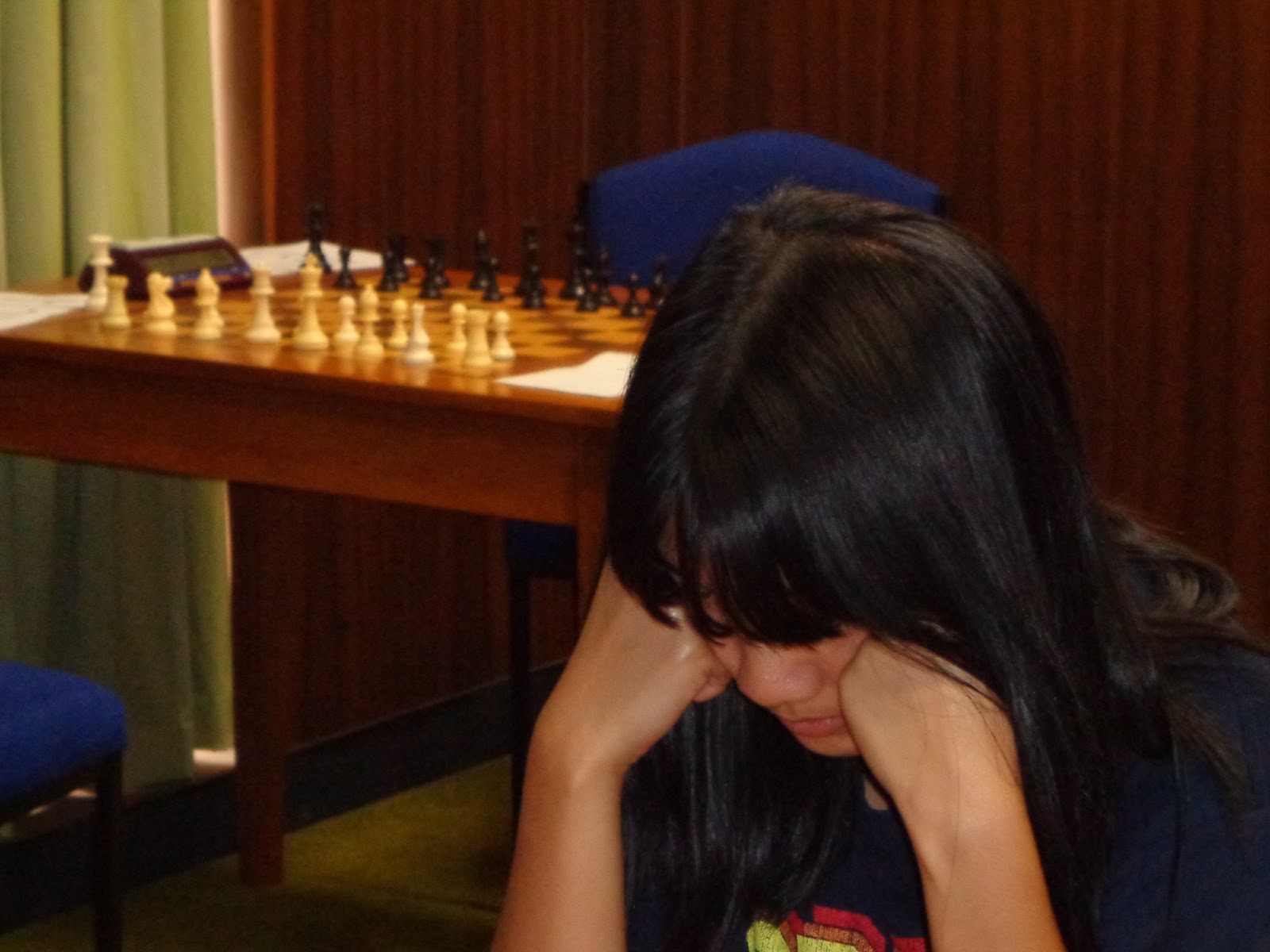 |
| Megan Setiabudi |
 |
| Katherine Jarek |
Subscribe to:
Posts (Atom)