The City of Melbourne Open at the Melbourne Chess Club is now reaching the climax of the event. There have been 6 of the 9 rounds played and the clear leader on 5.5 is FM Domagoj Dragicevic. Domagoj had won the battle of the titled players when he beat FM Greg Canfell in round 5. I'd like to see the end of this game which was an opposite side castling Sicilian from what I remember. By the end of the round, there were 3 players sharing first place, Domagoj and juniors Vishal Bhat and Ray Yang. It has been really good to see the growth of junior chess at the MCC over the past 5 years. Junior successes such as IM Ari Dale and FM Jack Puccini are now being followed by the likes of Vishal and Ray, as well as Bobby Yu, David Cannon and Tristan Krstevski. With these strong young players around, the MCC appears to have a bright future!
Domagoj took clear first in round 6 when Vishal and Ray drew. Domagoj won against Tom Kalish to take a half point lead with 3 rounds to go. Greg Canfell bounced back to win in round to become the third player half a point behind the leader. A further half a point back are Malcolm Pyke, Tritan Krstevski and Mehmedlija Dizdarevic. Mehmedalija is at the other end of the age spectrum in retirement age. In round 6 he smashed me in the biggest upset of the round and followed that up with another good win against Justin Penrose. It's hard to see the winner of the tournament coming from below this group, though with 3 rounds to go, anyone who scores well can finish in a high position.
Some other results that are worth mentioning over the past couple of rounds. Juniors beating adults: Ray Yang beat Malcolm Pyke, Tristan Krstevski beat Thai Ly, and Christopher Lim scored an excellent win against Tony Davis in round 5, while Jody Middleton held Kanishka Premathilaka to a draw also in round 5. In round 6, MCC Vice President, Simon Dale scored a good win against Roger Beattie.
The sad news from my point of view is that my last game caused me to have a splitting headache, so I took a bye in round 6, but still don't feel fully recovered, so I might not be playing any more games in this event. I'm taking things week by week to see if I'm improving, and then I'll start playing again. I'll keep blogging about it, and wish every one in the tournament good games, and hope that you all get full enjoyment from the competition.
Showing posts with label junior chess. Show all posts
Showing posts with label junior chess. Show all posts
Thursday, June 2, 2016

Tuesday, November 24, 2015
Melbourne's Big Summer of Chess
There's going to be a mass of good quality chess in Melbourne, both to play in, or to spectate or follow this summer.
The fun starts this weekend, when Chess Kids, the company I work for hosts their National Interschool Finals. Actually, it's a huge junior chess festival starting on Sunday 29th November with a set of individual 7-round 15-0 allegro events. Then on the Monday and Tuesday the Chess Kids National Interschool Championship will take place. It is a 7-round 25-10 format with close to 300 players expected over both primary and secondary divisions.
All these junior events are being held at Queen's College, Melbourne University near the centre of Melbourne.
The weekend after this (5th-6th December) sees Melbourne Chess Club's amazing summer schedule start with the traditional Christmas Swiss. Perhaps the publicity for this has been overshadowed by other events coming to the club, but make no mistake that this tournament looks likely to be a good one. Visiting GM Arturs Neiksans from Latvia will be playing in the weekender. He is currently rated 2602, but might be even higher after his performance at the European Team Championship where he scored 4.5/7 including a draw with Arkadij Naiditsch. There are currently over 20 players entered, and this is a good opportunity to get some practice for the Australian Championships.
The MCC then hosts the Australasian Masters which will consist of two 10-player round robins. Chess Victoria President, Leonid Sandler has worked hard to get a GM norm event, and an IM norm event happening, and according to Leonid, this GM tournament might be the strongest ever in Australia. It certainly looks to be one of the strongest, with foreign GM's Neiksans, and Papin competing, and a strong local field including Melbourne based GM Darryl Johansen. I'll be playing in the IM event, so I should be able to bring some first hand reports of the goings on. The tournament runs from 12th-20th December
The Masters then goes out with a bang as it is immediately followed by the Victorian Blitz Championship which will also be hosted by the MCC. In recent years this tournament has proved very strong as players from the Masters join in with the best local players. I don't have details of this event, but it will probably be held Monday 21st December, a good lead in to Christmas.
The Christmas break will bring only a short relief to the summer of chess, as Box Hill Chess Club hold their traditional Australian Championship warm up event, the Canterbury Summer Swiss. After their move to Waverley/Essex Hills last year, Box Hill Chess Club have had to reinvent themselves a bit. One issue is that the club cannot hold weekend events at their current venue, but thanks to their strong organisational background, they have managed to find a venue for their summer event, the German Club in Windsor. For anyone who is short on practice before the Australian Championships, this is a must! It runs from the 27th December through to 30th December, and you can follow details here.
Then comes the big one, the Australian Championships and Reserves. Hosted by the Melbourne Chess Club in their 150th anniversary year, this is already shaping up to be an amazing tournament. Defending Champion, IM Max Illingworth entered early making it clear he intends to defend his title. But with 2 GM's and another 5 IM's already entered, Max will have to work hard to take the title again. I also intend to play in this event, running from January 2nd-January 12th 2016 at Fitzroy Town Hall. There is a rest day on 8th January when the Australian Blitz Championship will be held.
Phew...that's an unbelievable amount of chess this summer. But that's not all!!! (I've always wanted to say that, like in the adverts on the shopping channels). The MCC continues as Australia's premier chess venue to host the Australian Women's Masters event. Starting on 14th January, this will be 10-player round robin event and is shaping up to be the strongest ever women's event in Australia.
The Women's Masters finishes on the 22nd January, which leads nicely into the last event of the summer, Melbourne Chess Club's Australia Day Weekender. The Australia Day Weekender is, and has traditionally been, the first weekender of the year, even though it will seem like the last in a long line of chess events. Another great field is promised by the very first entry, hanging around after the Women's Masters, WGM Julis Ryjanova of Russia rated currently 2387!
That is an amazing amount of quality chess in Melbourne for players of all standards of players, and at various time limits. Long play chess fanatics have a dream summer coming up. And with the Victorian and Australian Blitz Championships being held here, the fast players should also be satisfied. And even if you are not a fan of long chess, nor the very fast chess, the MCC holds it weekly allegro 15-0 chess tournaments, and these will continue over the summer of chess! I'll be trying to follow as many of these as possible, so stay tuned :)
Friday, July 5, 2013
Last Day of Chess Camp
The 2013 Chess Kids camp finished with a day of serious play.After clearing out of our cabins, the kids had one more coaching session this morning before getting on with tournament games. The kids had been placed into 7 teams, and they were to play a round robin event. Before today, they had played 4 rounds so there were 3 games left to play. There was a great deal of tension around the games as each player was trying to win their board prize. In the end the event was very close which meant that our seeding of players into teams worked well. Before we headed off there was a prize giving, with loads of books, t-shirts, caps and other things given out tot he kids.
I think everyone had a good time and I'm sure all the kids will go away with some great memories of this camp, and with a better appreciation of chess endgames, and a better understanding of chess generally. Some parents came along, and they did a great job helping out around the scenes, making the jobs of the coaches somewhat easier. It meant I had more energy to spend on actual coaching, as I needed to do less child minding over the 4 days. I've already been talking to David Cordover about next year's camp. Last year we had a good time in Hobart, Tasmania, but we wanted to make it even better this year, and I think we succeeded. We won't sit still though, and hope to make it even better next time round!
I'm pretty tired after the camp so I'm leaving this post fairly short. Here's a final few photo's of the last day of the camp.
 |
| Good play is encouraged, good sportsmanship demanded |
 |
| The Winning Team, l-r Ryan, Ethan, Oliver, Daniel and Yoni |
 |
| Top board 1 player, Rebecca |
Tuesday, June 25, 2013
Blink and you can miss it
It seems that the past month has flown past for me, and I can barely credit what has happened with chess. From a personal point of view, the chess club that I helped to start has been a great success, but more of that in a future post. I have nearly finished my term's worth of coaching, and am preparing for an endgame camp that we are running in the holiday period. This is very exciting for me, as the challenge of teaching endgames has always been appealing to me, and seeing how weak young players usually are in this department of their game, we are hoping that the camp will pay big dividends in the rising strength of our group of young players. Personally, I haven't played any tournament chess, but I am hoping to get to a few tournaments in the second half of the year.
Nevertheless, chess has been happening and Melbourne is as active as ever. The Victorian Championship has just finished with a convincing victory for teenager, Bobby Cheng. There is still a round to go, but Bobby cannot be caught with a score of 9/10. Next come 2 more young guns, Ari Dale and Justin Tan who are on 6.5 which shows that the new generation have found their place among the elite of Victorian chess. There is also a Reserves event taking place and this is being headed, not surprisingly, by Pano Skiotis. Pano's rating makes him eligible for the Championship so I'm not sure why is playing in the Reserves event. He is currently 1 point clear of young MCC player Jack Puccini, and I'm not sure what will happen if Pano wins the event as the winner qualifies to play in the 2014 Championship, though Pano shouldn't really be playing in the Reserves, so perhaps that part of the prize will go to the next player?
While I now am dedicated to making the new club in Glen Eira a success, I still like to follow the events at the Melbourne Chess Club. Currently, the City of Melbourne Open is reaching the business end of the tournament Mirko Rujevic has the tournament wrapped up with a round to spare. Malcolm Pyke and Bosko Mijatovic are his closest rivals on an otherwise excellent score of 6/8, but this is still too far behind Mirko's 7.5/8. I'm sure that there are a number of happy players with their performances, but the name that stands out for me is Daniel Dobos who has scored 4.5/8 despite being the second lowest rated player in the tournament.
The MCC also had an unsavoury moment with the banning of ex-President, David Beaumont. I am not sure about all the details of this incident, but I have seen David who is very unhappy about the whole episode and who feels he has been unfairly treated. Of course, the banning of anyone from a small organisation such as the Melbourne Chess Club is not to be taken lightly. The MCC committee followed a rigorous procedure, and the eventual decision was held at an EGM. I'm still unsure of what David did to warrant the ban, or what he was officially banned for but it would appear that he will not be playing at the MCC again.
This weekend sees the start of the Victorian Junior Championship, held at Canterbury Chess Club. As a coach I have urged my students to play, and hope to see them achieve their potential.
Wednesday, August 15, 2012
Midweek Look at Chess
Before taking stock of what is happening in the chess world, I was sad to see that Yugoslav chess legend Svetozar Gligoric passed away. As with many players of my generation, I grew up with the King's Indian Defence a major system in chess and part of my own repertoire, and therefore had plenty of chance to study games of Gligoric. Perhaps one of his most famous is his win against Najdorf from the 1953 Mar del Plata tournament. Of course, this game was partly responsible for the opening being called the Mar del Plata Variation!
The Russian Championship finished with rapid play off which was won by young (22 I think?) Andreikin. Hot on the heels of this comes the French Championship, another round robin elite event with another youngster, Maxime Vachier-Legrave one of the favourites. All this talk of young players comes in the midst of the World Junior Championships which have just one round left. Richard Rapport of Hungary and Alexander Ipatov of Turkey lead by half a point going into this final round, but they've already played so a tense finale awaits.
In Melbourne another young player, Dusan Stojic, has taken the lead from Guy West in the MCC Club Championship play off. Currently game number 3 is in progress but I would imagine this endgame of queen and opposite bishops will end in a draw. If this is the case, then Dusan needs only a draw in the final game to clinch the title.
Loading embedded chess game...
The Russian Championship finished with rapid play off which was won by young (22 I think?) Andreikin. Hot on the heels of this comes the French Championship, another round robin elite event with another youngster, Maxime Vachier-Legrave one of the favourites. All this talk of young players comes in the midst of the World Junior Championships which have just one round left. Richard Rapport of Hungary and Alexander Ipatov of Turkey lead by half a point going into this final round, but they've already played so a tense finale awaits.
In Melbourne another young player, Dusan Stojic, has taken the lead from Guy West in the MCC Club Championship play off. Currently game number 3 is in progress but I would imagine this endgame of queen and opposite bishops will end in a draw. If this is the case, then Dusan needs only a draw in the final game to clinch the title.
Saturday, August 11, 2012
Opening Diversity vs Specific Knowledge
I have recently been showing some of my students some positions that come from very different openings, and am encouraging them to try out different systems. We've discussed various typical pawn structures, and central formations with typical plans surrounding them as well as natural development. The point is to play and study different openings so as to see and work through different sorts of positions.
The students I'm talking about have graduated from 1.e4 e5 systems and are looking at some Sicilian structures and some semi open games. Here are some typical positions to consider:


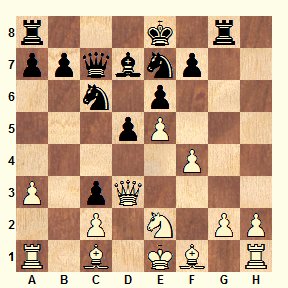
These are all typical opening positions that most experienced players will know of, but to kids, these positions are new and interesting. They have to consider strengths and weaknesses in the positions that they would not have considered during their play and study of 1.e4 e5 openings.
However, a question that arises to me is whether it is more important to play and study a diverse series of openings, or whether it is more important to deeply study a few openings. From a repertoire point of view, top players have tried both methods successfully, but for lesser players it is usually easier to play or learn a small repertoire which may expand over time. For kids, it is surely important to get them to examine as many types of position as possible, but at what stage should we be directing them to deeply study a repertoire?
Of course, getting the kids to work on their tactical, technical and positional understanding is vitally important, but opening choices are a fundamental question for all of us.
So I put the question to all readers of this blog: do you think opening diversification of specific opening knowledge is more important for an improving young player? And when, or if, does it change from one to one to the other?
The students I'm talking about have graduated from 1.e4 e5 systems and are looking at some Sicilian structures and some semi open games. Here are some typical positions to consider:
However, a question that arises to me is whether it is more important to play and study a diverse series of openings, or whether it is more important to deeply study a few openings. From a repertoire point of view, top players have tried both methods successfully, but for lesser players it is usually easier to play or learn a small repertoire which may expand over time. For kids, it is surely important to get them to examine as many types of position as possible, but at what stage should we be directing them to deeply study a repertoire?
Of course, getting the kids to work on their tactical, technical and positional understanding is vitally important, but opening choices are a fundamental question for all of us.
So I put the question to all readers of this blog: do you think opening diversification of specific opening knowledge is more important for an improving young player? And when, or if, does it change from one to one to the other?
Tuesday, August 7, 2012
Back Rank
Teaching by repetition is a great way to work with kids. Find a theme, explain the issue, and then start with some easy examples and it is quite surprising just how advanced kids can get in a short space of time. Of course, to ensure maximum retention the subject can be repeated in further sessions, or homework can be given out and the answers worked through (otherwise it can be a case of in one ear and out the other). This week at some of the Primary Schools I am working at with Chesskids, I am talking about the back rank. The classes have kids of mixed ability so some definitions are needed, and then some very basic examples of checkmates on the back rank. However, once the pattern has been established all the kids are looking for a check on the back rank, and even assessing moves to see whether they are safe or not.
Without knowing it, the kids are introduced to concepts such as exploiting a battery on a file, distraction, intermediate checks, sacrificing for mate (surprisingly difficult for a lot of kids to give up material) and guarding possible escape squares for the enemy king. Here is the homework I'm giving out this week, all taken from recent examples.


Answers in the next post :)
Without knowing it, the kids are introduced to concepts such as exploiting a battery on a file, distraction, intermediate checks, sacrificing for mate (surprisingly difficult for a lot of kids to give up material) and guarding possible escape squares for the enemy king. Here is the homework I'm giving out this week, all taken from recent examples.
White to play and win
White to play and win
Black to play and win
White to play and win
Friday, August 3, 2012
No chance for a breather
Following chess tournaments is now an ongoing experience. There is no shortage of events and as soon as one finishes another starts. The super GM event in Biel finished with Wang Hao taking first prize thanks to the 3 points for a win, soccer style scoring system. Under the more traditional 1 point for a win the winner would have been World number 1 Magnus Carlsen. But Magnus can be content with his performance, and the fact that his rating has moved closer to Kasparov's peak of 2851, and further from his rivals.
Rather than taking a breath and working out when the next big event will take place, there is no break as the Russian Championship starts today. Both the men's and women's sections boast excellent fields and National Championships often bring interesting results as the players know each other well. It seems to be a time for national championships with the British about to conclude and the Ukrainian entering the second half. These Championships are run on different levels, with the British being a medium sized swiss and the Ukrainian being an elite round robin.
The British has one round to go and is being led by GM Stephen Gordon who is half a point ahead of ratings favourite GM Gawain Jones, who is himself half a point clear of GM David Howell. But for me the swiss system event is all about players getting a chance to move up and in the British Marcus Osborne has taken his chance. I can't say I know him, but the 2245 rated player has scored 6.5 against a field that includes 3 GM's (and he has to face another in the final round!) and 2 IM's. His performance rating after the first 10 rounds is a whopping 2433 so a big congratulations to him.
Another interesting event that has just started is the World Junior Championship in Turkey. The tournament has a rich history dating back to 1951 when Yugoslav Boris Ivkov took the title. Ivkov went on to become a World Championship Candidate and other famous winners of the World Junior include Spassky, Karpov, Kasparov, Anand, Miles and Aronian. The current event has over 10 GM's, 4 of which are over 2600. again, you'll have to excuse my national pride as I cheer on the Australians (Andrew Brown and Fedja Zulfic, but sadly no players in the girls event) and English (Zhou Yang-Fan, Callum KilPatrick, William Jones, Ravi Haria, Henryk Stepanyan are all in the boys section while the girls section has Lateefah Messam-Sparks and Anna York-Andersen). The tournament started yesterday and hopefully we'll get some first hand experiences. Already in the first round, one of the Australians performed well above his rating. Fedja Zulfic (2135) scored a draw with IM Bajarani (2446) of Azerbaijan. Fedja found a nice resource in his endgame.
Loading embedded chess game...
Tuesday, July 31, 2012
A great.....and not so great week
I wonder what the news headline of this week will turn out to be?
Fantastic finale in Biel?
National Championships of Ukraine and Britain decided!
French players banned for cheating.
9 year old beats Grandmaster!
Of course, we would love for the tournaments to have dramatic finales and National Championships usually do have moments of interest as the players tend to know each other and their playing styles very well. The Ukrainian Championship is a strong (2724-2584) 12 player round robin with Ruslan Ponomariov the highest rated player. It has just started while the British Championship is drawing to a close with Jones and Gordon leading the way while Howell leads the chasing pack. The Biel super-GM event is also drawing to a dramatic conclusion with rating favourites Carlsen and Nakamura having to come from behind Giri and Wang Hao.
The big cheating scandal from the 2010 Olympiad concerning French players has finally been resolved with bans being handed out for all 3 Grandmasters. Thankfully, chess is not riddled with cheating scandals but in some ways that makes each one seem worse. When a cyclist is suspended for using a banned substance, I tend to think, 'here we go again, another one caught....I wonder how many others don't get caught'. But with chess, it's more like, 'oh my God, how did they do that, and why?' Actually, now that I think about it, I wonder how much cheating does go unnoticed at chess events? As an amateur enthusiast, I would hope very little.
As a coach of mainly young players, the most impressive headline to me would be the last one. I am constantly being amazed by the talents of young players. Here in Melbourne this past Sunday we ran a 7 round 15 minute per player tournament. In the under 10 section, second place was taken by a 4 year old! I saw the headline in the excellent Chicago Chess Blog of Bill Brock. I've been reading this blog for a while now, and find it really enjoyable reading, with excellent local coverage from the Chicago area. A 9 year old beating a Grandmaster is an incredible feat, though the record for the youngest player to beat a Grandmaster in a regular tournament game goes to a player already mentioned in this article, David Howell. Howell was only 8 when he beat GM John Nunn....unbelievable! And another previously mentioned player in this piece, Ruslan Ponomariov was the youngest to hold a World Championship at 18 (though some would dispute the legitimacy of this title).
Loading embedded chess game...
Wednesday, July 25, 2012
I have to play...
I thought I was going to have a bit of a break from chess, but I forgot that I'd committed to play for my club, the Melbourne Chess Club in the Victorian Teams Championship. So Sunday I am having to play a game of chess in the middle of my 'vacation'. To be honest, I'm ok with that and am looking forward to the game. It isn't until the late afternoon, so I'll be able to have a lie in and spend some time with my wife in the morning. I guess the thing that springs to mind for me is how little do you have to play to get rusty? I'm not in that shape yet, I would hope. My last serious game was only a few weeks ago, and I've been working at the game in the meantime. In fact, I'm hoping the couple of weeks without playing chess makes me fresher. We'll see come the weekend.
Looking at the field for the British Championship one name sticks out as a comeback player, GM Matthew Turner. Turner worked his way up to the GM level in the late 1990's gaining the title in 2002. However, he didn't play much tournament chess after that, though he has continued with chess as a teacher at Millfield School and as a player in the 4NCL in Britain. I wonder what it's like for a GM to play little chess and then come to a tournament like the Championship? Is Turner rusty? Not if his first game is anything to go by. I'm guessing that Charley Storey wasn't the player that Matthew Turner would have liked to have played in the first round. Storey is a dangerous attacker. But it was the GM in charge of the tactics and when the dust settled Storey had 2 rooks for a queen, but chronically weak light squares.
After 2 rounds there are now 6 players on a perfect score, GM's Jones, Gordon, Arkell, IM Hawkins and Hugh Murphy and James Jackson who both came through the acceleration to beat IM opposition in the second round. The rest of the GM's all sit half a point back along with Don Mason who won his second round game to line up a test against former champion GM Conquest.
The Championship is only the main event of the festival and in this first week there are currently age group championships for under 16, under 13 and under 11 taking place as well as non championship events of which the most notable has traditionally been the Major Open, though this year it seems smaller than in years gone by. The format of the British Championship allows for players to double up in events. For example, Radha Jain is playing the under 16 Championship in the morning and the Championship in the afternoon! Full on! To think, I'm worried about getting worn out by playing 40-50 games per year!
Stop Press: I've just heard Morozevich has had to withdraw from Biel through illness. :(
Wednesday, January 25, 2012
Worst Tipster
The next time I say someone will win something, then pick someone else to win it! It's official, my predictions are very poor. However, self knowledge is a great thing, and I know that this is a weakness of mine so I don't gamble. In fact, I don't even buy lottery tickets! Let's see my last set of predictions and assess their progress so far....
Wijk A: Aronian
Wijk B: Potkin
Wijk C: Sadler
Aus Junior: Justin Tan
Queenstown: Jones
Well 1/5 is not so bad, is it? Levon Aronian took the lead in the Wijk A group yesterday, after Magnus Carlsen suffered a defeat to World Number 7 Karjakin. So this leaves Carlsen in joint second place with Ivanchuk and Radjabov, but a whole point behind Aronian. There are 4 rounds to go, so nothing is clear yet, though Aronian is in the box seat.
In the B-group, I chose Potkin, the 2011 European Champion, but he has played well below that form and currently sits in the bottom half of the field. Indian GM Harikrishna is a point clear here of L'Ami, Bruzon and Motylev, and these are well clear of the rest. In the C-group, Matthew Sadler has been really disappointing in my opinion. He is at plus one but doesn't seem to be able to win games. With a strong finish he may still end near the top of the table, but he is too far back to win (2.5 points back with 4 games to go). After his comeback successes before Christmas, I thought Matthew would run away with this tournament, but 2 other GM's, Turov and Tikkanen lead the field.
Queenstown seemed like a great swiss event this year, but my prediction didn't live up to expectations. In the early rounds Jones was in with the leaders, but in consecutive rounds he faltered against young Victorian players. First he could only draw with IM James Morris, who produced a nice exchange sacrifice to stabilise the position, and then in the following game, he was outplayed by FM Chris Wallis. This game ended with the unusual material imbalance of rook and 4 pawns versus rook, bishop and knight. Chris had no pawns, but managed to exchange rooks and win all the pawns, finally showing he knew the technique to win with knight and bishop.
The tournament was won by Melbourne GM Darryl Johansen who was backing up from the Australian Championship that he also won. In Queenstown, he finished joint first but won on tiebreak ahead of Chinese GM's Li Chao and Zhao Jun. It's a great effort by Darryl and good to see him at his very best form. With the current crop of strong young players around Australia, it is important that older players retain their strength and force the youngsters to stretch themselves to overtake them.
The Australian Junior Championship concluded at the weekend and was certainly affected at the top level by the absence of players competing in Queenstown. However, there were still a group of talented players and there was no clear favourite for the under 18 Championship. All the results can be seen online at the site of the tournament management software, tornelo. It was a close affair in the end, but finally, South Australian third seed Alistair Cameron won by half a point from Justin Tan and 10 year old Anton Smirnov. All of these are very good players, and Alistair was a worthy and popular winner. The 9-round format which was used for the first time last year, again proved sufficient and all the age group championships were hard fought. On the tornelo site, there is a database of 1142 games, most of which were uploaded by the kids themselves during the event.

As the worst tipster, I thought it best not to predict any more results, bringing my kiss of death to players. However, I couldn't help myself when a friendly debate at the Australian Junior occurred between IM's Leonid Sandler and Vladimir Smirnov reagrding the upcoming World Championship. The upshot is that I have now officially tipped Anand to win, which I guess must dramatically increase Gelfand's chances in this match!
Wijk A: Aronian
Wijk B: Potkin
Wijk C: Sadler
Aus Junior: Justin Tan
Queenstown: Jones
Well 1/5 is not so bad, is it? Levon Aronian took the lead in the Wijk A group yesterday, after Magnus Carlsen suffered a defeat to World Number 7 Karjakin. So this leaves Carlsen in joint second place with Ivanchuk and Radjabov, but a whole point behind Aronian. There are 4 rounds to go, so nothing is clear yet, though Aronian is in the box seat.
In the B-group, I chose Potkin, the 2011 European Champion, but he has played well below that form and currently sits in the bottom half of the field. Indian GM Harikrishna is a point clear here of L'Ami, Bruzon and Motylev, and these are well clear of the rest. In the C-group, Matthew Sadler has been really disappointing in my opinion. He is at plus one but doesn't seem to be able to win games. With a strong finish he may still end near the top of the table, but he is too far back to win (2.5 points back with 4 games to go). After his comeback successes before Christmas, I thought Matthew would run away with this tournament, but 2 other GM's, Turov and Tikkanen lead the field.
Queenstown seemed like a great swiss event this year, but my prediction didn't live up to expectations. In the early rounds Jones was in with the leaders, but in consecutive rounds he faltered against young Victorian players. First he could only draw with IM James Morris, who produced a nice exchange sacrifice to stabilise the position, and then in the following game, he was outplayed by FM Chris Wallis. This game ended with the unusual material imbalance of rook and 4 pawns versus rook, bishop and knight. Chris had no pawns, but managed to exchange rooks and win all the pawns, finally showing he knew the technique to win with knight and bishop.
The tournament was won by Melbourne GM Darryl Johansen who was backing up from the Australian Championship that he also won. In Queenstown, he finished joint first but won on tiebreak ahead of Chinese GM's Li Chao and Zhao Jun. It's a great effort by Darryl and good to see him at his very best form. With the current crop of strong young players around Australia, it is important that older players retain their strength and force the youngsters to stretch themselves to overtake them.
The Australian Junior Championship concluded at the weekend and was certainly affected at the top level by the absence of players competing in Queenstown. However, there were still a group of talented players and there was no clear favourite for the under 18 Championship. All the results can be seen online at the site of the tournament management software, tornelo. It was a close affair in the end, but finally, South Australian third seed Alistair Cameron won by half a point from Justin Tan and 10 year old Anton Smirnov. All of these are very good players, and Alistair was a worthy and popular winner. The 9-round format which was used for the first time last year, again proved sufficient and all the age group championships were hard fought. On the tornelo site, there is a database of 1142 games, most of which were uploaded by the kids themselves during the event.

Australian Under 18 Champions, Miranda Webb-Liddle and Alistair Cameron
As the worst tipster, I thought it best not to predict any more results, bringing my kiss of death to players. However, I couldn't help myself when a friendly debate at the Australian Junior occurred between IM's Leonid Sandler and Vladimir Smirnov reagrding the upcoming World Championship. The upshot is that I have now officially tipped Anand to win, which I guess must dramatically increase Gelfand's chances in this match!
Sunday, January 15, 2012
I'm back...
I have been in New Zealand for the past week and missed some action.
The Australian Championship was won by GM Darryl Johansen for a record 6th time! He took the lead before I left and never relinquished it winning the event by a full point from an elite group of players consisting of GM Zhao, IM's Xie, Solomon and Smirnov. The contingent of younger players failed to breach this experienced group, and FM Junta Ikeda and IM Moulton Ly led the younger challenge a further point behind, and alongside IM Wohl.
The Reserves tournament was won by MCC member Justin Penrose. I have never played Justin but my impression is a tough fighter who is happy to play difficult positions with a dogged determination. He will cause problems for his opponents at any turn and does not give up on positions which others might think too troublesome to continue the effort. Another MCC member came second, and pleasingly a junior. Like most juniors, Ari Dale has good days and bad days, but he is generally moving forward at an alarming rate. This result confirms that the MCC has another young player of 2000+ strength. Joint third were Omar Bashar, David Spuler, and another MCC member, Frank Lekkas.
All the games from the Championship are available in pgn format and the latter rounds of the Reserves have been made available as well. This is a pretty good effort seeing there was such a small staff on duty. I haven't been able to go through these games yet, but I will see if any interesting things show up over the next couple of weeks.
Unfortunately, the Hastings Congress reverted back to the days when the foreign visitors dominated. The event was won by top seed GM Wang Yue of China half a point clear of GM Istracescu of France and IM's Lalith and Shyam from India. The top English players were a further point behind in joint 8th, the GM group of Howell, Hebden, Flear, Williams and Nick Pert. This group on 6 points also included Icelandic IM G Kjartansson who seems to have had a very good tournament, scoring 2/3 in the final rounds against GM's Howell, Hebden and Istratescu!
So I have got back just in time for the start of 3 tournaments of interest to me. There is the SuperGM event in Holland, the Tatasteel Wijk aan Zee starring World number 1 Magnus Carlsen. The Australian Junior Championship started yesterday as well and runs until next weekend. And the Queenstown Classic started today and runs until next weekend. This last tournament is especially interesting to me as I've just been on holiday in Queenstown. This beautiful new Zealand town is a perfect holiday destination and I hope that the players will get some chance to experience some of the beauty of their surroundings!

OK, I suppose I better put my head on the block and throw out some tips for these tournaments:
Wijk A: Aronian
Wijk B: Potkin
Wijk C: Sadler
Aus Junior: Justin Tan
Queenstown: Jones
But good luck to all, and great to have so much interesting chess around!
The Australian Championship was won by GM Darryl Johansen for a record 6th time! He took the lead before I left and never relinquished it winning the event by a full point from an elite group of players consisting of GM Zhao, IM's Xie, Solomon and Smirnov. The contingent of younger players failed to breach this experienced group, and FM Junta Ikeda and IM Moulton Ly led the younger challenge a further point behind, and alongside IM Wohl.
The Reserves tournament was won by MCC member Justin Penrose. I have never played Justin but my impression is a tough fighter who is happy to play difficult positions with a dogged determination. He will cause problems for his opponents at any turn and does not give up on positions which others might think too troublesome to continue the effort. Another MCC member came second, and pleasingly a junior. Like most juniors, Ari Dale has good days and bad days, but he is generally moving forward at an alarming rate. This result confirms that the MCC has another young player of 2000+ strength. Joint third were Omar Bashar, David Spuler, and another MCC member, Frank Lekkas.
All the games from the Championship are available in pgn format and the latter rounds of the Reserves have been made available as well. This is a pretty good effort seeing there was such a small staff on duty. I haven't been able to go through these games yet, but I will see if any interesting things show up over the next couple of weeks.
Unfortunately, the Hastings Congress reverted back to the days when the foreign visitors dominated. The event was won by top seed GM Wang Yue of China half a point clear of GM Istracescu of France and IM's Lalith and Shyam from India. The top English players were a further point behind in joint 8th, the GM group of Howell, Hebden, Flear, Williams and Nick Pert. This group on 6 points also included Icelandic IM G Kjartansson who seems to have had a very good tournament, scoring 2/3 in the final rounds against GM's Howell, Hebden and Istratescu!
So I have got back just in time for the start of 3 tournaments of interest to me. There is the SuperGM event in Holland, the Tatasteel Wijk aan Zee starring World number 1 Magnus Carlsen. The Australian Junior Championship started yesterday as well and runs until next weekend. And the Queenstown Classic started today and runs until next weekend. This last tournament is especially interesting to me as I've just been on holiday in Queenstown. This beautiful new Zealand town is a perfect holiday destination and I hope that the players will get some chance to experience some of the beauty of their surroundings!

Bob's Peak from Queenstown beach
OK, I suppose I better put my head on the block and throw out some tips for these tournaments:
Wijk A: Aronian
Wijk B: Potkin
Wijk C: Sadler
Aus Junior: Justin Tan
Queenstown: Jones
But good luck to all, and great to have so much interesting chess around!
Sunday, December 4, 2011
Chess professional and amateur
There are 2 news stories about chess that have grabbed my attention that couldn't be more different. One involves the Super Grandmaster tournament being held in London at the moment, the other a story about 2 primary school boys being asked to leave their school for travelling to Brazil to represent Australia in the World Youth Chess Championships.
The London Chess Classic has the top 4 players in the World playing, along with World number 10 Nakamura and 4 top English players. The Tournament started with a match between the Grandmasters and anyone via Twitter and there is an odd number of players in the tournament so that the player with the bye can provide commentary on the other games. There is something for everyone at the tournament, with the GM tournament great for chess spectators, a FIDE open with 10 Grandmasters and a host of International Masters and other strong players, shorter events, fast chess events, a women's invitational and junior events. There are simultaneous displays, and film screenings and free coaching to schools.
This festival of chess brings professional chess players and amateurs together, and creates great press coverage. When the top players go to battle every chess player takes notice of their games and results. At London this year, ex tennis Champion Boris Becker made an appearance to make the first move against the Grandmasters in the Twitter game.

Unfortunately, chess in Australia is anything but professional. This doesn't mean that there aren't good players, or that it isn't run to the best of the ability of the organisers. However, there are limitations when a game which is considered a profession in some countries, is not considered a profession in others. In Australia, funding for chess has been non existent (at least in the 7 years I've been here). Our top players have to find their own way to the events, even when they are representing their country. Chess players in Australia do the right thing and donate from their own pocket to help our top players travel to Olympiads and World Championships, but mostly the players themselves have to fork out, or do some fundraising themselves.
The funding issue follows on with tournaments. Without decent government funding (chess isn't a sport or an art according to government, so they don't have to fund it via either of those avenues) chess tournaments seek private sponsorship which has created some great events (Doeberl, Sydney International Open, to name just 2) but these are few and far between. And more often than not, tournaments will be funded by the entry fees of the competitors, or may even just accept a small loss.
Of course, when an activity like chess isn't recognised by the authorities as anything other than a pastime, then incidents will occur like the one in Sydney last week. There should be no greater honour for a school than to say that one of their students has represented their country, but alas this was not the case. And things will continue to be marginalised for Australian chess players as long as they are seen as happy go lucky amateurs. If there is one thing that chess players and administrators should be doing in this country, it is working towards getting chess accepted as a sport and then applying for funding from the government. Getting recognition is the first step towards greater professionalism of chess in Australia, and until that is done, tournaments such as the London Chess Classic will sadly not be happening on Australian soil.
Tuesday, November 29, 2011
Chesskids National Interschool Championships
The last 2 days have been quite a manic affair for me. I have been getting up in the middle of the night (well, quite early) to drive to the finals of the Chesskids National Interschool Championships, provide lectures and post game analysis, and then driving back. The finals were held in Kyneton which is about an hour and a half from Melbourne by car, and most of the teams (if not all) stayed on site over the couple of days. The Interschool tournament was preceded on the Sunday by our last RJ Shield of the year. These one day tournaments are 7 round 15 minute tournaments for kids divided into age groups. They are a great introduction for young chess players to tournament chess, though there are quite a few experienced players who still love competing in them.
 The beautiful countryside around the Campaspe resort provided open air facilities for the kids when they weren't playing
The Interschool tournament started on the next day, Monday 28th November, and was played at a slower rate of 25/10. Players were required to record moves until the final 5 minutes of their game. Although this may not strictly be required by International Chess Laws, this tournament is still an educational event for the players. So the emphasis is on improving a players ability through imitating proper tournament standards, and then analysing games after they've been played. The players could consult a host of coaches who were on hand to look at games and give post mortem analysis. The tip of the iceberg of the coaching staff was Mr. RJ himself, ex Australian Champion, and Olympiad player, International Master Robert Jamieson, but the rest of us are pretty good players as well :)
 Mr. RJ, IM Robert Jamieson giving a well attended advanced lecture.
There were 2 tournaments, a Primary Schools event and a Secondary Schools event, and teams from new Zealand also competed. In fact the teams from New Zealand walked away with both titles this year. The Secondary division was won easily by Auckland Grammar School who came over fielding a remarkably strong team: Daniel Shen (FIDE 2182), Luke Li (FIDE 2105), Alex Huang (FIDE 2060), Hans Gao (FIDE 1898). It is no surprise that this team won their division comfortably! The Victorian Champions, Glen Waverley Secondary College finished in the runners up spot.
 The playing venue
The Primary section was much closer and with 2 rounds to go, any one of about 5 teams could have won first. But the strongest finishing team was the New Zealand Takapuna Normal Intermediate School who ended up one and a half points ahead of Melbourne team, Doncaster Primary.
 The smallest sometimes have to stand on their chairs to reach the far end of the board!

The Interschool tournament started on the next day, Monday 28th November, and was played at a slower rate of 25/10. Players were required to record moves until the final 5 minutes of their game. Although this may not strictly be required by International Chess Laws, this tournament is still an educational event for the players. So the emphasis is on improving a players ability through imitating proper tournament standards, and then analysing games after they've been played. The players could consult a host of coaches who were on hand to look at games and give post mortem analysis. The tip of the iceberg of the coaching staff was Mr. RJ himself, ex Australian Champion, and Olympiad player, International Master Robert Jamieson, but the rest of us are pretty good players as well :)

There were 2 tournaments, a Primary Schools event and a Secondary Schools event, and teams from new Zealand also competed. In fact the teams from New Zealand walked away with both titles this year. The Secondary division was won easily by Auckland Grammar School who came over fielding a remarkably strong team: Daniel Shen (FIDE 2182), Luke Li (FIDE 2105), Alex Huang (FIDE 2060), Hans Gao (FIDE 1898). It is no surprise that this team won their division comfortably! The Victorian Champions, Glen Waverley Secondary College finished in the runners up spot.
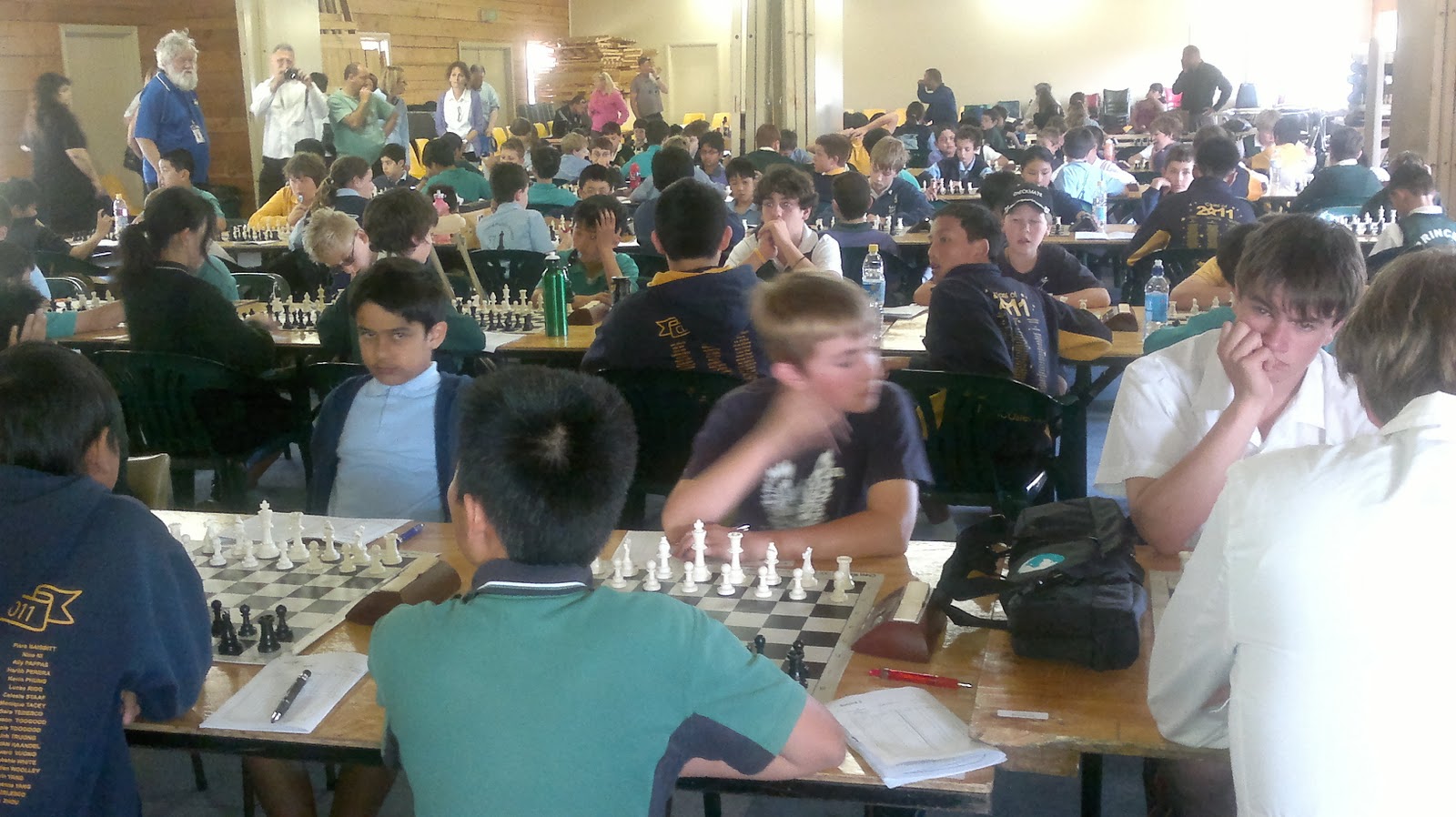
The Primary section was much closer and with 2 rounds to go, any one of about 5 teams could have won first. But the strongest finishing team was the New Zealand Takapuna Normal Intermediate School who ended up one and a half points ahead of Melbourne team, Doncaster Primary.

Subscribe to:
Posts (Atom)