I had intended to post games and ideas from many of my chess books showing classic games and using them as talking points. But after posting yesterday's game, Lasker-Lipke Breslau 1899, I couldn't help but notice that the second game in the book is Lasker's amazing double bishop sacrifice against Bauer from Amsterdam 1899, so I will look at this game and go on to another book next (though I'd better not look at the next game in the Lasker book!)
While not quite the originator of this type of sacrifice, Lasker undoubtedly made it famous by this game. If you've never seen this game before, then be warned, it is fantastic. Lasker used Bird's Opening (like Magnus Carlsen did) and set up aggressively as if he wanted to attack from the start. When given the chance, Lasker took it with style!
Black expected White to play 15.Qxh5 when it is simple to shut down the attack with 15..f5. Lasker sped things up with 15.Bxh7+! sacrificing a piece, as he is already a knight down in this position. After 15..Kxh7 16.Qxh5+ Kg8 White has brought his queen into the attacking sphere but lacks support or targets. Another sacrifice helps with that!
Lasker opens up his opponent's position with a second bishop sacrifice, 17.Bxg7!!. With Black's king lacking cover, a White rook lift will be deadly, Rf3-g3/h3. Playing through the game with the comments from Fine and Reinfeld one sees the way that Lasker quickly developed a position from which to attack, and then forcefully followed that attack through. Another important thing to remember from this game is that a sacrificial attack needn't always lead to mate. Here, Lasker used the opening of Bauer's king to win more material than he gave up, eventually ending up with a queen and 2 pawns for a rook and bishop. Of course his position was also dominating.
Chess players are fascinated with what they consider to be beautiful motifs on the chess board. It is sometimes hard to describe what is beautiful in chess, and it may be different for different players. I mean, beauty is in the eye of the beholder.
When we start learning the game, traps fascinate us. But after a while we learn that these are just guiding posts for us to avoid,or for us to deliver if someone doesn't know them.
As these traps usually involve moves which don't appear natural, such as sacrifices, our next fascination comes with the unusual in actual play. There are no end of famous sacrifices in the history of chess and just mentioning words like Morphy, Tal, Immortal or Evergreen will conjure images of wonderful combinations. But again, after a while playing chess, we realise that sacrifices work rarely (which is why they are probably so wonderful in our minds) and we are more likely to win a game of chess by playing solidly, winning a little bit of material, and converting in the endgame.
Which then brings us to a study of endgames. With minimal pieces on the board there can also be beautiful ideas, moving pieces around in seemingly impossible fashion to manufacture wins or draws, using various methods to save positions, especially stalemate themes, or creating amazing pawn breakthroughs to promote. However, the practical reality of the endgame is that what is most useful for us, is to develop a technical understanding of how to generally play endgames, backed by a reasonable theoretical knowledge of basic endgame positions that can help guide us in making plans.
So it would seem from what I'm saying that we are attracted to the beautiful in chess, but then most of us develop a playing style which is practical and technical, rather than flamboyant and beautiful. And that is fine. It doesn't mean that we can't enjoy the beautiful, or on occasion, dish out an extravagant move.
I remember thinking about these things and wondering if I'd ever be able to play a double rook sacrifice in my games like Anderssen in his Immortal win against Kiezeritsky. I have then since wondered about using various endgame ideas that I've worked on in my games.
But I now have fully seen the light, with the most amazing move possible. Can you imagine under-promoting to a knight in a corner square to deliver mate? Not in a made up study, in a real game? Well if you manage it, then you certainly won't be the first. I don't know if anyone else has done it, but Ding Liren managed it last night in a play off game in the World Cup against Kravtsiv.
110..a1=N#
I'm struggling to think of a move more stylish than this to finish a game of chess!
So most people who play our game have some ambition of becoming better. But just what exactly does that mean? And how does someone go about becoming better at chess? The first question seems easy to answer, we just become stronger players! But what exactly is a better player? Higher rated? What if a player improves, but not as quickly as others? So better can be a relative thing, and is a difficult subject to answer. How does one get better might be easier to answer. There are a set of stages in our development as chess players.
- first we gain knowledge of patterns and ideas.
- second we learn to recognise what we know in our games.
- third we develop an understanding of when our knowledge can and cannot be used.
So I guess we can say that we look to acquire as much chess knowledge as possible, then we try to apply that knowledge in our games to a deeper and gradually more successful degree.
Most people start by learning tactical processes, but this is a never ending process. And we find tricks that become evermore elaborate, good enough to beat top players! Like in the recent American Championship, the winner Wesley So played a brilliant attacking game against reigning World Junior Champion, Jeffery Xiong. It all started with an excellent sacrifice which paved the way for So's minimal force to jump into the attack.
So, as black played 21..Nxf2! and after 22.Kxf2 Rxb2+ 23.Kf1 Qh5 the position had become impossible to defend and So won shortly after.
After So's sacrifice, Jeffery Xiong has an impossible task defending as white.
The knight sacrifice removed a defender, opening up white's king and isolating it for an attack by minimal forces. A brilliant sacrificial attack? Well yes, of course, but there are plenty of examples of this sort of sacrifice, and a player of Wesley So's ability would almost definitely be aware of the pattern. However, the rest of us can learn from this and other examples of this sort.
For example, yesterday, Yifan Hou finished her game from the Grenke GM event with a similar knight sacrifice.
This one is much easier to spot, especially when you know what you are looking for. 29..Nxf2! This opens white's king, and let's black's heavy pieces into the attack. 30.Kxf2 Qe2+ 31.Kg1 Re3, an overwhelming force to attack a lone king. The game finished 32.Qc2 Rg3+ 33.Kh1 Rxh3+ 34.Kg1 Qe3+ a position which caused the white player, Georg Meier, to resign.
White's best is to play 35.Qf2 which will cost a queen after 35..Rh1+ distracting white's king.
Here's an early example of the sacrifice.
This is the game Burn-Pollock Belfast 1886 and black came up with our themed move 12..Nxf2! The key to understanding the success of the knight sacrifice now, is spotting that is followed by another knight leap opening black's light squared bishop to help threaten mate on g2. 13.Kxf2 Nd4! the joint threat of winning a queen and mate in 1 on g2 was too much for white to handle and although the game endured, the result was in little doubt.
Here's a classic example of the same theme, but taken to the extreme. Black has a whole army to break through which he starts with our custom sacrifice. Golgidze-Flohr Moscow 1935: 19..Nxf2 20.Kxf2 Qh4+ White's king has been attracted into a queen check and has to advance to hold on to material, 21.Kf3
But what now? Flohr's concept is absolutely brilliant, denuding white's king of defenders one by one until the white king faces a small but powerful black force alone. 21..Bxh3 22.Bxh3 Qxh3+ 23.Kf2 Qh4+ 24.Kf3 White's rearguard has gone.
And now Flohr removes the final defender, the dark squared bishop 24..Be5 Against this sacrificial onslaught white now crumbled 25.e3 Bxf4 26.exf4 Qh3+ 27.Kf2 Re3 with a similar force to that which Yifan Hou finished with yesterday!
White played a couple more moves before resigning, which brings another point to this issue. The fact is that it is harder to defend than to attack, and there are examples where the sacrifice wasn't fully correct but still worked. Like for instance the game Norman-Colle Hastings 1928
I don't know much about Colle except for his opening, and a game where he played a Greek Bishop Sacrifice. Here he comes up with our themed sacrifice: 19..Nxf2!? 20.Kxf2 Rae8
Although the white king looks in danger, it is also hard to see where the white attack will come from. The cool 21.Rhd1 Qe7 22.Kg1 would have removed much of the threat to white's king, but what better than to trade? 21.Rhe1?! Qe7!
Probably now white realised that trading on e3 is impossible 22.Ne2 [22.Rxe3?? Qxe3+ 23.Kf1 Nc4 when white has to play 24.Rd1 but that puts rook, queen and king in forking position of a knight 24..Qf4+ with the lovely final variation 25.Kg1 Ne3
Black's fork is countered by a white pin 26.Qd2 but black has the temporary queen sacrifice 26..Nxd1! 27.Qxf4 Re1+ 28.Qf1 Rxf1+ 29.Kxf1 Nxc3 with an easily won endgame] 22..Nc4 throwing another piece forward, again without anything concrete 23.Bd3
I guess Colle just couldn't resist, and decided that it was time to give up his other knight! 23..Nb2?! 24.Qxb2 Rxd3
At this point white had to move his knight, but he missed this defensive possibility, losing quickly after the blunder 25.Rc3?? which allowed black's pieces to penetrate 25..Qe3+ 26.Kf1 Re6 and it was all over soon after.
Here are these last 2 classic games!
So by looking at a number of examples with the same theme, we can gain knowledge and hopefully get to use it in our own games, or at least prevent our opponent from using the theme against us. There is one last game with this theme, that happened only a few days ago, but I think I'll show this tomorrow as it was a genuinely magnificent example that deserves a post of its own,
Today was a miserable day for me. First, I've been feeling pretty ill, and have had to drop out of the Monday night game at the Melbourne Chess Club this week. I've tried hard to keep playing, but last week, I developed a splitting headache through the game, and was completely washed out from just playing. As much as I love playing chess, when it is affecting my health, I'm not particularly happy doing it. Anyway, I've been to see my doctor, had some tests done and will get the results back this week, and will then see how I feel about continuing on Monday nights from next week.
Saying that, I've continued to work, even though the doctor has told me that I should rest and take time off. Thankfully my wife doesn't read my chess posts, or she'd be telling me off about this issue! Today, I had a relatively easy job of talking to strangers and playing all comers simultaneously in the CBD of Melbourne. I say relatively easy, though that wasn't strictly true. I was set up in an under cover outdoor corridor, which was cold and a bit damp. So while talking to people about chess is something that I can easily do, and playing simultaneously against people who don't regularly play chess is not a big challenge either, the weather conditions didn't do me any good today, and I felt pretty bad at times.
While I had some boards set up to play people, I set up a few positions to talk to people about. My work was part of The Festival of Steve in the CBD partly sponsored by ACMI, the Australian Centre for the Moving Image. So I decided that a position or 2 from films would be a good talking point, and in fact it was. I ended up speaking more about James Bond than I spent playing chess! Yes, probably the most famous position from the movies was the Spassky-Bronstein inspired position from the Bond movie, From Russia With Love.
Imagine that there are no white pawns in the centre of the board and you have the position that featured in the bond film. The game was an amazing slugfest, well worth a look if you haven't seen it before.
I also like to show queen sacrifices, so I had one lined up from the book 200 Miniature Games of Chess by Julius du Mont. Du Mont was a concert pianist, but an average chess player, but he was an avid organiser and writer. He worked tirelessly for the British Chess federation and British Chess Magazine between the first and second world wars, and is probably best known in chess circles for his collaboration with Tartakower on the excellent 500 Master Games of Chess. In our digital age of information overload, these books might seem a bit odd, but compilations were great mines of information in the pre digital age, and I remember learning much from this volume when I worked through it.
This position was from the game Horwitz-Bledow, 2 of the stars of the German Pleiades group who really paved the way for the dominance of German chess in the second half of the nineteenth century. Bledow is one of the under rated players in chess history, and there is reason to believe that he was in the running for being considered the world's best in the 1840's. Anyway, the position above sees the cute 1..Nxe4! 2.Bxe7 Bxf2+ 3.Kg1 Ng3#
And finally a position to stump chess players, but which was the most interesting to most of those I spoke to.
This is the position that IM Jeremy Silman created for the film Harry Potter and the Philosopher's Stone. Harry is a black bishop on a3 that will give mate, while Ron Weasley is the g5 knight, and Hermione Granger the rook on f8. As black threatens Nh3 mate, Silman had white play 1.Qxd3, when he fashioned the finish 1..Rc3 2.Qxc3 Nh3+ 3.Qxh3 (oops, that's Ron Weasley out the game), 3..Bc5+ 4.Qe3 Bxc3# with Harry winning the game and getting revenge on the white queen. Much of this didn't actually get to the screen as the director's chose only to play a couple of moves, but the story behind it is quite interesting.
Other than the weather it was an enjoyable few hours talking to people about chess and spreading the word! But when I get back I look at the big, wide world of chess and see the field for the London Classic in December with no English player in it. It is an unbelievably good field of players, but it is very disappointing to see a tournament in England with no English elite players competing. There are other events in the festival, but with a bunch of 2650+ GM's and Adams still knocking around 2730, I would have expected London to offer a place to a home representative.
No, don't worry, I'm not going to pour my heart out while in the midst of a middle aged crisis. Diaries, or personal notebooks, are often kept by chess players and I wondered how many readers do just this. So do you keep a chess notebook, or chess diary? I guess in the digital age, we can store information on our computers, or phones/tablets easily, so perhaps personal databases fulfil the same role.
I used to keep a notebook back in England, though that was in the days before online databases and resources. So as well as my own ideas and analysis, there was a lot of material that I collected from books and periodicals that I bought or borrowed. Unfortunately I left all the stuff in England when I emigrated to Australia, and all my chess books as well. So I've decided to start a chess notebook again. I'm not sure whether to use pen and paper, or a computer but the vast amount of material that is readily available to players of all standards needs to be filtered into manageable proportions. Otherwise looking a 5 million game database to improve your game is like trying to find a needle in a haystack.
One thing that all chess players enjoy is a good sacrifice, so my diary entry for today has involved sacrifices and attacks. Examining sacrifices is good for a number of reasons:
- we get away from pure materialism in out thinking.
- we improve our imagination, looking for unusual ideas in positions.
- we learn to calculate variations correctly.
- we develop a series of known patterns we can put into our game.
An easy one to start with. This was an online game I played. 1.White to play.
We all love a queen sacrifice, so here is one from the great Hastings 1895 tournament. This first round game Albin-Bird continued 40..fxg3!? allowing 41.Bxh6. 2.See if you can spot the follow up.
This is a game I played at my local club, Glen Eira, the other night. I was black and had a piece for 3 pawns. 3. Can you use your imagination to find the move I played?
Finally, here's a position from the game Malyutin-Yemelin Moscow open 1995. I looked at this game because it started with the same Ponziani opening that I have been using a lot recently. If we look at the position, it might seem that black is doing well, especially with his advanced protected e-pawn eating into white's territory. However look at each sides pieces. White's pieces are concentrated centrally and even his queen side rook has lifted and is ready to swing to the king side. Black's pieces are somewhat disorganised with the Na6, Ra8 and Be8 being particularly odd looking. White used that fact to strike. 1.Ngxf5 Rxf5
2.Nxg4! [all of a sudden white's pieces are threatening to swamp the king side. This move clears the g-file for a possible Ra3-g3 pinning black's queen to his king. 2.Nxf5 was possible giving 2 pieces for rook and pawn, but the text move is an elegant and imaginative solution to the situation] 2..hxg4 3.Bxg4 Rh5
Black tries to stem the tide by giving back a little material. This move also gives the king shelter on the h-file should white intend Be6+ 4.Bxh5 [Not materialistic, but a line clearing move which also happens to win material] 4..Qxh5 5.Qe6+
Finally White has broken through. Here's a little calculation test. 4. See if you can refute all of black's possible moves here.
It was fun looking at some sacrifices, and even playing some, and I'll post some answers tomorrow.
Answers (as I see them anyway!)
1. I launched the fork 1.Nc6! where the knight can't be taken 1..bxc6 2.Qa6+ Kb8 3.bxc6 with unstoppable mate on b7.
2. The game Albin-Bird Hastings 1895 continued 41..gxh2+ 42.Kxh2 Rxg2+ [black has rook and pawn for the queen while white's king is exposed] 43.Kh3 Rg6 44.Be3 [In his annotations for the tournament book, Schiffers claims 44.Qc1 is better] 44..f4 45.Bf2 Rh6
There now seems no satisfactory defence, and Albin crumbled with 46.Bh4 Ng3 47.Rxd7 Nxe2 when white can't capture either piece (48.Qxe2 Rg3+; 48.Rxb7 Ng1+) and soon lost.
3. I was happy to find 1..Rxc3! when the tactics work for me. 2.bxc3 Rb8 is not playable, so my young opponent found 2.e5! but I had 2..Qf3 3.Rf1 Rc5 with a winning position
4. Maljutin-Yemelin, where black played 5..Bf7 which lost to 6.Rg3+ Kh7 7.Qe4+ when black resigned.
I don't think alternatives were any better.
a) 5..Kh7/h8 6.Rh3 wins the queen
b) 5..Kg7 6.Rg3+ Bg6 7.f5 +-
c) 5..Kf8 6.f5 again looks strong 6..Bg7 7.f6
d) 5..Qf7 is probably best 6.Rg3+ Kh7 [6..Kf8 7.Qxd6+ Qe7 8.Rg8+; 6..Kh8 7.Qh6+ Qh7 8.Qf8+] 7.Qh3+ Qh5 8.Qxh5+ Bxh5 9.Rh3 when white will end up an exchange and a couple of pawns ahead
After the shock of the past few days, I'm bringing this blog back to it's chess and coffee content. I'm still a little dazed as I'm sure most of the Melbourne chess community are, and so this blog might not move too fast for a while yet. Hopefully you'll understand and be patient with me.
I did leave some tactics and endgames on Monday and never got back with the answers. Well, the endgames are going to be serialized here, but I can look at the tactics now.
It was white to play and win here. Ukrainian GM Gennadi Kuzmin played 22.Nxd6! pinning his own knight and after 22..Ne8 he unpinned with the amazing 23.Nxf7!! leaving the following position
The point is that 23..Rxd4 loses to the double check 24.Nh6+ Kh8 25.Rxf8# Ftacnik tried to close the f-file with 23..Bf6 but resigned after 24.Ne5+!! when the bishop on f6 becomes pinned so after 24..Kh8 white can take the exchange 25.Nxd7 as 25..Bxd4 loses immediately to 26.Rxf8#
The other position led to a classic tactical shot.
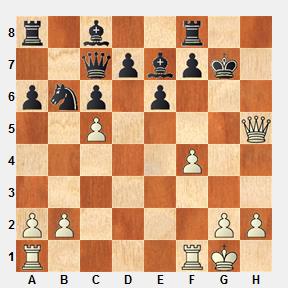
Kuzmin-Sveshnikov USSR ch 1973 it is white to play and win. Kuzmin came out with the double bishop sacrifice 17.Bxh7+!! Kxh7 18.Qh5+ Kg8 19.Bxg7!! [threatening 20.Qh8#] 19..Kxg7
White has sacrificed both bishops to destroy black's king cover. After 20.Qg4+ Kh7 21.Rf3 black resigned as he will have to give up his queen to avoid immediate mate.
This is, of course, an excellent tactic to bring off in a tournament game, but Kuzmin would have been fully aware of the double bishop sacrifice, as should all chess players. The famous Lasker-Bauer game is the classic early version of this great attack:
Here's the famous position after black's 14th move, and it is probably easy to spot what the second World Champion did as white in this position now that you already know the theme. Here's the game: