Showing posts with label calculation. Show all posts
Saturday, April 23, 2016
Studying Chess
A friend of mine on Facebook asked this question:
"Is it better to work on one part of your game (say tactics) for a month and then move on or is better to work on tactics on Monday and endings on Tuesday for example?"
I don't claim to be a strong player but as a 2200 ish player, perhaps my opinion, or work regime might provide some ideas for others. One proviso: I have no ambition, so the work I do isn't designed to help me improve, but it maintains my level, roughly.
The simple answer to the question is that I do what I want, when I want, but the work I do is done totally by me. That is, I don't give up on puzzles, I don't guess, I don't use a computer engine. I break the work into 2 distinct types.
- analysis
- calculation
Analysis involves me looking at games, and trying to discover the truth about those games or just some positions. It can be any games, there's no shortage of them. Like the games from the recent Candidates tournament in Moscow were quite interesting at times, but I'm also looking at games from the famous Hastings 1895 tournament.
Thinking nostalgically, a big improvement in my game came in the early 1980's, after I worked through all the games from the 1981 Linares tournament. I had the bare game scores in a little booklet and just worked through the games. It was just 66 games, but I studied them over and over until I found things in the games that I hadn't seen before.
Here's a position from that tournament. It's white to move. White's in a good position, but what's the best way to proceed? I'm guessing that anyone looking at this position for the first time will be able to see a whole bunch of promising moves for white. Finding different plans and ideas, as many as you can is good. Try looking for moves, then black's best replies, seeing if you can come up with a line that you like. It doesn't have to be too deep. Take a break, and then look at it again and see if anything new appears. Do it as many times as you like, either trying to find new ideas, or seeing further down variations. I'll post the game, and some good ideas for white tomorrow.
As I said, I'm currently working through the games from Hastings 1895 and using some games and positions in my lessons. There are some amazing games, some wild positions, some crazy old openings, and some terrible blunders. The strategic considerations aren't as deep as games are now, but the calculation is at times excellent. I've seen most of the games before, but I still enjoy looking through them again and again, and find new things, a bit like someone reading a favourite book many times, or watching a favourite film loads of times.
This is from the game Schiffers-Chigorin that I've been showing kids this week. White had just played Bg5, and to block the diagonal to d8, black has just played ..f6.
The question is, what is white's best move? And just how many plausible options does white have?
Analysing games and interesting positions is unbelievably good for your chess. And looking through analysed games is also good. It teaches you to think of options, and to use your imagination. You have to think of most plausible, and less plausible options, and calculate those moves to see wheich is the best, and why your favourite option doesn't work, or whether it would have been better than the move the GM played. Of course, analysing your own games is important, but studying analysed game collections, and practising analysing GM games is obviously great practice for when you start analysing your own games.
There are other things that one can do to work on one's game. Solving tactical puzzles on a site like chesstempo, working on endgames or openings to improve your technical knowledge. I personally think that help from a strong player, or even employing a coach is good for this. (I'm not looking for clients here, but I'll keep trying to post material on this blog that might make people think)
The last thing. Do I stick to a program or just randomly work when I feel like it, doing whatever I want? Actually, I do more of the latter. I'm of the opinion that if you're looking at different positions, honing your analysis skills and trying to develop and extend your calculation skills, you're already doing more than most players are who are just ploughing through tactics and trying to learn openings in great depth. Sure, I do some tactical puzzles, and when I see a problem that interests me I can't help but try to solve it. And sure, I work a bit on openings, but not that much!
Most adults are hobby players, and as such, they should be playing and studying because they enjoy what they're doing. We all get afflicted by ambitions, and if this ever happens to you, I suggest investing in a coach for a bit (make it a good coach, and one that can work face to face rather than by online instruction; you might need to try out more than one coach before you find the right one for you). Otherwise, work at the game when you can, and if you don't feel like studying, then don't push yourself because you're meant to be enjoying this! Wait until you feel like it, and then start up again. If you play hard and work hard when you feel like it, your game will make jumps at those times. You may quickly plateau out, but it will be at a higher level than when you started.
And please remember! More knowledge won't help necessarily. The most important thing is to be able to put ideas into practice. Therefore, learning to analyse positions, and to calculate variations are the 2 most valuable skills a player can have. Adult club players should leave the latest theory on the Anti-Moscow Gambit to Masters, and promising juniors who have the chess memory to cope with these things.
This advice might not be right for everyone, but it is my view on the game and how an adult should approach it and I guess it explains the way I think about the game, study the game, and play the game.
Labels:
analysis,
calculation,
carl,
Chess,
chess coaching,
Hastings
Tuesday, March 8, 2016
MCC Championship Draws Galore
In the first 5 rounds of the 2016 MCC Championship there were a grand total of 12 draws out of the 106 games played. In round 6 there were 8 draws out of the 21 games played. Now it might be that the further into the swiss tournament we get, the more even the pairings are likely to be. But there was a definite lack of fighting spirit on some of the boards.
Top board saw a quick draw between FM Jack Puccini and IM James Morris, while my game against IM Guy West also ended fairly quickly. The other IM's, Ari Dale and Mirko Rujevic also could not win against David Cannon and Tom Narenthran respectively. But Vishal Bhat bounced back after his loss to James Morris last week with a win against Thai Ly. This brings Vishal back to the top of the standings alongside Morris and West on 5/6. I'm on 4.5 with Jack Puccini and Eamonn O'Molloy and there is then a big group another half point back.
James Watson provided the biggest upset win of the night beating Justin Penrose who is rated about 200 points higher. However, James is obviously under rated as shown by the fact that he keeps providing upset wins. Soon his rating will rise, and there will be no further upsets!
Next week the MCC Championship takes a break while the Ballarat Begonia Open celebrates its 50th anniversary. A lot of MCC players will be there, along with visiting GM Nigel Short from England. Unfortunately I can't play, but I will definitely make the trip over at some stage this weekend.
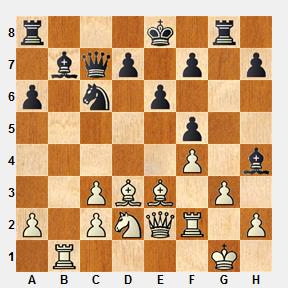
Ok, it's time to show the amazing position that was arrived at in my games against James Morris from round 3. I'd played ok against James but the game directed down a line where the master had seen further than the non master. In fact even the computer engines don't see it through clearly at first.
James as black had just played Rg8. The position is totally unbalanced with black's king in the centre. As white I played 17.Rf2 and James threw in his bishop 17..Bh4. I blocked with 18.g3.
Here James played 18..Ne7. His idea was to defend his king and drop his bishop back to f6. I probably should have stopped this with 19.Bd4, but I tried to force things. However, I only managed to force things out of my own control.
19.Nc4!? I reasoned that I could improve my knight's position with the threat of 20.Rxb7 Qxb7 21.Nd6 forking king and queen. 19..Bd5 20.Bb6
When I'd gone into this line I'd thought James had to drop his queen back to b8, but he quickly picked up the queen and moved it forward. 20..Qc6. I couldn't believe it, and thought James had blundered. It was my thinking that was wrong though. 21.Ne5 Qxc3 22.Qh5
So this was the position that I'd been aiming for, but unfortunately James had it all under control. White threatening Qxf7 mate, the bishop on h4 and the h7 pawn. James calmly defended with 22..Ng6! I'd initially thought this unplayable because I could just play knight takes knight and then take the bishop. However, at the last moment I stopped myself after seeing that 23.Nxg6 hxg6! 24.Qxh4 Rh8 25.Qg5 Rh5 traps my queen
It's somewhat scary to believe that James had this type of position in mind around the time he'd played 19..Bd5. Although I stopped myself going for this, I still dropped into a bad position after. 23.Qxh7. Stockfish thinks this is winning for white for about 10 seconds on my laptop. Then it moves from level to slightly better for black. 23..Nxe5
Here I had to play 24.fxe5 but I blundered with 24.Qxg8? where I'll get some material for the queen but my king is too exposed, and I have too many weaknesses to survive. However, I missed some fairly amazing moves in the oncoming positions. 24..Ke7 25.Qh7 Ng6
White's queen is in trouble, so I was thinking what can I get for it. I blundered again with 26.Bxf5, but the crazy line runs with 26.gxh4!? when 26..Rh8 traps white's queen.
Here white has the amazing move 27.Bd8+!? If this doesn't encapsulate the maxim "look for all checks and captures", then nothing does! 27..Rxd8 will allow white's queen to escape via h6, though this might be better than 27..Kxd8 28.Rb8+ Ke7 29.Rxh8 when it is white who will have to bail out with a perpetual.
A bizarre position with white's heavy pieces stuck in the top right hand corner and black's queen and bishop coming very close to mating the white king, but not quite.
As always, it is the variations that contain the most interesting lines, but what was most impressive to me was the depth of James calculation, leaving me far behind in that department.
Top board saw a quick draw between FM Jack Puccini and IM James Morris, while my game against IM Guy West also ended fairly quickly. The other IM's, Ari Dale and Mirko Rujevic also could not win against David Cannon and Tom Narenthran respectively. But Vishal Bhat bounced back after his loss to James Morris last week with a win against Thai Ly. This brings Vishal back to the top of the standings alongside Morris and West on 5/6. I'm on 4.5 with Jack Puccini and Eamonn O'Molloy and there is then a big group another half point back.
James Watson provided the biggest upset win of the night beating Justin Penrose who is rated about 200 points higher. However, James is obviously under rated as shown by the fact that he keeps providing upset wins. Soon his rating will rise, and there will be no further upsets!
Next week the MCC Championship takes a break while the Ballarat Begonia Open celebrates its 50th anniversary. A lot of MCC players will be there, along with visiting GM Nigel Short from England. Unfortunately I can't play, but I will definitely make the trip over at some stage this weekend.
Ok, it's time to show the amazing position that was arrived at in my games against James Morris from round 3. I'd played ok against James but the game directed down a line where the master had seen further than the non master. In fact even the computer engines don't see it through clearly at first.
James as black had just played Rg8. The position is totally unbalanced with black's king in the centre. As white I played 17.Rf2 and James threw in his bishop 17..Bh4. I blocked with 18.g3.
Here James played 18..Ne7. His idea was to defend his king and drop his bishop back to f6. I probably should have stopped this with 19.Bd4, but I tried to force things. However, I only managed to force things out of my own control.
19.Nc4!? I reasoned that I could improve my knight's position with the threat of 20.Rxb7 Qxb7 21.Nd6 forking king and queen. 19..Bd5 20.Bb6
When I'd gone into this line I'd thought James had to drop his queen back to b8, but he quickly picked up the queen and moved it forward. 20..Qc6. I couldn't believe it, and thought James had blundered. It was my thinking that was wrong though. 21.Ne5 Qxc3 22.Qh5
So this was the position that I'd been aiming for, but unfortunately James had it all under control. White threatening Qxf7 mate, the bishop on h4 and the h7 pawn. James calmly defended with 22..Ng6! I'd initially thought this unplayable because I could just play knight takes knight and then take the bishop. However, at the last moment I stopped myself after seeing that 23.Nxg6 hxg6! 24.Qxh4 Rh8 25.Qg5 Rh5 traps my queen
It's somewhat scary to believe that James had this type of position in mind around the time he'd played 19..Bd5. Although I stopped myself going for this, I still dropped into a bad position after. 23.Qxh7. Stockfish thinks this is winning for white for about 10 seconds on my laptop. Then it moves from level to slightly better for black. 23..Nxe5
Here I had to play 24.fxe5 but I blundered with 24.Qxg8? where I'll get some material for the queen but my king is too exposed, and I have too many weaknesses to survive. However, I missed some fairly amazing moves in the oncoming positions. 24..Ke7 25.Qh7 Ng6
White's queen is in trouble, so I was thinking what can I get for it. I blundered again with 26.Bxf5, but the crazy line runs with 26.gxh4!? when 26..Rh8 traps white's queen.
Here white has the amazing move 27.Bd8+!? If this doesn't encapsulate the maxim "look for all checks and captures", then nothing does! 27..Rxd8 will allow white's queen to escape via h6, though this might be better than 27..Kxd8 28.Rb8+ Ke7 29.Rxh8 when it is white who will have to bail out with a perpetual.
A bizarre position with white's heavy pieces stuck in the top right hand corner and black's queen and bishop coming very close to mating the white king, but not quite.
As always, it is the variations that contain the most interesting lines, but what was most impressive to me was the depth of James calculation, leaving me far behind in that department.
Labels:
Ballarat,
calculation,
carl,
MCC,
MCC Championship,
morris
Thursday, November 19, 2015
Chess Tempo
Every chess player should work on their calculation and tactical ability. Most chess playing sites have a tactical solving element, but the one I use at the moment in Chess Tempo, and I advise my students to use it.
While it has a number of features, the one I mainly use is a tactical solving training element, and I prefer to not work against the clock, although I will sometimes test my vision in timed tests.
You get a solving rating, and the site rates puzzles and then tries to match each solver up with a puzzle of roughly an equal level. If you correctly solve the puzzle your rating goes up and you'll start to get harder puzzles, while if you get it wrong your rating goes down and you'll get easier puzzles. (the puzzle rating also goes up or down depending on whether it is solved)
Solving puzzles like this helps a player to develop their imagination and improve their calculation skills. Or put another way, you work on diverse ideas, and how to accurately employ them.
Here's a puzzle that I was given today. See if you can solve it, I'll post the answer tomorrow. And improve your tactical ability by joining Chess Tempo and solving puzzles.
It is white to move, black has just played Rg8-g6. You don't know what your objective is (mate, winning material, saving a lost game etc), you just have to find the best line for white.
TIP: make sure you look at your opponent's ideas and resources.
Labels:
calculation,
carl,
Chess,
chesstempo,
Tactics,
thinking processes,
training
Subscribe to:
Posts (Atom)