Showing posts with label robert jamieson. Show all posts

Tuesday, July 2, 2013

Chess Camp 2013

Today is the first day of the 2013 Chesskids chess camp. The camp is being held in the seaside town of Cowes, on Phillip Island, and the theme of the camp is endgames. I was on a bus that took us down to Phillip Island and we spent the first part of the day playing open aired simuls with locals looking on, and even joining in. It is a good team building exercise, with the kids playing in simuls against the coaches, and then being encouraged to play simuls against the other kids.
Guest coach Luke Li giving a simul (left), while kids like Max Phillips (right) also gave simuls
After the simuls we headed back to the venue for the first of the games and training sessions. The kids are split into groups for training purposes, and they are also placed into teams for playing purposes. To start with they played the first round in their team matches, and then they broke into the training groups for endgame lectures and activities. I'm not totally sure what the other coaches were teaching, but I was looking at rook endings with my main aim being to get my students think about when to "place rooks behind passed pawns", "place rooks on open files", or to "cut the enemy king off along the rank/file". Talking about king and piece activity will be a big part of this week, as well as creating and promoting passed pawns.
Lessons are good, but tournament games are better!
The chess camp is going on for 4 days, which is a long time to focus continually on chess, so there are some other activities planned. Tonight the kids are chilling out watching a movie (Searching for Bobby Fischer, I think) and we have some excursions and non chess activities planned for the next few days. We also have some endgame quizzes for the kids, homework that they will have to try and complete throughout the week. FM Luke Li, IM Robert Jamieson and I have all come up with some testers for the kids to solve. Here's a puzzle that I gave to them, see if you can solve this as good as our kids can. I will warn you, that some of the kids are pretty good, but try to solve this puzzle faster than our youngest kids who are 5 years old!

White played 1.Rf8. Does this win, lose, or draw?

Edit: although this an amazing looking move, it actually loses! 1.Rf8? Rxf8 2.g7, but black has the amazing counter sacrifice, 2..Rf3+!! and after 3.Bxf3 Bxh7 white will not promote, while black's queen side duo, guarantee him the win. The moral of the story: "always examine all checks and captures"

Saturday, June 29, 2013

Chess Endgame Camp

This week I will be heading off to Phillip Island along with a group of coaches and about 30 talented chess kids. The idea is to run a chess camp, and this year we have dedicated the endgame as the subject of the main body of lessons. Of course, there will be lots of games and activities, and it is a great chance for the kids to get to know each other better, as well as perhaps to meet some great coaches who they haven't met before. Foremost of the coaches going is IM Robert Jamieson and the kids should get a huge amount from his experience, especially as Robert enjoys nothing better than quiet positions and endgames.

As coaches we have been given certain areas to work on, and lecture topics cover. Personally I'll be giving 4 lectures on the following broad subjects:

- Rook Endgames
- Winning a won position
- Minor Piece endgames
- Pawn Endgames

While compiling material for the camp, there will probably be some material left over, so I'll be showing some endgames here that I've seen but decided to hold back. For example, what inspired me to come up with the subject 'winning a won position' was the following game I saw not long ago.

Now time could have been a factor, as it often is in the endgame, but when analysing a game we are free of the time constraint and must find the best move or plan. There may also have been a case of the player with black thinking that the game will win itself. This example goes to show that nothing could be further than the truth, and the phrase "the hardest thing is to win a won game" springs immediately to mind.

So how could you improve black's play and win this "won position"?

Saturday, April 27, 2013

Glen Eira Chess Club

Friday 26th April was the official start date for Glen Eira Chess Club. The doors opened shortly before 6 pm  and the junior club started soon after. Both David Cordover and I were unsure of who we would get coming along to our new initiative. While Friday evening is great for kids, there are already chess clubs running to the north (Canterbury) and south (Frankston) of us and our opening night coincided with a weekend event at the Melbourne Chess Club, their annual ANZAC Day Weekender. Nevertheless, David and I know loads of people in this area interested in chess. There are ex-players, up and coming juniors, and keen adults who have never played club chess before as well as current tournament players who live in this area but travel to chess clubs around the city. There are also a number of people around who are interested in playing chess, but who aren't that bothered about playing in a tournament environment. These are things that we want to cater for.
Good turn out at the junior chess club
So all in all I was pretty impressed to see over 30 people show up on the first night. There was a blitz tournament which was played in a fun spirit, and juniors were encouraged to participate with the adults. The junior club saw the kids encouraged to write their moves down and to play games with a time control of 25 minutes and 10 second increment. The idea is to graduate the kids through to adult chess as quickly as possible. It is not their standard of play that we are so interested in as their level of focus. Most kids are used to 15 minute games at the most, so throwing them into a 60 minute longplay game can be a culture shock. So our junior club hopes to engender the spirit of the club within the kids, and to prepare them for adult chess.

David Cordover and the future of chess
A successful junior club, and young membership is the hope for the future of any institution, and David and I do have high hopes for the future. A first night of 34 players was more than we expected and we are hoping to build the club to well over 100 members. To do this we have one simple idea. We want to make our club a place where people want to come to. That is not a place where people just come to play chess, but a place where they want to come to, and where they also play chess. A social environment for players, their families and friends.

I'm getting beaten by IM Robert Jamieson with Sam Low making a welcome return to chess next to Robert and juniors showing they can focus as well as their elders
Saying that, we are all turning up to play chess, and it was great to see some parents stepping up and joining in the games. We ran a blitz event which was won by IM Robert Jamieson. It was great of Robert to join in and his participation may prove a magnet for other players. Of course it is amazing to be able to play someone of that calibre at your local club. And I always find it heartening to see players of all ages and standards sitting alongside one another united by this amazing game. If you have time, and are in the area, then feel free to come down to our friendly club next Friday. I believe we are planning a time handicap tournament as well as plenty of social chess. This week we had home made cookies as an incentive, thanks very much to Kate and David and their children for this fantastic gesture :)

Tuesday, March 5, 2013

Why You Should Study Elementary Endgames

I have had a strange sort of day. Summed up, I worked as normal going from school to school teaching chess, until I ended up at an after school class where the classroom that is usually used for chess was unavailable due to parent teacher interviews. So I was directed to another room which was much smaller and with no air con. After an hour in the stifling room I thought I was going to pass out, and was very grateful to get out. I then went to some private group classes at our chess shop and found that I only had to give one class, as my second, more advanced class was being taken by our premier coach IM Robert Jamieson. If you haven't seen Robert in action then you should really check it out. He is consistent, rigorous and has great material both new and old. His lessons challenge students to think, to plan and to produce results in an accurate way. Before leaving I saw the first position he was challenging the kids with and said, "Hey, that's the position I was going to put on my blog tonight!", to which he replied "I thought so".

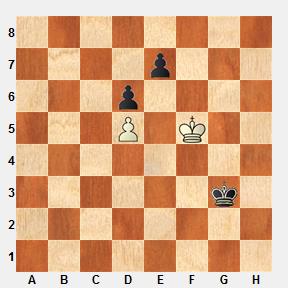
This position was the culmination of the board 1 game in last night's Melbourne Chess Club (MCC) Championship between Phillip Drew and Guy West. The game had been a hard fought Benko Gambit, where it seemed that the outsider was fully prepared in the opening. IM Guy West got the typical Benko position with queenside counterplay for the pawn, and after exchanges black's position seemed to get better. Eventually an endgame of rook and 4 pawns each was reached where neither side had a passed pawn and the game looked as if it was heading towards a draw.

However, the moral of this game must be that all players would benefit from a study of fundamental or basic endgames. Phillip as white blundered just 2 moves into this position. After 1.Ke4 Kxh4 White is a pawn down and should seek a draw with the opposition move 2.Kf4. However, Phillip played 2.Kf5 which looks plausible but Guy quickly outflanked his opponent with 2..Kg3.
Now white is lost, a tragedy for Phillip. But once again, you have to admire Guy West and his never say die attitude. Guy kept giving his opponent every chance to go wrong. It was a challenging opening, a hard fought middlegame with the main theme being positional compensation for a pawn, and then various transitional possibilities to different endgames. Phillip navigated well through all these difficult phases, but Guy kept on into the purely technical rook ending, and finally the theoretical pawn endgame, and it was in this last stage that his opponent finally blundered!

The result leaves Guy clear at the top with 5/5 before the week break for the Ballarat weekender. Guy is now a point clear of Ari Dale and Dusan Stojic and he has played both these talented young players. A further half point back on 3.5 is a group of 5 players, Chris Wallis, Domagoj Dragicevic, Justin Tan, David Hacche and Malcolm Pyke. Paul Kovacevic continued his good tournament with a draw against higher rated Dizdarevic. But there were a couple of upsets last night. First Finley Dale won against Richard McCart. But probably the biggest upset of the night was Tanya Kolak's victory against Jim Papadinis who is rated nearly 600 points higher!

Endgame knowledge is a big problem for most players, especially in today's ever speedier time controls. More emphasis is placed on tactics and openings than other parts of the game, but anyone who has lost a basic endgame, or been unable to win a clearly won position will know exactly how Phillip is feeling now. The answer is to devote a little of one's chess work on endgames. Karsten Mueller's articles at the chess cafe website are excellent, and some even relevant to a study of basic pawn endgames!


Thursday, January 10, 2013

Chess on my mind

Today it was a privilege to be at an informal training session for some Victorian kids alongside IM Robert Jamieson. Robert is a demanding coach who gets the kids to think outside the box, stretching their imagination and vision on the chessboard. The material he uses is always excellent, and the questions he poses push the kids to the limit of their ability. Today we were looking at some games from the current tournament, the Australian Open Championship. Here's a couple of positions he tortured the kids with today:

What would you play as black here? Most of the kids opted for castles, as did IM Ly in the game. Unfortunately, a quick check for all checks and captures reveals that after 10..0-0 11.Nxd5! wins at least a pawn

Fast forward to this position. The question the kids had to answer was how did IM Andrew Brown cause black to resign in 2 moves? Getting kids to visualise is important, especially seeing more than one possibility in a variation. 18.Rc1 seems the obvious try but how will the bishop be trapped after 18..Bb2? So other tries were given, such as 18.Rb1 and 18.Ra2. But it came down to the mainline, so what can white do after 18..Bb2? The first thought was 19.Rc8, though this doesn't achieve anything. Finally someone saw 19.Rc6 which wins time by attacking the queen. Black resigned rather than move his queen and lose his bishop after 20.Qb3.

Robert also talked about the game Li-Zhao which he told the kids was one of his favourite games in the event so far. This was an unbelievably tough game in the Noteboom opening where white tried every trick in the book to unseat his GM opponent. In the end black came through but Zhao must have been pretty happy to win this game in the end.

We then started watching the live games introducing the kids to kibitzing techniques. Though we didn't have time to see the conclusion of the games, the result of the day was certainly 15 year old FM Bobby Cheng's victory over GM Igor Khenkin. This leaves Bobby in clear first which hopefully he can maintain till the end of the tournament.

Of course, running workshops with great players can only fuel ones own interest in the game. So I would like to give a big thanks to the inspirational Robert Jamieson. I came home today, picked up a chess book and drove to the bay! I'm eagerly looking forward to Wijk aan Zee starting at the weekend, where 3 World class round robins are taking place, all with interesting fields. For Australian fans, Ari and Finlay Dale are competing at Wijk in lower sections and will no doubt have some great stories to bring back to Australia. Then next week I'll be flying to the Gold Coast to coach at the Australian Junior Championships.

Looking into the future a little, I have to decide whether to play in the Melbourne Chess Club Championship. It is always one of my favourite events of the year, but it is very tiring for me, finishing late on Monday nights when I have an early start on Tuesday. I'll probably leave the decision until I'm in the Gold Coast! By the way, it is a pretty exciting time at the MCC. IA Gary Bekker has organised a Women's International that starts this weekend, the traditional Australia Day Weekender will take place over the last weekend in January, while GM Igor Khenkin is going to be at the club after the conclusion of the Australian Open!

Easter is fairly early this year, but that probably won't stop me from going to Canberra to play in Doeberl. This tournament should start just before the finish of the Candidates tournament in London in March. This will give us a challenger to Anand for a World Championship match in November! What an exciting year for chess, my head is absolutely spinning! And I won't even get started on the amount of tweets I'm picking up about cheating in chess, though I will say that Mig Greengard's opinion that cheating in chess is a small problem while promotion of the game in its educational and sporting forms is a bigger problem that needs tackling is one I subscribe to.

Sunday, October 21, 2012

Chess in the Future?

This weekend I was fortunate enough to be involved in a chess tournament with a massive amount of technology. Chesskids organised a Victorian Youth Championship which was held at Swinburne University's new KIOSC building, a state of the art technology centre. The tournament was for kids below 15, but it was envisaged as an elite junior event as chesskids already runs a number of tournaments for players who are new to tournament chess, or have little experience.

Interactive Touch Screens
While the kids were playing in near by classrooms (large laboratory style spaces, with lots of natural light) the main hub area of the event was a room with amazing facilities, including touch screen monitors, and computer  to wall display projectors. Thus we were able to link the touch screens to interactive chess sites, such as chesstempo, promoting self improvement plans to kids and parents.

Projected Wall Displays

Live Commentary with IM Robert Jamieson
Projecting computer screens on to the wall allowed us to commentate on games, give lessons to kids and parents, and follow the action live as it was happening. Yes, I do mean live, and this was because of another innovation. Chesskids have developed their own tournament management software, tornelo. Tornelo is more than just a pairings program. It processes tournament entries, acts as a pairing program and allows for games to be entered and stored. This last facility was the big one for me this weekend. With the support of Swinburne University, we had the use of a number of Ipads which the kids used as score sheets to record their games. This meant that we saw the moves as they were being made (and some parents with their own laptops/Ipads were following their own kid's game).

Scoresheet of the Future

"Where's my Ipad?"

Some still preferred pen and paper
The significance of this technology has never been apparent to me. I guess I'm just too old to see the way these things work. Well, my eyes were opened this weekend. As I was commentating on some games it suddenly struck me that we were able to see games by players, some of whom are pre-school and who probably wouldn't be able to write their moves down. Wouldn't it have been amazing if this would have been  around to record the games of an infant Fischer, or Kasparov, and on the other hand, I also wondered whether we were recording the games of future Grand Masters?

Technology aside, this was still a kids chess tournament and all I saw was kids having fun, playing chess, socialising with friends and generally enjoying their competitive weekend. The results can all be found on the tornelo page, along with a database of over 200 games (check out the link at the top of the page). The winners of each section won $150 but more importantly, they each won a trophy!
Joint Winners of under 7's admiring their prizes!