Showing posts with label mirko rujevic. Show all posts

Tuesday, August 25, 2015

Malitis Memorial Wrap Up

Last night was the final round of the Malitis Memorial. This year the tournament had been split into 2 sections, an 8-player round robin for the top rated players, and a swiss for all others. This had the desired effect of getting a larger than usual number of players to attend. A total of 43 players competed across the 2 divisions and I'm sure this is something the MCC will look at repeating in the future.

The Round Robin section had already been decided before yesterday's final round. IM Mirko Rujevic was 1.5 clear before the last round, but relentlessly won his final round game to score a clean 7/7 picket fence. Second place on an excellent 5/7 was junior David Cannon. I'm not sure if this is David's first breakthrough performance, but it will certainly not be his last. The improving youngster deservedly came clear second. I managed to salvage a bad start by claiming third place on 4.5/7. Not a brilliant performance, but not bad either. Somehow, I felt that I didn't play well enough to credit the +2 score.

The Swiss section was won by another veteran, Mehmedalija Dizdarevic, with an excellent 6.5/7. Mehmedalija could still have been overtaken going into the last round, but he secured victory with a win against Irishman Eamonn O'Molloy. The field was very competitive, which makes the winner's result even more impressive. Second place was shared by David Lacey, Rad Chmiel and Gary Bekker on 5/7. The strength of the field can be seen by the fact that no one in the top 18 was FIDE rated below 1700, with the top rated player being 1946. Roger Beattie proved to be the best under-1700 player, though Axel Ahmer finished on the same score as Roger, 3.5/7 but couldn't receive a rating prize because he is unrated. I don't think it will be long before Axel has a rating of at least 1700.

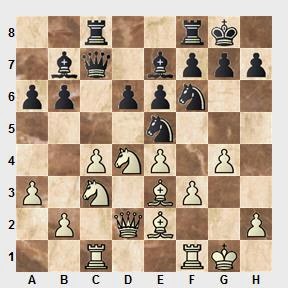
The MCC offer brilliancy prizes for each of their FIDE rated tournaments. I am, unfortunately, probably my own harshest critic, and instead of seeing the brilliant in my games, I tend to focus on that which was less good. Oh, and endgames, but it isn't often that an endgame wins a brilliancy prize! So while I've played some ok chess in this tournament, I haven't been too impressed overall with my play. Last night against Malcolm Pyke, I was gifted a positionally strong position out of the opening, and then converted it. There were some interesting tactics, but as is often the case, these were in the variations, rather than that which was played. The key position was:
This is a fairly typical Sicilian Rauzer type position. I can't say I know too much Rauzer theory, but I know that if white castles king side, it takes a little out the sting of a black exchange sacrifice on c3, but offers little in the way of playing for an opening advantage. As I tend to be the safety first type of player, this suited me. I thought that the game would continue with 8..Qa5 which virtually forces white to play 9.Bxf6 when we have  dynamically difficult position for both sides to play. I was also considering 8..Be7 in the above position, where it looks more like a Scheveningen, though white has played Bg5, rather than the more common Be3.

I was surprised to see 8..Rc8?! played. It is obviously what a Sicilian player is thinking of, putting a rook on the semi open c-file, but it leaves d6 weak. In the game, I was thinking that I'd seen this type of thing but without black having played e6. However, I haven't looked at the Rauzer for quite a while so I might have been mixing things up. Anyway, I played 9.Ndb5 hitting d6 twice, and black is already on the defensive. Malcolm saved his pawn with 9..Qe7, but it is not the sort of move that he would have wanted to play.
Black's pieces are all in the way of each other. I chose a plan to weaken black's light squares, and it worked out nicely. 10.Bf4!? e5 11.Bg5 losing a tempo, but taking over the d5 square, and the light squares.
Now, a white knight is going to land on d5 with plenty of force. After the moves 11..a6 12.Nd5 Qd8 13.Na3 Be6 14.Bxf6 gxf6 15.Bg4 black is in a very difficult position, which I was able to maintain, and develop into a winning advantage later in the game. 
By pinning the Be6, white maintains the knight on d5. Black is cramped for space, has weaknesses to aim at, and no counterplay so the win was relatively straightforward from here. I think that if I was black here, my chances of surviving against an equally rated player would be close to 0%.

My play in this tournament hasn't been brilliant. I have played some solid positional chess and some decent endgame play, but my openings are still rather shaky, and my calculation has been off at times. I can't play in the next event, The MCC Open which starts next Monday. It's a shame as it looks as if it's going to be another good field.


Wednesday, August 19, 2015

Malitis Memorial

Last night saw the penultimate round of the Malitis Memorial at the MCC. The tournament has been split into 2 sections, and 8 player round robin for the 8 highest rated players in the field, and a swiss for the rest of the field.There is still a lot to play for in both sections, but one thing is for sure. IM Mirko Rujevic has won the round robin with one game to spare. Mirko has been in great form in this tournament, hang tough from some not so good positions and given himself chances in all his games. He has an amazing 6/6 which is likely to take him back above 2200.

After Mirko, David Cannon has continued his excellent form drawing last night with Simon Schmidt to sit on 4.5/6 and clear second place. David is a point clear of myself in third place, so even if results go against him, he will finish equal second at the worst, which will be a fantastic result. My 3.5/6 is back above half points, but is still only about par, or a little worse. I have had an issue with over extending my positions which I'm trying hard to work on, and last night I played a nice game to win with black against Omar Khaled Bashar. So along with most of the field, I'm fighting for third place, which doesn't sound too bad, but it is only an 8 player event!

The swiss is more competitive. Veteran Mehmedalija Dizdarevic is the clear leader on 5.5/6. He is half a point ahead of David Lacey but they have already played. So teh final round will see Mehmedalija play Eamonn O' Molloy while David plays Rad Chmiel, both tough games. Eamonn sits on 4.5 in clear third, while Rad is part of a group of players on 4/6. Whoever ends up winning this tournament will have deserved it as the field is quite evenly matched at the top end.

Next Monday is the last round, and the following Monday the MCC already start their next event, the MCC Open.This is a 9-round swiss which already has a field of over 30 players entered, so it looks like being a good tournament which means the Monday nights of 2015 have proved a great success for the MCC.


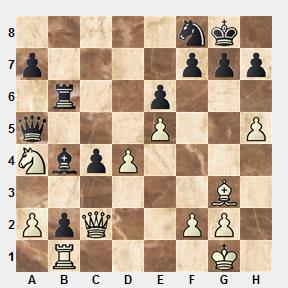
This was a position from my game last night. I was black against Omar Khaled Bashar, and I'd managed to create an immense passed pawn on b2. The next part of the game was a fight for this pawn, and finding a way for each side to activate their dormant king side minor pieces.

29.Rb1 Bb4 30.Na4

30..c3! Now I'm not saying that this was a difficult exchange sacrifice to play, but I was very happy to be considering these types of plans, as I am usually too materialistic. 31.Nxb6 axb6 32.a4
White has blockaded my pawns on the light squares. There is only one piece that can break that blockade. 32..Nd7! 33.Rd1 Qd5 34.f4 a bit of desperation and to retreat the bishop to e1 to fight against black's advanced passed pawns.

34..b5 making way for the knight 35.axb5 Nb6! There is no need to take the pawn back now, improving pieces is the most important thing at the moment. While this line of play might seem sharp, it is wholly positional and I was very happy with it. My exchange sacrifice was to secure a pair of advanced passed pawns, and then I moved queen and knight to their optimum squares. All that is needed now is a breakthrough, which my opponent allowed after 36.Be1 Qxb5
White's position is pretty hopeless, but the game finished after 37.f5 when I was finally able to take charge of the light squares by 37..Qa4. Omar thought for a while before resigning. It will be massive material loss for white after black plays c2.

Tuesday, May 26, 2015

City of Melbourne Open Round 5

We have a new leader in the City of Melbourne Open. My brief spell at the top ended at the hands of IM Mirko Rujevic. Mirko is playing in the Victorian Championship at the moment, but it doesn't dampen his fighting spirit, and it took just a moment of hesitation on my part to allow him to take the initiative which he didn't relinquish until I resigned in a hopeless position. It was a powerful display by Mirko and he leapfrogs over me into a half point lead on 4.5.

I'm joined on 4/5 by FM Jack Puccini and Simon Schmidt, who is also playing in the Victorian Championship, while among those half a point back is Malcolm Pyke, another Victorian Championship competitor. This all goes to show that the City of Melbourne Open is a pretty good field, and that lots of hard competition is good for your chess. Simon Schmidt is playing more than anyone, as he's also competing in the Box Hill Club Championship!

With 4 rounds still to play, there are still a lot of ways the tournament could go, but the per tournament favourites are beginning to rise to the top. Nguyen bounced back with a win to join Malcolm and another 5 players on 3.5. The group on 3/5 is led by 2200+ rated Nedimovic. There were a couple of upsets on the lower boards with Tanya Krstevska, Simon Dale and John Beckman overcoming players rated 200 points higher.

The pairings are usually up on Thursday and once again, I will not be making any predictions about who will be playing who. To my simple mind, Jack Puccin and Mirko Rujevic should be playing, which would be a great board 1 fight. But I'll make no predictions on the pairings as I'm more often wrong than right.


If it's black's move in the above position, then c4 closing out the light squared bishop, followed by a queen side expansion gives black level chances. Unfortunately for me, it was white's turn, and Mirko took the initiative with a typical central thrust 13.e5! After 13..dxe5 14.Nxe5 Be6 15.Bxe6 fxe6 white has a better position, but more importantly has an initiative which is one of Mirko's strengths.


Defending difficult positions, and trying to negate an opponent's initiative is one of my own weaknesses, and from the above position I succumbed rather too easily to Mirko's powerful play.


Tuesday, May 19, 2015

City of Melbourne Open round 5

Due to some work changes I found myself at the MCC early. I walked into the main tournament hall, and placed my stuff by my board and looked up to see the official banner of the 2016 Australian Championship.

I usually arrive with moments to spare, or with time already on the clock, so I felt fairly relaxed, and had time to chat a bit and look around. I even had time to head to Brunswick Street for a coffee before the game.
Richard Voon is always ready for a chat
Round 4 of the City of Melbourne Open saw little in the way of upsets. Only one game in the top 10 boards went againt the rating, and that was Justin Penrose's victory against Hoai Nam Nguyen, but Penrose is an accomplished player so I take it as only a small upset. The field is beginning to spread out with myself, Carl Gorka, leading on 4/4 followed by IM Mirko Rujevic and Justin Penrose on 3.5. While last week I couldn't begin to guess who I might play, I can quite confidently say that the top board game next week will be Rujevic-Gorka.

IM Mirko Rujevic just half a point from the lead
I feel as if I'm in pretty good form, but Mirko is absolutely fearless. Playing against talented youngster David Cannon, Mirko didn't hesitate to play the Two Knights opening. I sat eagerly watching to see whether David would throw his knight to g5, but he opted for the safer 4.d3 instead of testing Mirko's calculation in a critical opening.

FM Jack Puccini heads the group of players on 3/4. He is joined by Malcolm Pyke and Simon Schmidt, who are both doubling up in the Victorian Championships, Richard Voon, Zhi Lin Guo and the brilliancy prize winner from the Club Championship, David Lacey.

Brilliancy Prize winner, David Lacey
Further down the field, the Zou brothers both scored good draws, Edwin against Tanya Krstevska, and Brendan against Gary Bekker, while Tanya Kolak had a good win against Stephen Jago.

My game finished abruptly when my opponent misjudged a position in a Hedgehog type Sicilian. I'm no great expert, but black has a very tough job of sitting and waiting for white's advances and being ready to strike at the right moment.

Black has just thrown his knight into e5 feeling that white would have to protect the pawn with b3. I managed to punish this aggression by playing 15.g5 Nfd7 16.f4!

My opponent, Efrain Tionko, couldn't find a good continuation, so he went with 16..Nxc4? Unfortunately, after the forcing sequence 17.Bxc4 Qxc4 18.Nd5 Bxd5 19.Rxc4 Bxc4 black has a rook, bishop and pawn for the queen.

Now after 20.Rc1 black's bishop is short of squares, while his other pieces display no activity. It didn't take too much to convert this to a sizeable material advantage.

Sunday, October 6, 2013

Back to Chess

I have been on a chess free vacation for the past 2-3 weeks and it is time to get back into the swing. It seems while I was away I missed much in the chess world, though there is now so much top class chess happening and being reported on that it doesn't really matter much. It was no surprise that Yifan Hou regained her World Championship, though perhaps the ease with which she defeated Anna Ushenina was. And while I was away there were men's and women's Grand Prix tournaments, that now seem to happen so frequently that they are just more of the same old thing. This time round, Koneru won the women's event, while the men's tournament was jointly won by Caruana and Gelfand. The World Junior Championships were won by the top seed in the boys, Yangyi Yu while my tip for the girls title, Aleksandra Goryachkina won the event. It is reassuring that one of my tips has come through, though I probably know more about girls chess than the top level of chess at the moment.

Personally, I am about to start playing again. Next week I am playing a small one day event at the Melbourne Chess Club. The MCC Quads are designed for players who have little time but want to play long play chess. Players are allocated into 4 player groups and have to play 3 games of about 60 + 20 in a day. I think it is a great idea, and while I know it will be tough to play at a constantly good level for 3 games, I am eager to play some rated chess again. In fact, it will be interesting to see how far off my play has dropped after not playing any serious competitive chess for about a year. I certainly expect a bit of rustiness, especially tactically. The question is, how to prepare for the event? Should I try to play loads of online chess? Should I study some openings? Should I be trying to solve as many tactical puzzles as possible? Hmmm, I guess I'll just continue to do what I normally do and play as best I can on the day. I'll be blogging some things here over the next week, so you'll see some of the things I'm doing to prepare.

One thing I'll be doing is following the games from the Russian Championship Final which started yesterday. The men's event is really an amazing field with Kramnik the top seed. Inspired by the fact that I recently got something right, I'm going to go for Peter Svidler for this event, he always seems to pay well at the Russian Championships. Yesterday, in the first round he started with a win, but then again so did Kramnik on a day when all the games were decisive. Number 2 seed, Karjakin lost though this was with black to Andreikin who proved just how good he was in the recent World Cup.

Finally, did I say my tipping had improved? Not really, I got one right and this has gone to my head a bit. Well, to come back to earth, I also suggested that Mirko Rujevic was going to be tough to beat in the MCC Open. Tough to beat he no doubt is, but not impossible as was proved last week by Justin Penrose. The previously unbeaten Rujevic is now on 3/4 with a large group of players while Penrose takes a half point lead into the 5th round played tomorrow. The tournament is still wide open, and Mirko must still be considered one of the favourites. Round 5 sees Penrose playing black against Dizdarevic on board 1, while the top 2 seeds, Rujevic-Pyke, play on board 2.

Right I'm off to do some preparation for next week's tournament. In America I bought a book and am going to find a good coffee and browse through it. Hopefully some of the games will get that far.


Tuesday, September 10, 2013

World's Worst Tipster

I'm so happy that I haven't lost my tipping form. As soon as I tipped Aronian to win the Sinquefield Cup and he plays a game with an unbelievable blunder for a player of his calibre. Even Aronian was amazed with how bad his move was.

This was the position last night between Nakamura and Aronian. Aronian as black has to move his queen, but chose the unfortunate 30..Qb5?? which allowed the simple refutation, 31.Qxb5 axb5 32.Nd7 where white will win an exchange as 32..Rfe8 allows the fork 33.Nf6+. The game continued for not much longer and my tip for the event was already off the pace. I suppose the good thing is that the first round of a tournament is probably the best time to lose, as you have the rest of the event to catch up. However, this is only a 6 round tournament, so Aronian will have to take some risks if he is to catch his rivals. Tonight Aronian plays Carlsen which will be an epic battle. The World number 1 already won a nice game against Kamsky in the first round, and will be looking to consolidate his position.

Meanwhile in Melbourne, the MCC started a new 9 round event last night. The MCC Open is a 9 round event played on consecutive Monday nights with a break for the long weekend at the start of November. The first round didn't see much in the way upsets. The only win against the seedings was Finlay Dale's win against Jack Puccini though when 2 young players meet it is difficult to really call things too much of an upset. I'm sure Jack will bounce back. Top seed in the 26 player field is IM Mirko Rujevic while Malcolm Pyke is second seed, just like in the last event. Mirko was almost unstoppable then, and I will tip him for this event too (sorry Mirko if my tipping curse continues). The MCC has also announced a Sunday quad event for October. I really like this idea. Groups of 4 players play a small round robin over a day, playing 3 games at a rate of about 60 minutes + 30 second increment. The games will be ACF rated and I could even be persuaded to play one of these myself. I will of course not be tipping myself as that would be tantamount to sporting suicide.

Finally, the MCC has re instituted the Endgame Group which I established a long time back. The idea was for players to come together to talk about endgames, to practice playing from endgame positions and generally to strengthen that part of their game. Older players might remember when we used to do this during adjournments, but since they no longer happen, studying endgames has fallen behind other parts of the game, such as tactics or openings, in the priorities of a modern player using modern time controls. The endgame group had a small but loyal following when I was running it, but it never really achieved what I aimed for it which was for all members to contribute material to be discussed. Perhaps I was unrealistic in thinking this could be the case, and really a group needs one or just a few to lead it. This is basically what happened. Well, though I ran the group for about 2 years, my work commitments got in the way, and I had to step aside and there was no one to take over my role and the Endgame Group fell away. Now FM Bill Jordan is running the group which started up again a few weeks ago. Bill is an excellent teacher of chess, and his knowledge of endgames is pretty good. There isn't a player in Melbourne who wouldn't gain something from these groups, and especially useful is the practical element as even if players do study endgames, there just isn't much opportunity to put these ideas into practice. MCC Endgame Group is running on Tuesday nights, and again, if I wasn't working, I'd be there. Hopefully, some of the endgames I post on this blog can make it to the endgame group to discuss.

Tuesday, August 6, 2013

Who's The Leader?

Last night saw the latest round of the Malitis Memorial at the MCC. The top 2 seeds, IM Mirko Rujevic and Malcolm Pyke met, and their game ended in a draw which keeps them in joint first place. Surprisingly the only player half a point behind them before the round started was Ray Yang, but Ray couldn't keep up his great start and lost to David Lacey. David finds himself in the chasing group, a point behind the leaders, along with Justin Penrose, Tom Kalisch, Anthony Hain and Paul Kovacevic. With this being only a 7 round tournament, and there only being 3 rounds left, I think we can say that this group is where the main prizewinners will come from. Of course, with a run of 3/3 players from behind this could still challenge for minor places.

Meanwhile at the British Championships David Howell maintained his half point lead with a draw against Mark Hebden. Hebden remains close behind in second along with Ameet Ghasi, Keith Arkell and Simon Williams. There is then a big chasing pack a further half point behind including top seed Gawain Jones who has started the tournament with a number of draws in the first week. I was able to catch the start of the games before going to bed last night (damn time zones!) and it was great to see Hebden playing the Hungarian Defence, 1.e4 e5 2.Nf3 Nc6 3.Bc4 Be7. I know it has a reputation for leading to cramped positions for black, but it is solid enough, and a tough nut for white to crack. Certainly 2639 rated Howell could only draw and it was a fully fledged battle, though I don't think black came out the opening badly. Simon Williams continued in his cavalier (coffeehouse!) style to take out Stephen Gordon. Williams again ditched a pawn for activity and and all of a sudden Gordon's king was wide open and Williams pieces were penetrating. In the end, a rook sacrifice was enough to gain the time to deliver mate. From move 16 onwards, Williams is interested in one thing, developing an initiative to generate a direct attack against white's king activating his pieces.


A fascinating match up is the game Williams-Howell on top board of round 8 (of 11). Howell is an excellent player, but he can expect Williams to throw everything at him. Equally fascinating for me is the board 2 game Hebden-Arkell. Having played the weekend circuit in the UK for many years, I saw these 2 GM's regularly cleaning up these small swiss weekend events. I've played both Hebden and Arkell numerous times and never managed even a draw against either of them, and have witnessed them both playing at the same weekender lots of times. In fact, I would have no clue how many times these great battlers have actually played each other, but I'd guess it would be hundreds of games! On board 3 Ghasi-Zhou brings 2 young talents together. Well, I understand Ameet Ghasi is not exactly a junior but I always think of him as a youngster from my days in the Birmingham league. I guess it just shows that I'm getting old!

A couple of nights ago I was following Aussie GM David Smerdon's progress in Denmark. Well, unfortunately he lost that game and dropped down the standings to equal 14th, whereas a win would have taken him to equal second. It just shows how brutal these big swiss events can be. Still it was agreat effort by David, who played his typical combative style of chess. The winner was Indian GM Parimarjan Negi who won a quick game against joint leader Sabino Brunello of Italy in the last round. Both players were evidently unhappy with the draw that would have secured equal first, and it was Negi that took the victory in an exciting game. I found white's use of his doubled h-pawns really interesting in this game.
 

Sunday, July 28, 2013

MCC Update

Since I moved to Australia about 8 and a half years ago, there have been 4 players who I've had a particularly bad record against. IM Guy West I have never managed to beat, I've scored a few draws, and lost quite a few. FM Dusan Stojic I have managed to win against, and have picked up the odd draw, but I must be at about -6 against him. My record against IM Mirko Rujevic perplexes me as I seem to get decent positions, but his sharp and imaginative sense at the chess board usually allows him to come out of things well. While I've beaten him, and drawn a few, I reckon I'm at -5 at least. And against Malcolm Pyke I have had a bad time. I don't remember the exact score, but he won a whole load back to back. I'm either up, level or no worse than -2 against everyone else I've played in Australia. (A bold announcement and if you are someone I've forgotten, then please don't hesitate to remind me)
Guy West and Dusan Stojic
What made me think about this was seeing the field for the Melbourne Chess Club's latest Monday night tournament, the Malitis Memorial. This mid year 7-round swiss has usually had small turn outs compared to other MCC events, but this year the tournament seems to holding it's own with the previous City of Melbourne Open and a field of 29 players are currently competing compared with 23 for the previous event. The top 2 seeds are from my nemesis group, Rujevic and Pyke and these 2 are currently on 2/2 and in the leading group of the event along with David Lacey, Tom Kalisch and Paul Kovacevic. It's still, of course, too early to tell what will happen but with only 7 rounds, the tournament will quickly sort itself out.
Malcolm Pyke

Mirko Rujevic
One player has asked for a bye for tomorrow's third round game in the Malitis Memorial. Jack Puccini is currently in China playing for Australia in the World Youth Olympiad, a team tournament for under 16's. Jack is currently playing board 3 for Australia 2 and has scored a magnificent 5/6, his only loss being to 2449 rated Russian FM Kiril Alekseenko. The MCC are also represented in the Australia 1 team with Ari Dale also having a stellar performance scoring 5.5/7 on board 4 although things were even better before the double round yesterday as it was the second game on the day he lost. All the young Australians are working hard to achieve the best results for their teams, and currently, the 1st team are 8th place (=7th) and the 2nd team are in 39th (=30th). There are still 2 rounds to go and both teams will be looking to improve upon their current standings.

In my last post, I complained about the lack of pgn games on the official website. Well, within about 1 hour of writing that post a pgn of rounds 1-6 was posted on the website. I was immediately ready to forgive the organisers, until I opened it and found it contained only the games from the live boards. To be honest, these games should have been posted to the site immediately, and it should have taken some time for other games to be manually loaded into a database. But I am now not going to hold my breath for the remaining games of the event to be published.

Thursday, May 2, 2013

Thursday Chess Observations

Is it my imagination or is the Informator not as good as it used to be? I remember getting a copy back in the 1980's, going through hundreds of games, loads of tactics and endgames, browsing positions throughout the book and basically getting loads from it. I can also remember someone saying that every good player should own at least 1 Informator, and with that 1 Informator and enough work, you could become a master. Well, maybe that was so, but hardly nowadays. I was looking through a recent Informator and the quality is still great, but the quantity is way down. The last Informator I read, back in the 80's had about 750 games in it, whereas the new edition has a little over 200. Now I know Informator has moved their production from 2 times per year to 4 times per year, but still that means the readers are only getting about half the amount of games we got in the past per year. There are some other nice features, but to be honest, I don't think Informator is really about Opening Labs or Player Profiles which are done much better by New in Chess and Chessbase. What made Informator stand out was the quantity and quality of their analysed games. Sad to say it isn't what it used to be :(

The latest Chess Informator
While we're on my imagination, I couldn't believe the size of the latest field for the Monday night MCC event. The recently concluded championship was a little down on numbers, but the first round of the City of Melbourne Open saw a very poor 20 people playing, while 4 others requested byes. I have to say that 24 for any MCC tournament is way below expectations ( the ANZAC Day Weekender tournament last week had a field of over 40 and the MCC has not been attracting huge weekend fileds over the past couple of years) and this is low enough for the committee to warrant having a look at things at the club. I will say that I've offered to help out when I can for the committee of the MCC again, but to be honest I have very little time, especially with trying to start another club on the other side of town. Anyway, while the field is small for the 2013 City of Melbourne Open, those playing in it I wish the very best of luck to. Top seed for the event is IM Mirko Rujevic and there was already a fairly big upset in round 1 when third seed FM David Hacche lost to Gary Bekker who is usually more noted for his skills as an arbiter than as a player. Gary does seem to have been putting some work into his game recently and his results have started to reflect this. I also guess that with such a small field for a 9-round swiss, the arbiter Kerry Stead will have some odd pairings to justify later in the tournament. I'm sure Kerry will be up to the task, as I know he takes these things very seriously and I hope he doesn't get a hard time from the players if some funny looking pairings come about.

1990 saw the 50th Informator produced
Ok, one last thing that I've been imagining this week. Is it my imagination or is the World Chess Championship not as prestigious as it used to be? I mean, the news all seems to be about the venue, Chennai in India. Magnus Carlsen's team have been expressing their concerns over the home venue for the champion, and the manner in which this venue was chosen. There is an excellent report on the chessvibes site. This came straight after an exciting Candidates tournament where at one stage Magnus Carlsen wasn't going to participate because of the nature of the qualification process to become a World Championship challenger. I remember a statement by Carlsen, or someone from his team, saying that it was more important for him to be number 1 in the World than World Champion. Perhaps as we become more and more interested in and governed by ratings, this will be the norm of the future. We have more rating periods than in the past (monthly compared to half yearly), we have FIDE ratings dropping to 1000 (I always wanted to get my rating to 2200 so as to get my name into the back of an Informator...another reason I don't think the Informator's are as good as they used to be!), and live ratings where we can follow the game by game rating changes for the top players. It is quite exciting, but are ratings becoming more important than titles?

Informator 14 covered the "Match of the Century", Spassky-Fischer 1972
And talking of the the World Championship, just what is the process...I mean how does one become champion nowadays? In the olden days of 750 game Informators, it was fairly simple. First you had to qualify from a zonal to an interzonal, and then proceed through a candidates event of either matches or a tournament. The World Championship cycle took 3 years to complete. I don't even know how long the cycles are supposed to take these days. In a couple of days time we have a zonal event happening in Oceania, in Fiji. Imagine (yes, I know I'm overusing this word somewhat today) that the winner of this zonal goes on to become world champion! What will they have to go through to do this, and how long will it take? I could look it up I suppose, but with the constantly shifting procedures and rules in FIDE I can't be bothered.

By the way, while I'm disappointed that Informators aren't as packed as they used to be, and while I'd like to see a regular and transparent World Championship cycle, I still enjoy Informators and will be eagerly following the unfolding saga of the World Championship. To me there is nothing bigger than a World Championship match, and seeing I share the same birth year as Informator and have grown up with it alongside me, I will not abandon it quite yet!

Tuesday, February 5, 2013

MCC Championship

This is usually one of the strongest club events of the year in Australia, and this time round looks no exception to that rule. The field includes 2 IM's, MCC perennial's Guy West and Mirko Rujevic and another 10 players rated above 2000. There are a number of strong young players including Justin Tan and Ari Dale so it looks both strong and interesting. There were only 36 entries on the opening night, which might be considered a bit disappointing, but late entries are accepted up until round 3, so perhaps some more might throw their hat in the ring.

Most of the seeds seem to get through the first round, though there were quite a few draws for a first round of a swiss. The biggest winner of the night was MCC stalwart Paul Kovacevic, who upset young talent Justin Tan. Paul usually finds himself near the top boards facing a big seed in the first round of MCC events, and usually makes the seed sweat, even if he doesn't come away with a result. I remember Paul completely outplaying Guy West last year, or the year before, only to blunder at a critical moment allowing Guy a nice king hunt. This time Paul was clearly worse against the higher rated Justin, but he just kept making moves, and with queens on the board anything can happen, and it did:
Justin as white is a pawn up with the preferable combination of queen and knight versus queen and bishop. All he has to do is get out of check. 32.Kh1? Paradoxically, in this position the king is safer in the centre than the corner. Both 32.Kf1 and 32.Qd4 were better ways of escaping the check, and would have left white with a clear advantage. 32..Qf2! Immediately taking advantage of the situation, with mating threats on g2 and e1, white is forced to sacrifice a piece. 33.Nh5+ gxh5 34.Qg3+ Qxg3 35.hxg3 and black soon won.

The tournament is a nine round swiss so it is early days. Personally I'm interested to see how the Dale brothers go after their trip to Europe. Both Ari and Finley played lots of chess, experienced lots of chess culture, and (presumably) learned loads about chess. Ari's strength has not been fully tested yet as he won against Felix Wyss who he out rates by about 400 points, but Finley has already caused an upset holding FM Domagoj Dragicevic to a draw.

Next week I intend to drop in on the tournament and blog from a live perspective so hopefully the report will be a little more detailed. For a more detailed report, check out arbiter Kerry Stead's blog!

Finally I wish to thank the many people in the Australian chess community who showed friendship to me and disbelief in the system that made me write the last post on this blog. While I might not join in with the FIDE rated events anymore, I still intend to be an active member of the Australian and Victorian chess community!

Wednesday, October 10, 2012

Mistakes can happen...

Today, I faced one of the biggest challenges in my role as a chess coach. Over the past 8 years of teaching chess for chesskids in Melbourne, I have experienced all sorts of problems, some caused by myself and some incidental. Over time I have arrived at classes without a demo board (minor inconvenience), with a demo board but no pieces (minor inconvenience), with a demo board and some pieces (frustrating), with a demo board and pieces but no normal playing boards (panic!!). I have been sent to the wrong school, the right school, but wrong campus, a school with no rooms to teach in, and best of all was a outdoors simul given in what can only be described as a blizzard!

Today the new challenge came through a lack of voice. I think that I caught a chill when running a few days ago. I had started out in sunshine, and then the temperature dropped and it started raining heavily. I was probably under dressed for the conditions, and caught a chill on my chest. The upshot is that I now have no voice and the making of a cough. Well, at least I got through it, and I now know that I can control a class without raising my voice :)

I wasn't feeling too great on Monday, but it was no excuse for my play against Ari Dale. I had intended to continue our theoretical duel in the main line of the Caro Kann. However, on Monday I didn't have the energy to finally prepare, so I decided to just play 1.d4 and stodge it. But a blood of rush to the head saw me throw in an early g4 in a Queen's Gambit Declined. To be honest, it was quite an interesting game up to a point, but I lost the plot and Ari put me away relatively easily. The tournament remains in the hands of Dusan Stojic who won against Mehmedalija Dizdarevic to go to 5/5. The board 2 game between Guy West and Malcolm Pyke was postponed due to Malcolm being ill, but the big sensation was young Jason Chew beating MCC stalwart IM Mirko Rujevic. Mirko castled queenside riskily on the white side of a French and was punished in no uncertain terms. These results mean that Dusan is followed by Ari and Jason who are a point behind (of course, Guy or Malcolm could join the leaders), with the rest of us trailing behind.


Tuesday, September 11, 2012

Playing Again

I've had a bit of a break from playing chess (a couple of months) and feel fully refreshed and ready to give it my all in the latest Monday night event at the Melbourne Chess Club. The MCC Open is a 9 round swiss event which started last night and runs until 12th November. So far 30 players have entered with the favourites being IM Guy West, FM Dusan Stojic and IM Mirko Rujevic. I'm sat at number 5 seed, which meant that I started in the top half which usually means an easy point. However, it seems to me that easy first round points are getting harder to come by, and in fact, a few games went against the odds. Thai Ly was the highest rated player to drop points, Alex Kaplan again scoring a good draw. But Finley Dale probably caused the biggest upset of the night beating Gary Lycett. Gary had been in excellent form in the recently finished Malitis Memorial, which made young Finley's win even more impressive. Tanya Kolak and Abraham Widjaja were the other upset winners beating Anthony Hain and Paul Kovacevic respectively.

While I'll be taking a personal view of this tournament, arbiter Kerry Stead is reporting on the event on his blog, while another MCC member, Paul Cavezza (who is largely responsible for the reconstruction of the MCC website) will also be blogging about the tournament.

From my point of view, I have had to build my playing schedule around my work as a chess coach. I now don't work on Mondays, so I have an easy run in to the tournament. But that is where the fun ends. Tuesday is my busiest day, starting at 8am and finishing at 7.30pm (I leave my house about 7am, and get home about 8pm!). So while I give my all in my games, I apologise now to players if I rush off without analysing our game. And though I will look at the games in some depth at some stage, it probably won't be until later in the week. What I will say about this game is that I played very safe at the start of the game and felt I had no tangible advantage for the first 15 moves. I didn't like Bill's 16th move pinning himself and was able to win a pawn, though I'm not sure I managed to do this in the best way. I was worried about possible opposite coloured bishop endings, and if Bill had played 28..Bd6 instead of 28..Ra8, we may have been in for a late night.