Today I was talking to one of the fighters, Anthony Hain, who was talking about the event, and he showed me the chess game he played. He played the black side of a Two Knights Defence very well, and came away with a small material deficit compensated for by a huge lead in development. (to be honest, don't know why sane people risk the Two Knights with white or black, but these guys were throwing punches at each other in between chess moves, so a combative chess game seems reasonable.
The Two Knights Defence is an ancient opening with many tricks and traps associated with it, and it starts with the moves 1.e4 e5 2.Nf3 Nc6 3.Bc4 Nf6
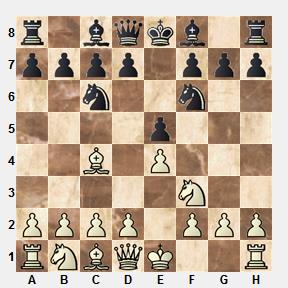
4.Ng5 [The pugilistic way of playing. 4.d3 is more likely to be seen in a 2700 GM encounter] 4..d5 [If this isn't crazy enough for you, then look up the Wilkes-Barre with 4..Bc5] 5.exd5 Na5 [Anthony, as black, opts for long term compensation not tempted into playing 5..Nd4 (Fritz, my favourite) 5..b5 (Ulvestad) 5..Nxd5? which allows the kids favourite Fried Liver Attack, 6.Nxf7] 6.Bb5+ c6 7.dxc6 bxc6

So far the players had made the fans happy with their aggressive chess (though the fans were probably more intent on seeing two chess players beating the crap out of each other!). In this position white's bishop must retreat, and the knight on g5 will also get chased away which will hand an initiative to black fort he sake of a pawn, or maybe 2. The question is, where should the bishop go? The traditional retreat has been to e2, but recently there has been a lot of attention placed on d3. On d3 the bishop looks to impede white's queen side development, but importantly it controls e4 which is where white's knight will drop back to when it gets kicked by h6.
All well and good, but in this chess boxing game, the bishop went a different way! 8.Ba4 I have to admit to knowing hardly anything about this move, once having read somewhere it was bad and never having looked at it again. Time to have a peek now :) Stockfish reckons that after the moves 8..h6 9.Nf3 e4 10.Qe2 black has a big advantage -1.34.

All well and good, oh great silicon monster, but you'd lose a chess boxing bout within the first minute of the first round of fighting! Unbelievably, the 2 chess boxers reached this position, from which Anthony continued to develop his advantage to winning proportions. Unfortunately, Chess Boxing Australia President Rafael Ward was the better boxer, and won the match on points, though I feel he would have had struggle to hang on to the chess game for much longer.
Anyway, here's a great game with a great finish from a time when the Two Knights would have been all the rage, the middle of the 1800's. The black winner of this game is the relatively unknown player Edward Pindar who was nevertheless, very strong. He won the Manchester Chess Club Championship in front of players such as the great problem composers Kipping and Horwitz, the latter being of world class playing strength, having beaten Bird in matches. Anyway, Pindar was born in Russia (no surprise that he was good at chess!) but moved to England where he was a teacher, and very good chess player. Look at the climax to the game!

Black to play and win, see if you can find the best line for black before looking at what happened in the game!
