Showing posts with label microbase. Show all posts

Saturday, August 11, 2018

Game of the Day 7

What makes a game great or important? There are a number of considerations to take into account, but the occasion, the players, the fight and the brilliance of play are all contributing factors. There will also be second hand opinion, by those who witnessed, or have seen and analysed the game. One of my favourite tournaments is Hastings 1895 and I must have looked at most of the games at least once.But a game I never really considered much was the first round game Lasker-Marco. It really isn't a brilliant game, certainly not the best by either player, and not even the best of the round, but it was an historically significant game. It was the first tournament game that Lasker played as World Champion, and as Hastings 1895 was his first International tournament after winning the title, it can be surmised that it wasn't the glorious start he would have hoped for, finishing third behind Pillsbury and Chigorin.

But Lasker isn't the only World Champion who didn't start their tenure with a bang. Euwe could only finish second, behind Reuben Fine at Zandvoort after beating Alekhine, and Botvinnik fared even worse finishing sixth at the super strong 1951 USSR Championship won by Keres. Admittedly, Botvinnik didn't play much after 1948 so would have been rusty, but this must have been a disappointment. In recent times, both Kramnik and Anand could only finish third in their first classical tournaments after winning the title. Then there were Steinitz, Smyslov and Fischer who never played tournaments as World Champions. As far as I can tell, all the other undisputed Classical World Champions started with a tournament win.

In the tournament book of Hastings 1895, the games were annotated by players, though they didn't comment on their own games. The 1st round game of Lasker-Marco was commented by the great German player, Tarrasch who tends towards the critical in his analysis style! Tarrasch was known for his dogmatic opinions on the game, but he was still a brilliant player and a magnificent calculator at the board. His fantastic win against Walbrodt from Hastings 1895 is a great example of his brilliance.

The game has an interesting middle game with black taking hanging pawns from a Queen's Gambit Declined opening. Unfortunately, the game finishes when it is just beginning to get interesting, as Marco made a huge, and somewhat elementary blunder.


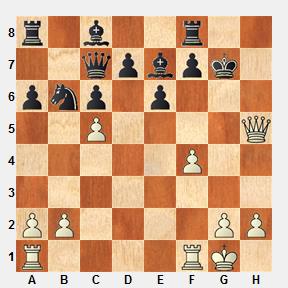
Black here played the shocker 22..Bf6?? allowing 23.Bg4 skewering queen and rook without the possibility of blocking with the f-pawn. The game falls apart quickly after that. Tarrasch's notes to this position are quite interesting and show a lack of regard for dynamics in the position which were not so well understood at the time (strange really, as the idea of gambiting for an attack was still quite prevalent at the time). Tarrasch considers 22..Qb6 as forced, but 22..f6!? keeps the position fluid. It looks as if White wins a pawn by 23.Nxg6 hxg6 24.Qxa5.
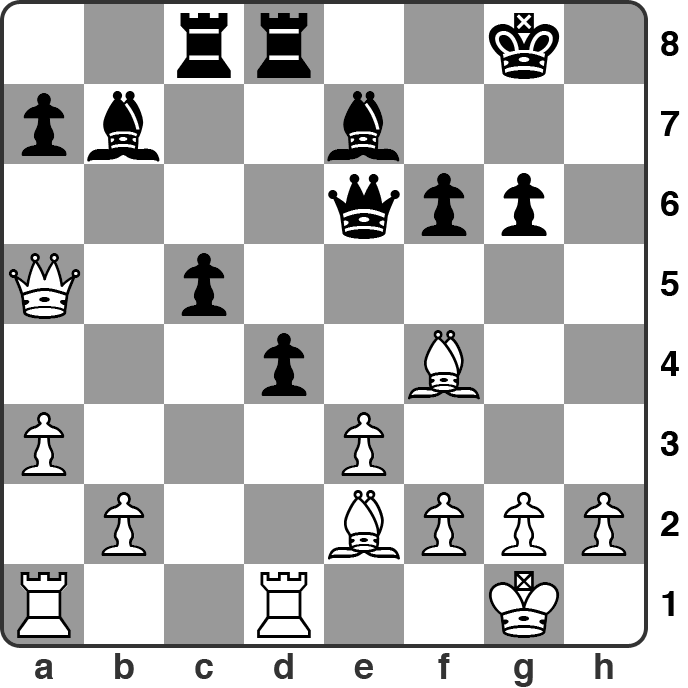

However, the position is highly unbalanced with White's forces dispersed. Black has 24..g5 (a move Tarrasch thought about in an earlier position) 25.Bg3 dxe3 26.Rxd8+ Rxd8 27.Re1 Qd5 28.f3 with an absolutely unclear position.


In fact, this crazy dynamic game would have suited Marco who played a game from the same opening position a couple of years earlier against von Scheve at Dresden 1892 where he took an IQP and managed to create all sorts of complications for himself and his opponent, who finally ran out of steam and blundered the game away. Here's that game, and then the Lasker game with notes by Tarrasch (and the f6 line added). Enjoy!


Loading embedded chess game...

Loading embedded chess game...

Tuesday, August 7, 2018

Workaholic?

Am I a workaholic? It's a question I often ask myself and it relates to the fact that my job and hobby are related. I teach chess (and some other subjects that aren't on the curriculum as well) and I play chess to a reasonable level. In my spare time, I study chess, sometimes to help my game, but often just for fun, or to search for material that will benefit students. In fact, I am sat in a cafe now, working on chess teaching materials while writing this blog post (the coffee is pure hedonism!)

From here, I go to a class where I am trying to teach some chess ideas using the Olympiad as a theme. This will hopefully add to the kids cultural knowledge of the game, and get them excited about an event that they can follow if they like. Finding appropriate material from Olympiads isn't difficult, but making it exciting and flowing from week to week can be challenging. I have been trying to teach my students about central pawn walls, and spheres of influence. Pawns on e4 and f4 suggest White has developed space on the king side, while pawns on c4 and d4, on the queen side. This should determine the nature of play, taking into account that we should attack where we are strongest (obviously, depending on circumstances).


Black has built an impressive centre, but White has a huge lead in development. The game continued 9.Rxh7! Kf7 10.Bxg6+!! Kxg6 11.Nxe5+!! and with White's queen coming to h5, Black is busted. A central pawn wall needs piece support. This game won a special beauty prize from the first chess Olympiad, Palau-Te Kolste London 1927
Loading embedded chess game...

Yates-Naegeli London 1927
Also from the first Olympiad is this position. Here, both sides are fully developed, and White's central wall has piece support. White undoubtedly is strongest on the king side, so that is where he should be thinking of developing an attack. Central pawn walls want to be pushed, and that is what happened here, White engaging the enemy camp. 14.e5 Nd5?! Natural, but wrong. I always think that if the natural move isn't best, then things are difficult. The knight wants to go to the centre, but 14..Ne8 was probably better, defending g7. 15.Nxd5 [15.Nf5! was a strong blow] 15..exd5 16.Nxc6 bxc6 17.Bd4


White's dark squared bishop follows the pawn wall as it advances. When White's pawns eventually disappear, they should clear the way for White's pieces to smash through. It is almost like the line of scrimmage in American Football, or a rugby scrum, trying to barge forward to gain a little space so that the star players are that little bit closer to the goal line. Here, White's bishop eyes g7, threatening exd6 with the double threat of mate and winning a queen. 17..Bf8 defending g7. And now the pawn wall advances again 18.f5!, and it wants to move on again to f6 compromising Black's defence.

Loading embedded chess game...
This game reminds me of one of my favourite games that demonstrates the power of pawn walls.

Loading embedded chess game...
Steinitz never had the chance to play an Olympiad, but this game is just too good not to show on the theme!


A World Champion who did play was Capablanca, and he is Black in this position. Following the theme, Capablanca played 19..f5, building a wall on the side of the board where he is strongest. White definitely has strength on the queen side, which Capablanca rightly ignores. White, no doubt fearing Capablanca's reputation tried to halt Black's king side advance with 20.f4, but this was the wrong plan, and only creates weaknesses on the side of the board where Black is strongest. Capablanca brilliantly refuted this move. Continuing with queen side play, with 20.Rxa8 Rxa8 21.Ra1 was probably best. We should attack where we are strongest!
Loading embedded chess game...
When teaching kids, it is important to repeat messages, hence similar types of feature keep cropping up to help cement ideas in their heads. The theme is developed, and thus knowledge of it becomes fuller. And then there are other aspects to the games, interesting tactics, great attacks, and ideas.

Saturday, July 7, 2018

Game of the Day 5

Different Analysis Styles

One of the things we're taught is that after we play games we should analyse with our opponent, especially if we are playing a higher rated, or more experienced player. When we go through the game we get an insight into the thought processes of our opponent, and the more players we analyse with, the more different thought processes we encounter. It is then down to us to filter the good analysts from the less good, to take the best parts of a player's thoughts and be critical of their weaker ideas.

It is the same when looking through books of games annotated by Grand Masters. Each will have a different style of presentation based on their style of thought. Some have stronger opinions, some are more verbose, some look deeply into calculating variations, some pick only critical positions to examine, some try to uphold their ideas through their analysis, while others will seek definite proof of  the truth in various positions. But whatever the style of thinking that brings a great player to come up with their ideas, it is worth examining.

This is the 5th game that I'm showing and it brings a different analysis style than the previous games

GotD 1 was a game by Lasker analysed by Reinfeld and Fine. The notes aren't too deep, and only a couple of critical positions are examined in any depth.

GotD 2 was another from the same authors, although here we see to a greater extent what a hero Lasker was for, at least one of the authors, Reinfeld.

GotD 3 was from Tartakower's autobiographical games collection. Tartakower is very wordy and likes to bring wit into the analysis, though it can sometimes be cutting.

GotD 4 was a clasic from Rubinstein analysed by Kmoch who like Reinfeld, was writing about a player he somewhat idolised. And like Reinfeld and Fine, the notes to this game are sparse and designed more as general advice for less experienced players than a thorough analysis.

Today's game is from "100 Selected Games" by Botvinnik. Now Botvinnik is perceived as one of the legendary analysts of the game and he believed that publishing analysis gave him a forum to debate his ideas about chess, to put his ideas in a public space for others to criticise, and for him to discuss and defend. Botvinnik's analysis style combines the general ideas style of Reinfeld or Kmoch and adds more analysis of variations with more definite assessments. Sometimes Botvinnik's analysis can seem rather brutal, but he upholds his ideas of logical thinking through to the end. Logically speaking, we can see Botvinnik's analysis style taken to its conclusion through the analysis style of his great pupil, Kasparov. It must have been truly amazing to see these two working together!

100 Selected Games is written in the descriptive notation, like the other other books I've mentioned, but if players could go through these games and analysis, they would get a great deal of wisdom and ideas. The book takes us up to 1946 so Botvinnik's early career and his build up to being the strongest player in the World. I have chosen his game against Tartakower from Nottingham 1936. This was a truly great tournament with a super strong top of the field: Alekhine, Capablanca, Lasker, Euwe, Botvinnik who all held the World title at some point in their life. Bogolyubov and Reshevsky who both competed for the World title also played! Botvinnik's win over Tartakower was awarded the brilliancy prize for this great tournament and shows what a great calculator Botvinnik was, always happy to join in a complicated fight and trusting his fantastic calculation and logical thinking.


This is my favourite bit of the game. Black has just played Ng6. Botvinnik's thinking is clear and execution is deadly. He describes ..Ng6 as "the only way of freeing the king's road to the Queen side without giving up defence of f7. If the king succeeds in slipping away (eg after Qh6 Ke7) Black will have chances of salvation. But how can White prevent the Black king from fleeing?"

See for yourself in this great, and under rated game. Enjoy!

Loading embedded chess game...

Friday, July 6, 2018

Game of the Day 4

I have more than 1 book on Rubinstein, a player I'm fascinated with. Rubinstein learned the game relatively late in life compared to most great players at the age of 16. But already 10 years later he was beginning to establish himself as one the top players in the world. He was strong enough to be considered for a World Championship match against Lasker, but never got the chance to play because of the outbreak of the First World War.

Rubinstein's style was fairly universal, but he tended more toward the safe side of chess. He was a great innovator int he opening, a fantastic attacking player when he had the chance, great with the initiative, and solid in defence, but his true forte was the endgame, and especially rook endgames.

I have 3 books about Rubinstein and others that contain short parts about him. The most basic of the 3 biographies is "100 Selected games" by Hans Kmoch, a master strength contemporary of Rubinstein. The notes in this book are fairly simple to follow, and it provides a great introduction to Rubinstein. Much of this book is available to browse in google books.


The game I have chosen today is Spielmann-Rubinstein St Petersburg 1909. This tournament was a great triumph for Rubinstein who shared equal first with World Champion Lasker, and winning their individual encounter. Rubinstein also played a masterful pawn ending against Cohn in this tournament that everyone should know. Against Spielmann, Rubinstein came back from a bad position to win a rook endgame that seemed impossible to win.


Rubinstein was Black in this game, but if his opponent Rudolf Spielmann, a famed attacking player, could have found the best continuation here, we would have been talking about him rather than Rubinstein. See what you can find, and then check out the full game at the end of the article.

The main brilliance of this game starts from the following position:


White has more pawn islands than Black which makes Black's position preferable, but if White can swap his a and d-pawns for Black's d-pawn, the endgame with 3 vs 2 on the king side is almost certainly drawn. Rubinstein was aware of this and his play was directed against this. Have a look at the game with notes by Kmoch, and I will post a more detailed analysis of this endgame, which is annotated in Kasparov's "My Great Predecessors" volume 1 among others.

Anyway, enjoy the game!

Loading embedded chess game...

Wednesday, July 4, 2018

Game of the Day 3

Time to move away from Lasker, and on to "My Best Games 1905-1954" by Tartakower. Takrtakower, like Alekhine, wrote 2 volumes of best games, and these are both included in this book. I decided to pick a random game, so as I'm 51 years old, I chose game 51 from volume 1, Tartakower-Marshall New York 1924.

Of course, New York 1924 goes down as being one of the greatest tournaments in history. It was a star studded field with Lasker, Capablanca and Alekhine all playing. Marshall finished 4th behind the big 3, while Tartakower struggled and could only finish 8th. In his book, Tartakower entitles every game and he called this one:

Transmission of Weaknesses


The position he had in mind was this one. Black has a weakness on d5, but it isn't easy to direct an attack against it, so Tartakower changes the weakness to c6 which can be attacked easily on the c-file. 13.Nxc6 bxc6 14.Ne5 Bd7 15.Nxd7 Nxd7 16.Bxg7 Kxg7 17.Rc1 and the position has changed significantly.


Black's c-pawn is immobile as it must protect d5, so it becomes a fixed weakness that can be piled up on. Meanwhile, Black has no counterplay so White can be said to have a stable plus. It is not enough to win, but Black is on the defence here. Marshall played 17..Qf6 here which perhaps wasn't best (maybe 17..Qb6 was a better direction to try).


Tartakower played 18.e3 relieving himself of any possibility of losing the e-pawn and a move he would probably need to play anyway if he continues with a slow build up. Tartakower makes no mention of another possibility in this position. 18.e4!? taking advantage of the fact that Black's d-pawn is pinned. After a trade of pawns on d5, a new weakness has been created, an isolated pawn on d5, while White will also have a 2-1 majority on the Queen side. A typical line would continue after 18.e4 Nb6 19.exd5 cxd5 20.a4 Rad8 21.a5 Nc8 when Black is feeling the squeeze.


Tartakower was quite wordy in his analysis, which might appeal to some and not to others. However, this is a theme which occurs in many games, and also a missed opportunity that spoils advantages. It is a skill to play against a weakness, and a bigger skill to transfer the weakness to a more easily attacked point. Here's the full game with Tartakower's analysis which is well worth a read. He rips into Marshall somewhat!

Enjoy!

Loading embedded chess game...

Tuesday, July 3, 2018

Game of the Day 2

I had intended to post games and ideas from many of my chess books showing classic games and using them as talking points. But after posting yesterday's game, Lasker-Lipke Breslau 1899, I couldn't help but notice that the second game in the book is Lasker's amazing double bishop sacrifice against Bauer from Amsterdam 1899, so I will look at this game and go on to another book next (though I'd better not look at the next game in the Lasker book!)

While not quite the originator of this type of sacrifice, Lasker undoubtedly made it famous by this game. If you've never seen this game before, then be warned, it is fantastic. Lasker used Bird's Opening (like Magnus Carlsen did) and set up aggressively as if he wanted to attack from the start. When given the chance, Lasker took it with style!


Black expected White to play 15.Qxh5 when it is simple to shut down the attack with 15..f5. Lasker sped things up with 15.Bxh7+! sacrificing a piece, as he is already a knight down in this position. After 15..Kxh7 16.Qxh5+ Kg8 White has brought his queen into the attacking sphere but lacks support or targets. Another sacrifice helps with that!


Lasker opens up his opponent's position with a second bishop sacrifice, 17.Bxg7!!. With Black's king lacking cover, a White rook lift will be deadly, Rf3-g3/h3. Playing through the game with the comments from Fine and Reinfeld one sees the way that Lasker quickly developed a position from which to attack, and then forcefully followed that attack through. Another important thing to remember from this game is that a sacrificial attack needn't always lead to mate. Here, Lasker used the opening of Bauer's king to win more material than he gave up, eventually ending up with a queen and 2 pawns for a rook and bishop. Of course his position was also dominating.

Enjoy this game :)

Loading embedded chess game...

Monday, July 2, 2018

Game of the Day 1

In my last post, I said that it was a good idea to look at classic annotated games where a lot of skills can be learned. I also said I would try to put up a game from my collection each day, so here we go.

Day 1:


The earliest player I have a set of games for is the second World Champion, Emanuel Lasker. I have "Lasker's Greatest Chess Games: 1889-1914" by Reinfeld and Fine, a book in the old descriptive notation which I am old enough to remember and have used! You don't have to go very far in the book to find beautiful ideas. In fact the first game, Lasker-Lipke Breslau 1899, has an excellent winning point to it


Lasker, as White, is a piece up, but Black threatens mate on h1. White can't play play Kh2, or it's a perpetual. But Lasker came out with 1.Bxf5+! giving back the piece with check. 1..Qxf5+ 2.Qg4!! an amazing retreat, giving up his active queen and a pawn to reach a winning endgame. This transition from aggressive middlegame, to winning endgame is something that we all need to understand. In fact, transitions are a hugely important aspects of the game that aren't really discussed much in books.


Earlier in the game Lasker showed his understanding for transitions. In the above position most of us would throw the c-pawn up to c4 holding on to the d5 pawn, but Lasker wants to play d4 to take control of the centre, and gain some extra space. So White played 10.Bg5! pinning at least one of the knights, and thus defending d5. While Black was untangling, White played d4 and took some space for his bishops.

Anyway, here's the game, in an algebraic form, with the notes of Reinfeld and Fine.

Enjoy :)

Loading embedded chess game...

Saturday, June 30, 2018

Box Hill Chess Club Championship

The final round of the Box Hill Chess Club Championship was played last night, and it was a very close affair. The event was split into two divisions. There was a 10 player round robin championship event, and a Swiss open reserves event. The winner of the reserves qualifies to play in the following years championship.

I was playing in the Championship and was low on confidence and will power at the start of the tournament, but seemed to have played myself back into some sort of form by the end, so I was happy to compete. The Championship was very close with only 1 point separating the top 7 players. There was a 3-way tie for first place between IM Leonid Sandler and FM's Domogoj Dragicevic and Luis Chan on 6/9. I finished half a point behind along with John Nemeth, while a further half point back were FM Eugene Schon and Kris Chan. Nobody went through the event unbeaten and all players showed both the strengths and frailties of the 2000-2300 band of players, and having to play late on a Friday night after a week's work.

I'm not sure what will happen with a 3-way tie. I don't know if the Championship is shared, if a tie break system is used, or if there is a playoff. There was no tie in the Reserves, with Brendan Zou winning another competitive event. Brendan went through the tournament unbeaten, taking 2 draws, and a half point bye in the middle of the event. Brendan has made big improvement in the past 2 years, and is now a 2000+ strength player, so he should be a good addition to the Championship field next year.

I didn't get to see too much of the other games as I was putting a lot of effort into my own. So I'll show my best and worst moments from the tournament!


This was my endgame as White against FM Domaogoj Dragicevic. I had played for this sort of position thinking (correctly), that my outside a-pawn must guarantee me a winning advantage. What I had failed to consider in the immediate lead up to this position was that there is still a lot of play in this position, and I'd missed a couple of chances to make my win a lot easier in the previous few moves, which must have given Dom some hope. Here as White, there is only 1 winning move, and after some thought I was bale to find it! This was my best moment of the tournament, and I'll give the game at the end of the article.

Now for my worst! I had been playing a tough game against FM Doug Hamilton who had thrown a lot in my direction and I'd managed to find a way to equality, but nothing more, and perhaps I was the one who was fighting to hold the position.


I saw the continuation 1.Ke3 Bd6 2.Nb4 as a fairly natural way the game would go with neither side really able to make much progress. I hesitated and looked again, and again, convincing myself that my knight would go to b4 after he played Bd6, and I hesitated again, thinking through the same thing, and then picked up my knight and put it on b4!! 1.Nb4?? Doug took my f-pawn, then my g-pawn and I then should have resigned straight away, but I played on for a few moves more out of shock than anything else.

Anyway, besides the errors, I enjoyed the tournament Box Hill's venue is absolutely fantastic. Congratulations to all the winners, the arbiters, IA Peter Tsai and Kyle Gibson, and to Box Hill Chess Club for making this a great event to play in.


Loading embedded chess game...

Friday, June 29, 2018

re Winning Moves

My last blog post was about the following position:


What is the best move for White? Well, if you saw that 1.Rxh6+ skewers Black's king and rook, and even better, forces Black to play 1..Ke5 which then pins the other rook, then good for you, you chose the same move as legendary Hungarian GM Lajos Portisch, and his opponent promptly resigned.

However, if you looked at other choices, you may have found that 1.Qd8 forces mate in a few moves. 1..Ke5 2.Re8+ with the nicest line probably 2..Kf4 3.Qxd2+ Qxd2 4.Re4#

Which is better? I guess the computers and purists would demand 1.Qd8+, but practically, 1.Rxh6+ wins easily, so it can't be considered bad.
Loading embedded chess game...

Monday, June 25, 2018

Victorian Chess Championship 2018 Round 2

The second round of the Victorian Championship was played yesterday and showed how tight this event will be as half the games played finished in draws. There are now only 2 players on 2/2, FM Luis Chan and myself.

When I say half the games played, there were a couple of postponed games, and 3 players took a half point bye this round. In the first round 5 players took a half point bye and the question has arisen as to whether we should allow byes in a Championship event. In the previous format, when the tournament was a round robin, there were no byes, but players could rearrange games as the draw was all prearranged. Now with the Swiss system in place, the pairings only come out a few days before the round so it is more difficult to rearrange with a specific opponent. But saying that, the round dates and times are known and so players should have some idea of whether they'll be able to play games or not.

My personal feeling is that the tournament would be better off as a round robin without byes, even if that meant I didn't qualify to play. However, as a Swiss event I don't see a problem with players being allowed to take byes, and I know the move to the Swiss format was partly due to Chess Victoria's funding of the event. There used to be 2 or more round robins running as Championship, Reserves etc, but it became harder to find players to enter these events as the Victorian chess calendar became more packed with club and weekend tournaments. These round robin tournaments were excellent. I played in both Championship and Reserves sections, which were competitive and great for learning about preparation and working on your chess in general.

In the second round, 8 games were played yesterday though I didn't get to see too much as I was grovelling as Black against Milenko Lojanica and having to work hard to cause him some problems. This paid off as Milenko failed to take advantage of promising positions, and the game finally equalised, and then I was able to take an initiative which my opponent seemed oblivious to. Instead of going in to deep defence he continued to try to play actively and his position fell apart.

Even though I was hard at work at the board for most of my game, I am still able to see a lot of games after the round because Box Hill Chess Club have now got 6 DGT boards displaying live games. I remember getting up after about 20 minutes and having a brief look at the openings of the games, then again about about 45 later. But the next time I got up to stretch, some games were already finished! FM Luis Chan won to go to 2/2, but it was a tough game against David Beaumont, with an interesting ending of rook and 4 vs rook and 3 which would be worth looking at in some detail.

There is a large bunching of players just behind first, led by top seed FM Domogoj Dragicevic who won comfortably. The game that most interested me from an early stage was Canfell-Dissanayake which started as Caro but soon turned into a crazy opposite side castling position. Black's king looked ominously placed at times, but he held on and in the end Greg Canfell had to take a repetition draw.

Loading embedded chess game...
It is early days in the tournament and a 3 week break before the next round means that the event will really only start properly from round 3, when the games will be played each week, and most of the players will be playing rather than taking byes.

Friday, January 19, 2018

Pawn Endgames 2

Yesterday, I introduced a pawn endgame between Csom-Suttles Indonesia 1982.


White had played for this position and must have thought the position was better or winning for him. For example, how will Black defend the king side pawns? 1..Ke5 is met by the opposition move 2.Ke3 and Black's king will have to give way as White has extra tempo moves with pawns. The only Black pawn that can move safely is the a-pawn, and that is, in fact, the move Suttles played, 1..a5. However, this doesn't solve Black's problem as after White advances their king 2.Kf3 Black has to prevent it coming to f4, 2..Ke5 and now 3.Ke3 gives white an opposition.


It is easy to see from this diagram that Black's king will be forced to move back. The only waiting move is 3..a4 but then the ball bounces back into Black's court after 4.a3 when Black will have to let white's king into f4. And even though Black can oppose the White king when it gets to f4, by moving to f6, White has spare tempo moves with the h-pawn. 4..Ke6 5.Kf4 Kf6


Now it really is clear to see that White will move their h-pawn and Black's king will have to move giving White's king a way forward. This is exactly what happened in the game, and White won this endgame.

So let's return to the original position:


the lines that I previously considered aren't too difficult to work out with just a basic understanding of pawn endings. So the only other measure is to counter attack. Black should look to run to the queen side with his king and try to promote simultaneously with White. So we come to the stage where we must count how many moves it will take to promote. Black has c6-b6-a5-b4-xc4-d3 and 4 pawn moves on 10 moves. White has f3-f4-xf5-h3-g4 (a trade on g4) then 4 moves with the pawn which equals 9 moves. As Black moves first that means that White will promote and then Black promotes straight after. 1..Kc6 2.Kf3 Kb6 3.Kf4 Ka5 4.Kxf5 Kb5 5.h3 Kxc4 6.g4 hxg4 7.hxg4


Now Black moves the king and both sides will promote simultaneously.However, where black moves their king is important. It might look as if b4 is a good square for black's king aiming at White's a-pawn as well as clearing the way for Black's c-pawn. But then White's king will be able to come back and defend.

7..Kb4 8.g5 c4 9.Ke4! and now if Black advances the c-pawn, White will simply move their king to d3 and that will be the end of promotion.


Black will have to advance his king to c3 which loses valuable time in the pawn race and White will promote a full move ahead of Black.


The correct move here is Kd3 (d4) shepherding the pawn through and promoting at the same time as White securing a draw.

Hopefully some of these variations will help you think about some key ideas in pawn endgames:

- should I trade into a pawn endgame?
- who has spare tempo moves?
- can either side win a crucial opposition?
- are there counter attacking ideas?
- counting accurately the moves to promotion is a good calculation skill.

Like I said, thse players are not world beaters, and the ending wasn't one of the greatest, but I found it interesting nevertheless.


Loading embedded chess game...

Monday, August 12, 2013

Hennig Schara Time Again

I'm not sure whether I'm more excited by seeing the Petroff or Caro Kann getting smashed, or by the Hennig Schara or Evans Gambits being used successfully. I must say that I found the first round of the current World Cup a bit tedious. I started watching, but it held the same sort of fascination as watching the first week of a Grand Slam Tennis tournament. You are hoping for some big upsets, but at the same time you want the top players to go through so there are some great battles towards the end of the event. While I'll look at the matches, and the games and follow the event closely, I don't think I'll be getting into it in a big way until some players have been whittles away and there are maybe 16 left. Trying to find the excitement in 64 games is a bit like finding a needle in a haystack. Still, the results showed a couple of good upsets, so some players will have to come out fighting tonight to take the games into tiebreaks, especially Morozevich and Judit Polgar who both lost in game 1.

In the latest issue of TWIC, there was a game in the Hennig Schara which was quite remarkable. It was played between 2 lower rated players (2100-1900 ish) but it still showed some interesting points. First, the positions are so random that it only takes a smallish error for one side or the other to go wrong. This is a great way for a lower rated player to unsettle a higher rated opponent, which is what happened in this game. Second, Black fights aggressively for the initiative and is often attacking which is much the easier position to be in below master level.

Here's a couple of highlights from this game:

White just played 10.Qa4 and he must have had a bit of a surprise when his opponent played 10..Bc5!?. Of course, taking on g4 is bad 11.Qxg4 Qxf2+ followed by regaining the piece on f1.

Black had castled long into a dangerous looking situation, but white's king doesn't look too hot either. White decided on 17.Bb5? seeing black's knight has nowhere to go! Black launched the knight into the fray with 17..Nd4!! utilising the pin on the e-file. After 18.Ba4 Black won an exchange with 18..Nxf3+ 19.gxf3 Bd4! utilising the same pin to unleash this nice skewer.
What a great position with black's dark squared bishop being the star of the show! Black maintained his material advantage until the following position was reached.
Continuing in his inspired form, black finished the game with the excellent 27..Rxe3+!! completely smashing away white's defences. 28.fxe3 Qxe3+ 29.Kf1 Qxf3+ 30.Kg1 Qe3+ 31.Kf1 Rc1+ 32.Kg2
There are many ways to win this, like taking the queen 32..Rxa1, or checking with 32..Qe4+, but the quickest is the one black played, 32..Rc2+! and black resigned as it's mate next move.


A great game, and a great advertisement for the Hennig Schara. White played a move that theory regards poorly in the opening, 7.Nxd5?!, instead of the more usual 7.Qxd5. This was a move introduced into practice by ex World Champion Euwe in 1920. To be honest, it gives black an easy game after 7..Nf6, as black will always be ahead in development. In fact, after 7..Nf6 white scores a miserable 36% from 15 games in Big Database 2013. An exchange on f6 usually follows with 8.Nxf6+ Qxf6 when white normally avoids a check on b4 by playing 9.a3, but as we saw in the main game, black has all the play. One of my favourite players who regularly played the Hennig Schara is Pavel Cech and there is a game of his where 9.e4?! was played. There followed 9..Bb4+ 10.Bd2
Here black played a move we know from the previous game. 10..Bg4!! It really is a great opening where moves like this can be played!

Once again, I urge players to take a few risks, find some interesting openings that will scare those higher rated players, and mix it up. If you lose, well it would probably have also happened if you played safe. But there's always that chance that your strong opponent will lose the thread, or miss a trick and that could very well be game over!


Friday, July 19, 2013

Hennig Schara Gambit

Everyone has favourite systems, and we all try to defend openings that get a bashing. Even some pretty decent openings come in for a bashing every now and again. Take the King's Indian Defence, or the Sicilian Dragon. Then again, if you're going to play a fighting opening, then you will also have to fight to defend your opening's reputation.

The system that I have a soft spot for is the Hennig Schara Gambit. When I was a young player, Kasparov was not yet World Champion and was playing the Tarrasch Variation of the Queen's Gambit (among other fighting systems). It was back then in the mid 80's that I first really became aware of the Tarrasch and the amazing piece play that black can generate at the expense of pawn weaknesses. Certainly at club level a player who is good with active pieces should consider openings such as the Tarrasch which offer excellent play for the expense of a pawn.

Black immediately challenges the centre, and after 4.cxd5 exd5 we will have a position where white can give black an isolated queen's pawn. In fact, positions with an isolated queen's pawn for black were those championed by Kasparov on his way to the World Championship in 1984. He successfully used the defence against Beliavsky, Korchnoi and Smyslov, and even used it against Karpov in their first match in 1984. Here is (essentially) the deciding game in the 1983 Candidates Final. It left Kasparov 8-4 ahead against Smyslov, needing only a draw to progress which he duly scored in the next game.


It wasn't until the 1990's that I became aware of an interesting sideline of the Tarrasch, the Hennig Schara Gambit. Instead of accepting an isolated queen's pawn, black sacrifices a pawn again for great piece play. I didn't really take it too seriously at first as I can't really say I am that inspired by gambit openings generally. I'm more the sort of player who grabs poisoned pawns and tries to hold on to them! However, I was fully converted by 2 articles written by Irish correspondence GM Tim Harding. Harding has been writing a monthly column at chesscafe.com since the mid 1990's and many of his early columns were about odd openings that tend to crop up more often in correspondence play that over the board. His articles on the Hennig Schara (no 1, and no 2)were beautifully written and were good enough to make me believe in the opening. I've used it on a number of occasions, and have every intention of trying it out some more. As pawn sacrifices go, it is very enterprising, and there is no easy way for white to get anything out of the opening. The mainline goes 1.d4 d5 2.c4 e6 3.Nc3 c5 4.cxd5 cxd4!? [The Gambit] 5.Qxd4 Nc6 [While white's queen grabs a central pawn, black is able to develop quickly and aggressively] 6.Qd1 exd5 7.Qxd5 [Now white will be a pawn up out of the opening, but with the centre wide open it's anybodys game] 7..Bd7 [Black can play a pawn down in a queenless position as well which is also interesting. 7..Be6!?] 8.Nf3 Nf6 9.Qd1
So here's the main tabiya. After 9..Bc5 black has excellent minor piece deployment, and to add a further random feature to the game, black most often castles queen side to whites king side castling. My own favourite game, a win against ex Australian Champion Doug Hamilton was in this opening, but rather than singing my own praises, take a look at this recent game where a 2600ish GM gets smashed by a 2300ish player. Enjoy :D

Saturday, June 29, 2013

Chess Endgame Camp

This week I will be heading off to Phillip Island along with a group of coaches and about 30 talented chess kids. The idea is to run a chess camp, and this year we have dedicated the endgame as the subject of the main body of lessons. Of course, there will be lots of games and activities, and it is a great chance for the kids to get to know each other better, as well as perhaps to meet some great coaches who they haven't met before. Foremost of the coaches going is IM Robert Jamieson and the kids should get a huge amount from his experience, especially as Robert enjoys nothing better than quiet positions and endgames.

As coaches we have been given certain areas to work on, and lecture topics cover. Personally I'll be giving 4 lectures on the following broad subjects:

- Rook Endgames
- Winning a won position
- Minor Piece endgames
- Pawn Endgames

While compiling material for the camp, there will probably be some material left over, so I'll be showing some endgames here that I've seen but decided to hold back. For example, what inspired me to come up with the subject 'winning a won position' was the following game I saw not long ago.

Now time could have been a factor, as it often is in the endgame, but when analysing a game we are free of the time constraint and must find the best move or plan. There may also have been a case of the player with black thinking that the game will win itself. This example goes to show that nothing could be further than the truth, and the phrase "the hardest thing is to win a won game" springs immediately to mind.

So how could you improve black's play and win this "won position"?

Thursday, April 11, 2013

Amazing Move

Yesterday I posted this position:

It is an analysis position from a game I was looking at. It is black to move who has both knights currently attacked. Amazingly, he can throw one even further into danger by 1..Nc3!! The resulting positions are difficult to follow and would be a nightmare to work out over the board in a game. Here's some analysis which I would love people to add to, improve upon, or disagree with :)


Tuesday, April 9, 2013

Lethargy

I have had a strange week. I have felt lethargic which has no doubt been somewhat to do with the horrific car accident that involved friends of mine. This is probably why I haven't posted for a week. I just haven't felt like saying anything. Thankfully for the survivors of the crash it appears that they are all on the mend. It will probably be a long, and at times painful, process to full recovery but that process seems to have begun with some success.

This week saw the penultimate round of the Melbourne Chess Club Championship. Guy West was leading the event and he won his game this week against Domagoj Dragicevic. This puts Guy a point clear of his nearest rival, Laurent Michaille who had a good win against Chris Wallis. The game between Justin Tan and Ari Dale has been postponed probably because both players were in the Sydney International Open. The result of this game will be crucial for the final results. If Justin wins, then he will join Laurent a point behind Guy, while if Ari wins, he will be just a half point behind Guy. This group of players will form the top places of the event.

However, in my opinion the "oomph" seems to have been knocked out of the event by the tragic events of last week. The MCC may be attempting to get back to normal, but it may take a while before things are truly functioning as they should. Besides the Tan-Dale game, there were 3 other postponements, there were 2 games won on forfeit, and 3 players who took 0 point byes. I can't say I blame any of these players for not wanting to play, whatever their reasons. I certainly haven't felt like doing very much the past week.

I would like to say well done to Anthony Hain for playing this week. Anthony was involved in the car accident last week and still managed to play his game in the club championship. This fighting spirit is typical of the young men who survived the accident which reinforces my belief that they will eventually come through this. The final round of the tournament will take place next Monday when we will see if anyone can stop Guy West winning another title (is this going to be his 12th?).

While I haven't felt like doing much, I've had to start work this week running a holiday program. We give lessons at these programs and the theme has been about sacrificial attacks. So I've shown a few queen sac's, a few crazy gambits, and the Evergreen Game between Anderssen and Dufresne, one of my favourites. If you have never seen it, then you really should, the final attack against the king in the centre is fantastic, especially seeing white is facing mate in one himself.


I notice that the MCC is offering a brilliancy prize for a game played in an MCC event in 2013. I wonder how brilliant it will be compared to this classic!

Thursday, April 4, 2013

Chess again...

After the shock of the past few days, I'm bringing this blog back to it's chess and coffee content. I'm still a little dazed as I'm sure most of the Melbourne chess community are, and so this blog might not move too fast for a while yet. Hopefully you'll understand and be patient with me.

I did leave some tactics and endgames on Monday and never got back with the answers. Well, the endgames are going to be serialized here, but I can look at the tactics now.

It was white to play and win here. Ukrainian GM Gennadi Kuzmin played 22.Nxd6! pinning his own knight and after 22..Ne8 he unpinned with the amazing 23.Nxf7!! leaving the following position
The point is that 23..Rxd4 loses to the double check 24.Nh6+ Kh8 25.Rxf8# Ftacnik tried to close the f-file with 23..Bf6 but resigned after 24.Ne5+!! when the bishop on f6 becomes pinned so after 24..Kh8 white can take the exchange 25.Nxd7 as 25..Bxd4 loses immediately to 26.Rxf8#

The other position led to a classic tactical shot.

Kuzmin-Sveshnikov USSR ch 1973 it is white to play and win. Kuzmin came out with the double bishop sacrifice 17.Bxh7+!! Kxh7 18.Qh5+ Kg8 19.Bxg7!! [threatening 20.Qh8#] 19..Kxg7
White has sacrificed both bishops to destroy black's king cover. After 20.Qg4+ Kh7 21.Rf3 black resigned as he will have to give up his queen to avoid immediate mate.

This is, of course, an excellent tactic to bring off in a tournament game, but Kuzmin would have been fully aware of the double bishop sacrifice, as should all chess players. The famous Lasker-Bauer game is the classic early version of this great attack:

Here's the famous position after black's 14th move, and it is probably easy to spot what the second World Champion did as white in this position now that you already know the theme. Here's the game:


Friday, March 29, 2013

It's a Good Friday for Chess

Well, it all happened yesterday and no mistake. The London Candidates which has already surpassed my expectations for excitement brought up some new drama. Having gone to bed before the action started, I awoke this morning to a draw for Carlsen, a loss for Aronian and a win for Kramnik. These 3 players are really bringing this event alive and one of them must surely be the winner. Carlsen retains his half point lead, but now it is ex-World Champion Kramnik in second. He has leapfrogged over Aronian who is a further half point back with just 3 rounds to go. As I said in the last post, Carlsen holds his destiny in his own hands, especially as he has white in 2 of his 3 remaining games. If Carlsen can avoid losing, then it is hard to see anyone overtaking him. And a lot will depend on the momentous clash between Aronian and Kramnik later today. It will definitely be a battle of nerves in the final 3 rounds, and alas for my tipping, it looks as if Aronian's nervous energy is shot away. After over pressing against Boris Gelfand a couple of days ago, he self destructed against Peter Svidler by throwing his g and b-pawn's 2 squares down the board on consecutive moves creating serious weaknesses which were easily exploited by Svidler.

But the game that interested me most was the Grischuk-Carlsen clash. This is mainly because Grischuk chose a line of the Grunfeld that I had a look at a while back, the Zaitsev variation. It's a funny system that gets right into black's face, which, to be honest, is what black attempts to do to white when playing the Grunfeld.

The move 5.h4 (or 4.h4 without the moves 4.Nf3 Bg7) is the very aggressive idea of Alexander Zaitsev, and it appeals to the likes of me (coffeehouse hacker) because of the simplistic concept behind the move. Essentially, white is getting ready to directly attack black's king side. Typical themes involve sacrificing the c-pawn, shuffling the king to f1 or g1 for safety, trying to dominate the dark squares on the king side but playing across the entire board. It is a nightmarishly difficult system to play, but fun nevertheless. To add to the appeal, the present favourite of top GM's amongst coffeehouse hackers such as myself, Alexander Morozevich, played this system twice in Beijing towards the end of last year against Anish Giri (the blitz game is especially fun!).


On the domestic front, Doeberl started with a bang. Yesterday, the first round went pretty much according to plan, but the second round was a carnage as the seeds fell one after another: 2680ish Loek van Wely came a cropper to 2400ish Stephen Solomon; Luke Li Zuhao defeated GM Adam Horvath, Justin Tan defeated GM Attila Czebe, and IM Moulton Ly was beaten by FM Domagoj Dragicevic. Not only that, but GM Varga, GM Laxman, IM Palit Somak and IM Brown were held to draws by Tingtie Lei, FM Dusan Stojic, Anton Smirnov and John Nemeth respectively.

There were further upsets on the lower boards as well. Today the Premier sees another 2 rounds after which we should have some idea of the lie of the land. And also the 'Major' (under 2000) and 'Minor" (under 1600) tournaments start giving an even more local flavour to the Easter chess festival.

Sunday, March 10, 2013

Ballarat Day 2

If you've never played a tournament where you have to play 3 games of 90 + 30 in one day, then you're one of the lucky ones! It is a question of stamina, and there are some very shaky looking players by the end of the evening, as the games start at 9.30am in the morning and can finish up to midnight (or even after as I believe one did last year). The conditions in the playing area are also not ideal with little or no aircon, so I'm guessing there will be quite a few headaches literally later on this evening.

So as the tournament reaches the half way point, most of the elite players are still around the top of the pairings, though they are now coming into contact. Of course, it is no surprise to see Solomon, Morris and McClymont among the players on 3/3, and it may be that these are the players to beat in the event. However, every tournament needs a hero, and we have a couple who have worked their way into the top pairings. The surprise pairings on the top boards is on board 6 where Luis Chan (1189) is playing Marko Grabovac (1390). Both these young players have created a number of upsets already and it great experience for them to be in and among the greats of the tournament.

The other hero of the tournament of the event so far is MCC stalwart Angelo Tsagarakis. So far Angelo rated 1749 (somewhat below what it has been in the past, and should be) has taken out Bill Kerr (2040), Doug Hamilton (2017), and in the last round Justin Tan (2298). Apparently, Angelo's last game was a real beauty, and it's great to see a regular club type player playing so great and being so happy.

There was a bit of dissension over the pairings for the fourth round, but they have been unchanged. David Hacche's second round complaint was apparently correct and a redraw was made. Unfortunately for him, he moved as black against Solomon to white against McClymont and got severely bashed. I couldn't help reminding David that Stephen Solomon lost in round 2 last year with the white pieces....hmm, I wonder who that was against :D

Funnily enough, the Hacche-McClymont game had a position unlike any I'd ever seen before. At one point all their pieces which have doubles (ie rooks, knights, and bishops) were situated next to each other. Quite a nice effect on the board!

Pieces sitting beside their doppelgangers


It was good to see spectators IM Guy West and Jean Watson. The heat of the playing hall must have deterred them as they went off to see the Begonia Festival. It's funny that Ballarat has this great festival over this weekend annually, but the chess players never get to see it. The playing schedule is just too demanding. Guy was happy not to be playing, though he intends to turn up for the big 50th bash in a couple of years time. It was clear that Guy was fairly happy to see Angelo doing so well. When asked about the acceleration, he said he wasn't a fan but could see the logic to it. Jean thinks that Brodie McClymont will be the man to beat (or Mr McBrodie as I've heard him called!).

There's no doubt that the arbiters have a difficult time with the pairings here. FA Jamie Kenmure has said that he isn't a fan of accelerated pairings, and that part of the trouble has been to do with the pairings instructions from FIDE which aren't necessarily clear. When asked about the fourth round pairings which saw a big clash between Morris-Dragicevic while high rated Stojic was floated down this was what Jamie said:

Jamie was able to answer questions quite easily. Angelo Tsagarakis couldn't float down as he already had in round 2 which meant Dusan was the lowest rated player in the white group. So why was Luke above Domagoj when his rating is much lower? Because the ratings displayed on tornelo are not the correct ratings and Luke Li actually has a rating above Dragicevic. Both arbiters, Gary Bekker and Jamie Kenmure were disappointed that they couldn't get the SP master file from the ACF as that would have made their lives easier.

IA Gary Bekker to the left of FA Jamie Kenmure

Saturday, March 9, 2013

More on Ballarat

A couple of nice moments from the first round. I was looking into the top board "pit" area when Domagoj Dragicevic found a nice tactic to trap his opponent's sidelined knight.

Domagoj now played the odd looking 23..Qg4. However, when you actually think about it, it traps black's knight. Black can't take because that terrible looking isolated h-pawn will become a star and trapped black's knight. Balck tried 24.Qxa2, but the intermediate 24..Ne7+ removes the knight from danger and gains a tempo to win the knight on h5.

While I was looking at this, IM James Morris pulled me aside and asked me if MCC member Anthony Hain was just winning with a central capture. I have to admit, I wasn't looking at the game, but when I went back to the board, it seems James might have had a point:

Here Anthony played 17.a3 to open lines on the queen side for an attack. James suggested 17.Nfxd4 the move favoured by Stockfish! the point is 17..exd4 is impossible as 18.Bf4 wins material.

The top games from Ballarat are being published on Tornelo and I'll add a couple of good wins by MCC members David Beaumont and Angelo Tsegarakis.