Saturday, March 9, 2013

More on Ballarat

A couple of nice moments from the first round. I was looking into the top board "pit" area when Domagoj Dragicevic found a nice tactic to trap his opponent's sidelined knight.

Domagoj now played the odd looking 23..Qg4. However, when you actually think about it, it traps black's knight. Black can't take because that terrible looking isolated h-pawn will become a star and trapped black's knight. Balck tried 24.Qxa2, but the intermediate 24..Ne7+ removes the knight from danger and gains a tempo to win the knight on h5.

While I was looking at this, IM James Morris pulled me aside and asked me if MCC member Anthony Hain was just winning with a central capture. I have to admit, I wasn't looking at the game, but when I went back to the board, it seems James might have had a point:

Here Anthony played 17.a3 to open lines on the queen side for an attack. James suggested 17.Nfxd4 the move favoured by Stockfish! the point is 17..exd4 is impossible as 18.Bf4 wins material.

The top games from Ballarat are being published on Tornelo and I'll add a couple of good wins by MCC members David Beaumont and Angelo Tsegarakis.


Ballarat

It's the Labour Day Long Weekend in Victoria which ironically means a day off for everyone! Chess players in Victoria know this weekend to be the time of the year when the Ballarat Weekender occurs. Ballarat is traditionally the strongest weekend event in Victoria and the biggest. This year 125 players are competing including 2 IM's, Stephen Solomon and James Morris.

Young Victorian IM James Morris

Top seed IM Stephen Solomon
The tournament is in it's 47th edition (only 3 years to the big 50!) and Ballarat continues to attract top class fields. Though last year may have been the strongest of all, this year's field comprises 2 IM's, 5 FM's and 21 players above 2000. The event has again been accelerated which is not necessary in my opinion but as I'm not playing I'm not going to complain too loudly. I will complain about the drive to Ballarat which took me for ever as there were big traffic jams due to careless driving crashing into each other on a very hot day. So I arrived just as the opening ceremony was taking place. In fact I walked in the door and the first thing I knew was Thai Ly shouting my name out.. So much for a quiet entry! In fact I was selected for an appeals committee, which hopefully won't mean me doing too much!

The opening ceremony saw IA Gary Bekker welcoming the players and setting out the rules. Ballarat Chess Club, the organisers of the event was represented by Patrick Cook who then went on to cause one of the biggest upsets of the round drawing with ex-Australian Champion FM Doug Hamilton. The other speaker was President of Chess Victoria IM Leonid Sandler who like me is a non player.

IM Leonid Sandler, CV President
The first round went without too many upsets. The main upset has been about use of accelerated pairings, and before round 2, there was already an official complaint from FM David Hacche who was black in round 1 and then was paired as black against top seed Stephen Solomon in round 2. It has to be said that 2 blacks in a row feels harsh, especially when you get paired up on board 1. The arbiters are with him at this moment. One person with no complaints was James Morris. Before the first round I asked him what colour he would prefer in the first round. With no hesitation he replied black! To his reasoning it should give him white in his first big round against a very strong opponent in round 5, assuming he wins all his games up to then....also he said he prefers playing with black!

I'll be posting a lot more over the weekend, including some positions from the games. The top 10 boards are being published by the organisers on the tornelo website.

Thursday, March 7, 2013

Chess on a Thursday

Time to catch up on what I've been looking at recently. I'm still lapping up anything to do with the upcoming Candidates tournament and it looks like Chessbase is running some regular columns profiling the players in the build up to the start of the event next week. By the way, is Chessbase's new look better than the old one? That's not a rhetorical question, I am personally not sure which one I prefer and wonder how others feel.

The first moment of Candidate excitement came when the pairings for the tournament were announced. The first I saw of it was on twitter from the Chessvibes website. The more I think about this tournament, the more trouble I'm having picking a winner and much will do with the form of the players. Of course, it would be easy to just say Carlsen is in a class of his own, but I'm not so sure. So rather than claiming that I'm hoping one player or another wins, I'll just say, may the best man win and I hope the tournament lives up to the billing of the highest rated tournament in history. Somehow last time's candidates finalists, Gelfand and Grischuk are complete outsiders which seems pretty unfair to me. Dennis Monokroussos agrees and points to an interview with Alexander Grischuk.

In the meantime I've been watching some games from the Women's World Teams Championship. There are some high profile names missing from the event, but it's still pretty strong with Russia and China the favourites to take gold. In fact, it is difficult to split these 2 teams who have won all their games so far except the match between the two which ended in a draw. I was watching a fascinating game a couple of nights back which unfortunately ended with a horrible blunder. The round 2 game Dzaganidze-Ju Wenjun started out life as a Staunton Gambit in the Dutch, a line that was played a long time ago by Jacques Mieses (he even managed to win a game against Rubinstein with black). White was doing good until the following position was reached:
Dzaganidze, rated 2554 played the unbelievably shocking 39.Kxe5 losing an exchange to the simple to spot 39..Bf6+. White played on for a few moves before resigning. There is hope for us all!


I've also checked out some other interesting chess sites this week. Trowbridge Chess Club in the West of England were voted the English small club of the year lat year. Their blog is an excellent combination of local chess news and regional reporting which is what all clubs should be striving for. I also went to the USCF for the first time, and was mildly impressed. The blog section has some interesting articles and I'm kind of surprised that it doesn't show up higher on google searches for chess blogs. Jennifer Shahade is the editor of online blog, but there are numerous contributors. Actually, I think this is a really good idea. It gives a website more diversity and differing opinions. In fact, if anyone wants to regularly write for this blog, then feel free to contact me on carl.coffehousechess@gmail.com. I'm happy for anyone who wants to regularly write about chess or coffee or preferably both!

Tuesday, March 5, 2013

Why You Should Study Elementary Endgames

I have had a strange sort of day. Summed up, I worked as normal going from school to school teaching chess, until I ended up at an after school class where the classroom that is usually used for chess was unavailable due to parent teacher interviews. So I was directed to another room which was much smaller and with no air con. After an hour in the stifling room I thought I was going to pass out, and was very grateful to get out. I then went to some private group classes at our chess shop and found that I only had to give one class, as my second, more advanced class was being taken by our premier coach IM Robert Jamieson. If you haven't seen Robert in action then you should really check it out. He is consistent, rigorous and has great material both new and old. His lessons challenge students to think, to plan and to produce results in an accurate way. Before leaving I saw the first position he was challenging the kids with and said, "Hey, that's the position I was going to put on my blog tonight!", to which he replied "I thought so".

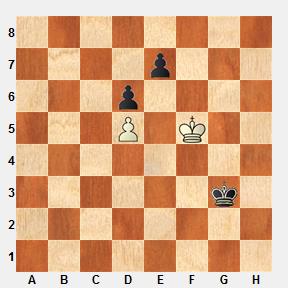
This position was the culmination of the board 1 game in last night's Melbourne Chess Club (MCC) Championship between Phillip Drew and Guy West. The game had been a hard fought Benko Gambit, where it seemed that the outsider was fully prepared in the opening. IM Guy West got the typical Benko position with queenside counterplay for the pawn, and after exchanges black's position seemed to get better. Eventually an endgame of rook and 4 pawns each was reached where neither side had a passed pawn and the game looked as if it was heading towards a draw.

However, the moral of this game must be that all players would benefit from a study of fundamental or basic endgames. Phillip as white blundered just 2 moves into this position. After 1.Ke4 Kxh4 White is a pawn down and should seek a draw with the opposition move 2.Kf4. However, Phillip played 2.Kf5 which looks plausible but Guy quickly outflanked his opponent with 2..Kg3.
Now white is lost, a tragedy for Phillip. But once again, you have to admire Guy West and his never say die attitude. Guy kept giving his opponent every chance to go wrong. It was a challenging opening, a hard fought middlegame with the main theme being positional compensation for a pawn, and then various transitional possibilities to different endgames. Phillip navigated well through all these difficult phases, but Guy kept on into the purely technical rook ending, and finally the theoretical pawn endgame, and it was in this last stage that his opponent finally blundered!

The result leaves Guy clear at the top with 5/5 before the week break for the Ballarat weekender. Guy is now a point clear of Ari Dale and Dusan Stojic and he has played both these talented young players. A further half point back on 3.5 is a group of 5 players, Chris Wallis, Domagoj Dragicevic, Justin Tan, David Hacche and Malcolm Pyke. Paul Kovacevic continued his good tournament with a draw against higher rated Dizdarevic. But there were a couple of upsets last night. First Finley Dale won against Richard McCart. But probably the biggest upset of the night was Tanya Kolak's victory against Jim Papadinis who is rated nearly 600 points higher!

Endgame knowledge is a big problem for most players, especially in today's ever speedier time controls. More emphasis is placed on tactics and openings than other parts of the game, but anyone who has lost a basic endgame, or been unable to win a clearly won position will know exactly how Phillip is feeling now. The answer is to devote a little of one's chess work on endgames. Karsten Mueller's articles at the chess cafe website are excellent, and some even relevant to a study of basic pawn endgames!


Monday, March 4, 2013

Where's the Hype?

In 10 days time the chess world has a most exciting prospect, a Candidates tournament offering the winner a shot at Anand and the World title. However you'd hardly know about this as there has been so little coverage in the chess media and especially by the organisers, Agon. Now when Agon were invited to organise the World Championship cycle by FIDE it sounded as if chess would be pushed into mainstream media and that coverage of the events would be highly jazzed up. But on the contrary, chess coverage is where it has always been and the website for the Candidates Tournament doesn't seem to be something to revolutionise the way chess is perceived.

Am I being a bit harsh here? Maybe the true litmus test will be the World Championship Match proper and the coverage it receives. I mean, do other sports hype the qualifiers for the World Championship, or pinnacle event? And if so, how long before the event does the build up begin? I know that soccer is constantly hyping itself, but it would probably be optimistic to put chess into the same category with the World Game. However if chess does want to grab headline news, then somehow it has to hype itself and events where the top 4 in the World battle out for a single World Championship place seems something that everyone can understand whether they are into chess or not. Add to that elements of youth versus experience, the top 4 players in the World doing battle, a World number 1 who didn't care about the World Championship now competing, and for a country with little World class chess pedigree. I have to say it has some newsworthiness if it was only presented right. Or if it was presented at all!

I've been hyping this championship at my classes and I now enter a class and kids are asking me who is winning. I have to remind them it doesn't start for 2 weeks, but then they get excited about who is going to win. Most kids I teach want Carlsen, some because he isn't from Russia, some because he's number 1 and they like a favourite, some because he is young, and some because his name is a bit like mine! But there are others who want other players and among the hundreds of kids I teach chess to each week, I reckon that every player in the candidates has at least one fan. And we are talking grades prep to 6 (5-12 years old), so not the kind to normally take much interest in the chess world, but who would rather just be trying to beat their best friend.

So let's hype these guys. This is what the kids hear from me:

Carlsen: World number 1 and unbeaten in tournaments for a year.
Kramnik: World number 2 and Mister Solid....the no. 1 from the World's top country.
Aronian: World number 3 and more of a risk taker...the last man to beat Carlsen in a tournament.
Radjabov: World number 4 and the mystery man, a great resourceful player.
Grischuk: World number 10 and great in time trouble which he always gets into.
Ivanchuk: World number 13, ex number 2 and on his day able to beat anybody, but very nervous.
Svidler: World number 14, a big soccer fan and 6 times champ of the strongest country Russia.
Gelfand: World number 18, last year's beaten challenger though he was really close to taking the title.

This is the sort of things the kids can understand, simple qualities that they can relate to and the kids that I'm teaching can't wait for the event to start. But then again, they've had constant weekly reminders for the past 6 weeks.

I must admit I was getting worried that I'd imagined the whole event and have been waiting for some announcements and hype. Thankfully, Chessbase have started the ball rolling with a profile of the players. Perhaps by this weekend I'll be complaining that there is too much Candidates Hype....I doubt it though!

Tuesday, February 26, 2013

Strong Westerlies at MCC Championship

The top of the table clash in the MCC Championship between established IM Guy West and up and coming junior Ari Dale was a bit of an anti climax. Guy won comfortably in a game where Ari never seemed to get going. It is interesting to see the opening choices on the higher boards as the players are working behind the scenes preparing before the games and aiming for certain sorts of games. It is instructive to follow their examples. Guy was white and has recently favoured a repertoire with 1.d4 and 2.c4. He has built a number of interesting combative systems that suit his flexible and aggressive style. However Guy can play a number of first moves and last night he reverted to 1.e4. So what does Ari think at that point? His main defence is the Caro Kann, though he can play 1..e5 and occasionally has played the Alekhine. So which to choose and why? Well I'm not sure what Ari had prepared for Guy's 1.d4 rep, but he tends to favour the Grunfeld. Did Ari prepare for 1.e4? If he did, then I wonder why he chose the Alekhine against Guy? If he didn't prepare for 1.e4, then I also wonder why he chose the Alekhine?

There are a lot of different ideas about preparing for games, but in my opinion it is better to play to your own strengths than to play against your opponent's weaknesses. Not that the Alekhine is a weakness of Guy's. In Big Database 2013 he has 13 games listed playing both sides of the opening (and there's 12 games in Ozbase, though quite a few cross overs). Funnily enough, there are no games listed with MCC stalwart and Alekhine expert FM Bill Jordan. I would be very surprised if Guy hasn't played a number of games over the years with Bill contesting the Alekhine Defence. In short, I would not really feel comfortable on either side of this opening against Guy West, and I think it was a mistake of Ari's playing this opening. After the first few moves, 1.e4 Nf6 2.e5 Nd5 3.d4 d6 4.Bc4 we reach a position that has occurred in Guy's games a few times and one in which he has had success. The next formative part of the game saw Guy build on the typical white space advantage and develop naturally, while Ari's pieces seemed to find bad spots, especially his light squared bishop. Guy was allowed a huge initiative on the king side which he easily converted.


Perhaps it was a brave decision by Ari to test Guy out on fairly unknown grounds. However, that is a place that Guy tends to feel extremely comfortable, and I was a little disappointed that Ari didn't trust his Caro against Guy.

While Guy stays clear at the top with 4/4, the surprise player in clear second is Phillip Drew who beat higher rated Sylvester Urban with the black pieces. A further half point back sits the bunch including FM Dragicevic, FM Wallis, and FM Stojic. So while the field is spreading out, the higher rated players are beginning to rise to the top.

Next week's games will push the tournament past the half way mark and then there is a break for the traditional Ballarat weekender so round 6 will be 2 weeks after the next round giving the players extra time to prepare. There is still a,long way to go in this event, but Guy looks in ominous form at the moment.

Saturday, February 23, 2013

Now That I Have Some Time....

....I can do all those chess things that I always wanted to do. What exactly do I mean by this? Well as a tournament player I always felt obliged to be studying the game in the hope of excelling in my games. Of course I still would like to do well when I play, but as I only play online at the moment, and have no future tournament ambitions, I don't feel that "training" is so important. Instead I can look at what I want, study whatever I feel like, and play whatever opening takes my fancy at the time.

Funny really, as that doesn't sound like too bad a plan for training for a serious tournament player. For instance, I've started looking at some games in the King's Gambit, not that I have any intention of playing this venerable opening in my games. But it has made me think about concepts such as dynamic compensation for material loss, tactical implementation of strategic goals, identifying correct targets in a position, which are concepts relevant in chess generally rather than being specific to the King's Gambit. I have always tended to be a rather materialistic player, but I recently reviewed a book on the Catalan where I noticed that white often sacrificed his c-pawn for excellent piece play. In essence, this isn't really too different from what white is trying to do in the King's Gambit even though the Catalan is considered a quiet positional opening while the King's Gambit has always been considered as a mad hack.

The term dynamic compensation is a really mysterious one for most players. It is an intangible quality to a position which makes chess so amazing. For a player to be material behind but to have a superior position is one of the great battles in chess. Will the materialist hang on, or will the gambiteer destroy them? The majority of chess players tend to love sacrificial play and will therefore side with the gambiteer. However, it is no less risky to grab material and try to hold on and I've always been attracted to this side of the game.

So when looking at the King's Gambit who will I be supporting? Actually, to be honest, I'm just enjoying learning the names of all the Gambits and seeing some crazy games in actions! If you don't believe me, download the latest issue of The Week In Chess (TWIC) and go through the King's Gambits (ECO C30-C39) and have some fun. Here are the games from the last TWIC where the players were rated at least 2000:

Game 1 Pham-Pijuan is a crazy King's Gambit Declined with the mad (or bad) 5.Na4. The game descends into thrust and counterthrust with black looking good until white throws in the unexpected 15.Bf6 which black blunders to, and we then find black's king hunted to white's end of the board!

Game 2 Fier-Radulov sees quality GM Alexander Fier playing the Bishop's Gambit. The game takes a much quieter course, and ends with Fier forcing positional concessions in his opponent's pawn structure and winning a knight ending.

Game 3 Ustiyanovich-Melnichuk sees the centre completely open and black's superior development triumph in a bizarre miniature (I say bizarre because I can't really understand how anyone can play like this in a serious tournament game! Not surprisingly, the white player finished last in this round robin!)

Game 4 Gargatagli-Queralto sees the modern ..d5 and ..exf4 variation, which is the one that I chose as a tournament player. It is fairly easy to play and avoids a plethora of white tricks in the accepted variations of the King's Gambits. Quite instructively, black makes too many pawn moves early in the game and white sacrifices a knight to ensure that black's king will be a target for the remainder of the game.

Enjoy!! You'll be seeing a lot more of the King's Gambit on this blog!