Last night saw the penultimate round of the Malitis Memorial at the MCC. The tournament has been split into 2 sections, and 8 player round robin for the 8 highest rated players in the field, and a swiss for the rest of the field.There is still a lot to play for in both sections, but one thing is for sure. IM Mirko Rujevic has won the round robin with one game to spare. Mirko has been in great form in this tournament, hang tough from some not so good positions and given himself chances in all his games. He has an amazing 6/6 which is likely to take him back above 2200.
After Mirko, David Cannon has continued his excellent form drawing last night with Simon Schmidt to sit on 4.5/6 and clear second place. David is a point clear of myself in third place, so even if results go against him, he will finish equal second at the worst, which will be a fantastic result. My 3.5/6 is back above half points, but is still only about par, or a little worse. I have had an issue with over extending my positions which I'm trying hard to work on, and last night I played a nice game to win with black against Omar Khaled Bashar. So along with most of the field, I'm fighting for third place, which doesn't sound too bad, but it is only an 8 player event!
The swiss is more competitive. Veteran Mehmedalija Dizdarevic is the clear leader on 5.5/6. He is half a point ahead of David Lacey but they have already played. So teh final round will see Mehmedalija play Eamonn O' Molloy while David plays Rad Chmiel, both tough games. Eamonn sits on 4.5 in clear third, while Rad is part of a group of players on 4/6. Whoever ends up winning this tournament will have deserved it as the field is quite evenly matched at the top end.
Next Monday is the last round, and the following Monday the MCC already start their next event, the MCC Open.This is a 9-round swiss which already has a field of over 30 players entered, so it looks like being a good tournament which means the Monday nights of 2015 have proved a great success for the MCC.
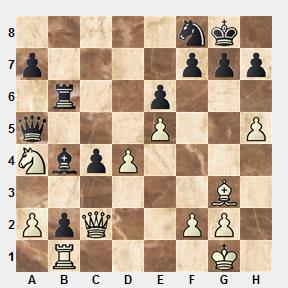
This was a position from my game last night. I was black against Omar Khaled Bashar, and I'd managed to create an immense passed pawn on b2. The next part of the game was a fight for this pawn, and finding a way for each side to activate their dormant king side minor pieces.
29.Rb1 Bb4 30.Na4
30..c3! Now I'm not saying that this was a difficult exchange sacrifice to play, but I was very happy to be considering these types of plans, as I am usually too materialistic. 31.Nxb6 axb6 32.a4
White has blockaded my pawns on the light squares. There is only one piece that can break that blockade. 32..Nd7! 33.Rd1 Qd5 34.f4 a bit of desperation and to retreat the bishop to e1 to fight against black's advanced passed pawns.
34..b5 making way for the knight 35.axb5 Nb6! There is no need to take the pawn back now, improving pieces is the most important thing at the moment. While this line of play might seem sharp, it is wholly positional and I was very happy with it. My exchange sacrifice was to secure a pair of advanced passed pawns, and then I moved queen and knight to their optimum squares. All that is needed now is a breakthrough, which my opponent allowed after 36.Be1 Qxb5
White's position is pretty hopeless, but the game finished after 37.f5 when I was finally able to take charge of the light squares by 37..Qa4. Omar thought for a while before resigning. It will be massive material loss for white after black plays c2.
Wednesday, August 19, 2015
Malitis Memorial
Sunday, August 16, 2015
Diplomacy
I was at a chess camp with my company Chess Kids and one evening we were playing a load of strategy games with the kids. I was talking to the other coaches about various games when the classic strategy game, Diplomacy came up. One of the coaches had never heard of it before, so we decided we would arrange a game of Diplomacy and after some negotiations, today is the day when it is happening. We have a group of players ranging in experience from raw beginner, to played once or twice, with one very experienced player, Frank Meerbach, who is hopefully going to be a referee (we're hoping all players show up, or Frank will play).
Diplomacy is an amazing game with no dice but lots of strategic play. The idea is to take control of the board and to this you have to move your armies around the board taking over control centres. To win you have to get control of over half the centres on the board, and to do this, most usually you have to create alliances with other players. The big problem is that when you try to move your armies, if another army moves to the same place, there is a stand-off. You need a superior force to move somewhere if you are opposed. This is why you need alliances.
So the first part of the game involves deciding who will be who.....
All the above was written before the game. Now for what happened! Well first off, I loved it. I really enjoyed the game which lasted from about midday to about 11 pm at night. The first half hour was spent teaching all us noobs the game. I found that even with a couple of games the best part of 30 years ago under my belt, I was by no means the least knowledgeable about the game. We had a random draw out of a hat and I picked Turkey which I'd never played before. And we also had to pick a name for the game. We chose "Dips Unlimited", as the game was played in the Kids Unlimited building (an excellent venue for a Diplomacy game with many nooks to go discuss things).
Frank was a referee and a stickler for the rules. he had us writing our orders out correctly, and playing to a set time. The first hour saw a big dust up in the Northern part of the board, and I think a couple of players who were trying out for the first time, realised that this wasn't really the game for them. So after about 2 hours, 2-3 countries were all but eliminated, and at least one of the players seemed pretty happy with that. I used a very defensive strategy which saw me survive but left me with a difficult job of growing my empire. As such, by the time I eventually made my move, a huge backstab against my boss David, it was already too late for me to win the game. Frank said that I'd played well, but was a bit timid. I think I can cope with that.
After 11 hours of play, we finally had to call it a draw, but the pyrrhic victor was definitely Smari. This is totally fitting for this game, as it was Smari who had been the coach on the chess camp who I'd been talking about Diplomacy to. Smari used the right combination of expansion, and consolidation and at the end he sat on 16 centres, just 2 from victory. Unfortunately for him, the rest of us stonewalled across the board denying him an outright victory.
So would I play again? Absolutely. I loved it, and would like to play it more. I'm not sure I'm ready to play regular players at a diplomacy club, but a few more friendly games would be good. I'm also looking into playing the game online. The problem with getting 7 players together for a full 11 hours to play a game of Diplomacy means that friendly games are going to be few and far between. But I'm hooked, and though I might not be the greatest player ever, it doesn't prevent me from enjoying the game!
Diplomacy is an amazing game with no dice but lots of strategic play. The idea is to take control of the board and to this you have to move your armies around the board taking over control centres. To win you have to get control of over half the centres on the board, and to do this, most usually you have to create alliances with other players. The big problem is that when you try to move your armies, if another army moves to the same place, there is a stand-off. You need a superior force to move somewhere if you are opposed. This is why you need alliances.
So the first part of the game involves deciding who will be who.....
![]() |
| Frank Meerbach, ex Victorian Diplomacy champion with grey hair, teaching a bunch of noobs the rules |
All the above was written before the game. Now for what happened! Well first off, I loved it. I really enjoyed the game which lasted from about midday to about 11 pm at night. The first half hour was spent teaching all us noobs the game. I found that even with a couple of games the best part of 30 years ago under my belt, I was by no means the least knowledgeable about the game. We had a random draw out of a hat and I picked Turkey which I'd never played before. And we also had to pick a name for the game. We chose "Dips Unlimited", as the game was played in the Kids Unlimited building (an excellent venue for a Diplomacy game with many nooks to go discuss things).
Frank was a referee and a stickler for the rules. he had us writing our orders out correctly, and playing to a set time. The first hour saw a big dust up in the Northern part of the board, and I think a couple of players who were trying out for the first time, realised that this wasn't really the game for them. So after about 2 hours, 2-3 countries were all but eliminated, and at least one of the players seemed pretty happy with that. I used a very defensive strategy which saw me survive but left me with a difficult job of growing my empire. As such, by the time I eventually made my move, a huge backstab against my boss David, it was already too late for me to win the game. Frank said that I'd played well, but was a bit timid. I think I can cope with that.
After 11 hours of play, we finally had to call it a draw, but the pyrrhic victor was definitely Smari. This is totally fitting for this game, as it was Smari who had been the coach on the chess camp who I'd been talking about Diplomacy to. Smari used the right combination of expansion, and consolidation and at the end he sat on 16 centres, just 2 from victory. Unfortunately for him, the rest of us stonewalled across the board denying him an outright victory.
![]() |
| The final scorecard showing Smari leading on 16 |
So would I play again? Absolutely. I loved it, and would like to play it more. I'm not sure I'm ready to play regular players at a diplomacy club, but a few more friendly games would be good. I'm also looking into playing the game online. The problem with getting 7 players together for a full 11 hours to play a game of Diplomacy means that friendly games are going to be few and far between. But I'm hooked, and though I might not be the greatest player ever, it doesn't prevent me from enjoying the game!
Labels:
carl,
chesskids,
diplomacy,
frank meerbach,
kids unlimited,
smari
Sunday, August 9, 2015
Australian Chess Championships 2016
There are only 145 days remaining until the 2016 Australian Chess Championships. The event is being held in Melbourne's suburb of Fitzroy which is a short hop from Melbourne's CBD. The tournament is being held from January 2nd through to January 12th with a rest day on the 8th January when the blitz championship is being held.. While the tournament is the property of the ACF, it is being run by my chess club, the Melbourne Chess Club.
The Australian Championship is held every 2 years with an Open Championship happening in the years between. Last year's open in Sydney saw Chinese GM Ni Hua come over and take the title by 2.5 points. The top Australian was IM Max Illingworth. The last Championship was in 2014 and was held in the south east Melbourne suburb of Noble Park. The champion was Sydney based IM Max Illingworth who will hopefully be defending his title in January. There is already one IM entered in the field, Ari Dale, and when I spoke to James Morris on Friday he seemed genuinely excited by the upcoming event. I think that will be the case for lots of local players, and I'd be guessing that a lot of travellers from interstate will come down too. The Championship in 2014 had a field of 42 players. The tournament has an eligibility criteria that basically means that you can't play unless you have an Australian Chess Federation rating of 2150 or higher, or are exempted under one of the other selection criteria. This ensures that the tournament has a decent quality field.
There is a reserves tournament for those players who don't meet the championship entry criteria. This will run alongside the championship and will also be a great event. Over 90 players entered the 2014 Reserves which was won resoundingly by ex Australian Champion, FM Doug Hamilton. In a very competitive field Doug ended up a point clear. Like Max Illingworth, I hope to see Doug at the tournament in January.
And I hope to play myself. My rating has made it 2151 and hopefully it will rise again. As an Australian citizen, I am hoping that my FIDE designation as English will not count against me. I'll put my name in the list and see what happens. It would be a funny twist if I did play. When I lived in England I tried to qualify for the British Championship and only managed it the year I emigrated and so missed playing in the Championship. Now after 10 years in Australia I could play in my first national championship, but not in the country of my birth.
Here is the final round game from the 2014 Australian Championship. It was dramatic with Max Illingworth playing Anton Smirnov, the winner taking the Championship.
The Australian Championship is held every 2 years with an Open Championship happening in the years between. Last year's open in Sydney saw Chinese GM Ni Hua come over and take the title by 2.5 points. The top Australian was IM Max Illingworth. The last Championship was in 2014 and was held in the south east Melbourne suburb of Noble Park. The champion was Sydney based IM Max Illingworth who will hopefully be defending his title in January. There is already one IM entered in the field, Ari Dale, and when I spoke to James Morris on Friday he seemed genuinely excited by the upcoming event. I think that will be the case for lots of local players, and I'd be guessing that a lot of travellers from interstate will come down too. The Championship in 2014 had a field of 42 players. The tournament has an eligibility criteria that basically means that you can't play unless you have an Australian Chess Federation rating of 2150 or higher, or are exempted under one of the other selection criteria. This ensures that the tournament has a decent quality field.
There is a reserves tournament for those players who don't meet the championship entry criteria. This will run alongside the championship and will also be a great event. Over 90 players entered the 2014 Reserves which was won resoundingly by ex Australian Champion, FM Doug Hamilton. In a very competitive field Doug ended up a point clear. Like Max Illingworth, I hope to see Doug at the tournament in January.
And I hope to play myself. My rating has made it 2151 and hopefully it will rise again. As an Australian citizen, I am hoping that my FIDE designation as English will not count against me. I'll put my name in the list and see what happens. It would be a funny twist if I did play. When I lived in England I tried to qualify for the British Championship and only managed it the year I emigrated and so missed playing in the Championship. Now after 10 years in Australia I could play in my first national championship, but not in the country of my birth.
Here is the final round game from the 2014 Australian Championship. It was dramatic with Max Illingworth playing Anton Smirnov, the winner taking the Championship.
Labels:
Australian Championship,
Chess,
Max Illingworth,
MCC,
Melbourne
Saturday, August 8, 2015
Glen Eira Chess Club
The club seems to have settled into a routine now, after being open for a bit over a year. We have about a dozen regular players, about another 5-10 occasional players, and a number of players who come along once in a while. Our year is made up of 4 tournaments and a load of free nights where social chess can be played. The four tournaments are all Swiss events with the first 3 being 7-round tournaments which qualify for the end of year 9-round championship.
We are currently into the last of these 7-round events and 2 of the 7 rounds have been played. There have only been 14 players involved in the tournament which is somewhat small compared to other events in the series, but the field is pretty good. I have had some enquiries from some other players, but I think we will probably have seen the field set now. Details of the tournament can be seen here, and I'll be putting out provisional draws each week:
https://au.tornelo.com/tournaments/glen-eira-last-chance
The third round saw the first games between the top seeds. John Nemeth had to play against me, and it was the sort of game that neither player would really want to remember. I walked into a typical f7 sacrifice that had my king wandering around the centre of the board, but amazingly, John missed a clean win, and the game fizzled out to a position where I had a piece for 2 pawns, but my king was rather open. I offered a draw which John accepted. The final position was one that neither of us really fancied! Next door to me, IM James Morris was winning handily against Jerzy Krysiak while Nick Husek and Axel Ahmer were able to overcome tough opposition from juniors to win through.
Here's the moment when John dragged my king into the centre. 10.Bxf7+! Kxf7 11.Ne6!! sacrificing 2 pieces to bring black's king into the firing line. The king has to take, as the knight threatens to take black's trapped queen 11..Kxe6
The congestion behind black's king and an inevitable opening of lines in front mean that black is pretty much doomed here. James Morris made an interesting observation after the game. He was surprised that John didn't finish things off as James thought that calculation was one of John's great strengths. I guess that having too many tempting moves can be an issue and while John played a variation that looked unbelievably promising, I managed to throw some spanners in the works and ended up in relative safety. 12.Qc4 d5 13.Nxd5 [13.exd5 looks immediately terminal] 13..Bc5!? [Allowing double checks, discovered checks and threatening nothing, but trying to untangle the clump of black pieces]
Now what to play for white when there are so many tempting moves? A knight check, or double check, develop a new piece into the attack? Stockfish suggests 14.Bg5 which coincidentally is what James thought was the best move in the post mortem! John played 14.Bf4 which also looks rather good, but that appearance is artificial and I was able to give a piece back to survive with 14..Nxd5 15.Qxd5+ Ke7 16.Bg5+ Nf6 17.Qxc5+ Qd6 when black is still a bit shaky but is not getting mated, and black is still a piece up for 2 pawns.
We are currently into the last of these 7-round events and 2 of the 7 rounds have been played. There have only been 14 players involved in the tournament which is somewhat small compared to other events in the series, but the field is pretty good. I have had some enquiries from some other players, but I think we will probably have seen the field set now. Details of the tournament can be seen here, and I'll be putting out provisional draws each week:
https://au.tornelo.com/tournaments/glen-eira-last-chance
The third round saw the first games between the top seeds. John Nemeth had to play against me, and it was the sort of game that neither player would really want to remember. I walked into a typical f7 sacrifice that had my king wandering around the centre of the board, but amazingly, John missed a clean win, and the game fizzled out to a position where I had a piece for 2 pawns, but my king was rather open. I offered a draw which John accepted. The final position was one that neither of us really fancied! Next door to me, IM James Morris was winning handily against Jerzy Krysiak while Nick Husek and Axel Ahmer were able to overcome tough opposition from juniors to win through.
Here's the moment when John dragged my king into the centre. 10.Bxf7+! Kxf7 11.Ne6!! sacrificing 2 pieces to bring black's king into the firing line. The king has to take, as the knight threatens to take black's trapped queen 11..Kxe6
The congestion behind black's king and an inevitable opening of lines in front mean that black is pretty much doomed here. James Morris made an interesting observation after the game. He was surprised that John didn't finish things off as James thought that calculation was one of John's great strengths. I guess that having too many tempting moves can be an issue and while John played a variation that looked unbelievably promising, I managed to throw some spanners in the works and ended up in relative safety. 12.Qc4 d5 13.Nxd5 [13.exd5 looks immediately terminal] 13..Bc5!? [Allowing double checks, discovered checks and threatening nothing, but trying to untangle the clump of black pieces]
Now what to play for white when there are so many tempting moves? A knight check, or double check, develop a new piece into the attack? Stockfish suggests 14.Bg5 which coincidentally is what James thought was the best move in the post mortem! John played 14.Bf4 which also looks rather good, but that appearance is artificial and I was able to give a piece back to survive with 14..Nxd5 15.Qxd5+ Ke7 16.Bg5+ Nf6 17.Qxc5+ Qd6 when black is still a bit shaky but is not getting mated, and black is still a piece up for 2 pawns.
Wednesday, August 5, 2015
Malitis Memorial Past the Half Way Mark
We're already into the end stretch of the Malitis Memorial at the MCC. In fact, the committee were already finding out who was playing in the next tournament, the MCC Open starting at the end of August. I expect the MCC Open to be massive, as virtually all the Monday night events have been heavily subscribed to this year.
The Malitis Memorial has been split into 2 groups, a top 8 round robin, and a swiss section for the rest of the field. I suggested the system of 2 swiss sections to committee member Simon Dale last night, and he seemed pretty interested in the idea. The system I suggested last week was to scrap the Round Robin and replace it with a small elite swiss event, with maybe the top 16 players represented in one tournament, and another swiss for the lower rated players. Saying that, I'm pretty happy at whatever system is thrown at me, so long as I get to play some chess.
The round robin section is looking like a 2 horse race. IM Mirko Rujevic is leading with 4/4, while junior David Cannon is second on 3/4. Both of these players won last night to extend their lead over the field. The 2 other games ended in draws leaving no one else above half points. There is still one game left to be played, but even a result in that game won't take anyone above half points. Still, with 3 rounds to go, there could still be some twists.
In the swiss section Mehmedalija Dizdarevic held on to his lead after drawing with Tristan Krstevski. Tristan was half a point behind, which is where he remains. He is joined by David Lacey, Ray Yang, Felix Wyss, Tom Kalisch and Sarah Anton. There's a further group of players another half point down, so this is still anyone's tournament. There haven't been too many big upsets through the swiss section of the Malitis this year, though I guess with the top 8 players out, it means there are less big rating differences. Saying that unrated Axel Ahmer won against MCC regular Alex Kaplan, while Sarah Anton defeated Justin Penrose rated 200 points higher.
My own game was a painful affair. I grabbed a pawn in a Catalan against Thai Ly and grimly held on to it enduring an awful position in the hope that I would at some stage come out of things still with that extra pawn. To be honest, I never got out of the difficult position, Thai won his pawn back and the game looked bleak. And then when I thought I'd got through the worst of it Thai simplified to the following pawn endgame.
I was black here and things look bad. Black's passed c-pawn is not dangerous while white's protected passed e-pawn most certainly is. Based on the general idea that the defending side should trade pawns, I managed to find the only drawing line, 52..g5!! This is probably the best move I've played this year, saving the game. 53.fxg5 [53.hxg5? loses as black will have distant passed pawns that white's king won't be able to cope with] 53..Kxe5
This position is a draw, but you have to know how to draw it, or it is very losable. White's king intends to head over and take black's extra pawn and black must be ready to defend his pawn, but he mustn't move it. The black king is inside the square of white's passed g-pawn and can remain inside that square as long as it sits on the d-file. So when white's king gets to c4, black must be ready to play Kd6. The game continued 54.Ke3 Kf5 55.Kd3 Ke5
A key position. If white now plays 56.Kc4, black will reply 56..Kd6, and the follow up 57.Kb5 is then met by 57..Kd5 bringing about the following position.
White can make no progress. His king has to retreat when black's king will do the same. If white pushes the g-pawn, black's king runs over and takes it, and even if white wins black's h-pawn, the game is a draw. Without going into all this Thai saw that there was no way through and offered a draw which I was very happy to accept.
The Malitis Memorial has been split into 2 groups, a top 8 round robin, and a swiss section for the rest of the field. I suggested the system of 2 swiss sections to committee member Simon Dale last night, and he seemed pretty interested in the idea. The system I suggested last week was to scrap the Round Robin and replace it with a small elite swiss event, with maybe the top 16 players represented in one tournament, and another swiss for the lower rated players. Saying that, I'm pretty happy at whatever system is thrown at me, so long as I get to play some chess.
The round robin section is looking like a 2 horse race. IM Mirko Rujevic is leading with 4/4, while junior David Cannon is second on 3/4. Both of these players won last night to extend their lead over the field. The 2 other games ended in draws leaving no one else above half points. There is still one game left to be played, but even a result in that game won't take anyone above half points. Still, with 3 rounds to go, there could still be some twists.
In the swiss section Mehmedalija Dizdarevic held on to his lead after drawing with Tristan Krstevski. Tristan was half a point behind, which is where he remains. He is joined by David Lacey, Ray Yang, Felix Wyss, Tom Kalisch and Sarah Anton. There's a further group of players another half point down, so this is still anyone's tournament. There haven't been too many big upsets through the swiss section of the Malitis this year, though I guess with the top 8 players out, it means there are less big rating differences. Saying that unrated Axel Ahmer won against MCC regular Alex Kaplan, while Sarah Anton defeated Justin Penrose rated 200 points higher.
My own game was a painful affair. I grabbed a pawn in a Catalan against Thai Ly and grimly held on to it enduring an awful position in the hope that I would at some stage come out of things still with that extra pawn. To be honest, I never got out of the difficult position, Thai won his pawn back and the game looked bleak. And then when I thought I'd got through the worst of it Thai simplified to the following pawn endgame.
I was black here and things look bad. Black's passed c-pawn is not dangerous while white's protected passed e-pawn most certainly is. Based on the general idea that the defending side should trade pawns, I managed to find the only drawing line, 52..g5!! This is probably the best move I've played this year, saving the game. 53.fxg5 [53.hxg5? loses as black will have distant passed pawns that white's king won't be able to cope with] 53..Kxe5
This position is a draw, but you have to know how to draw it, or it is very losable. White's king intends to head over and take black's extra pawn and black must be ready to defend his pawn, but he mustn't move it. The black king is inside the square of white's passed g-pawn and can remain inside that square as long as it sits on the d-file. So when white's king gets to c4, black must be ready to play Kd6. The game continued 54.Ke3 Kf5 55.Kd3 Ke5
A key position. If white now plays 56.Kc4, black will reply 56..Kd6, and the follow up 57.Kb5 is then met by 57..Kd5 bringing about the following position.
White can make no progress. His king has to retreat when black's king will do the same. If white pushes the g-pawn, black's king runs over and takes it, and even if white wins black's h-pawn, the game is a draw. Without going into all this Thai saw that there was no way through and offered a draw which I was very happy to accept.
Monday, August 3, 2015
Reading Materials
I've done a pretty good job of avoiding illnesses through 2015. That is, until Friday. Then, during the day I started to get short of breath, snuffly and thick headed. As per usual, I've not felt bad enough to stop me going to work but I haven't been running, and opted out of playing chess on Friday night. And with the winter being the coldest I've experienced in my 10 years of living in Melbourne, all I've really felt like doing over the weekend is sitting in a warm room reading a good book. The thing is, what constitutes a good book?
Well a good place to start is the longlist of the Man Booker Prize, which was announced a couple of days ago. I am always inspired by the Booker longlist and amazingly I just picked up Anne Enright's "The Green Road" to read when I saw the announcement of the list on Twitter, including the book I was intending to read. The Green Road has started in amazing fashion, a most readable book about real, and difficult issues. If it carries on in this vein, then it will be a truly amazing read.
Anne Enright is a previous winner of the Booker Prize, but I've never read her before. The thing is, there is so much to read that we're never going to be able to read everything we want to read. I have bookshelves with the best part of 40 unread books. So I'm planning on getting through some of these before I buy anything new (except perhaps for some more longlist books!)
I go on holiday with Caroline in 7 weeks time and have a reading list before then. I've been reading a fantasy series by Australian author Kate Forsyth. I like reading fantasy series or detective series to break up some of the heavier reading. I've read half the series and it is enjoyable with some interesting characters and a Celtic background. I'll hopefully finish the other 3 before we go to Europe.
Seeing we'll be travelling to France, driving around it, before heading to see family in England, I thought it would also be good to read something vaguely related to somewhere I'm going. I'll be driving around France with Caroline and one of our stops will be in the south western town of Carcassonne. I've read novels based around Carcassonne such as those by Kate Mosse, like Labyrinth and Citadel. But something sitting on the shelf waiting to be read is "Narrow Dog to Carcassonne" by Terry Darlington. It tells the story of a trip to France by 2 English pensioners who on their canal boat. I love reading books about unlikely adventures, and it almost classifies under the fantasy heading!
The most amazing novel I've read in the past couple of years about unlikely journeys is probably Rachel Joyce's "The Unlikely Pilgrimage of Harold Fry". Funny, sad, bizarre and very real all rolled into one beautifully written novel. Well, I'm ready to read the sequel, "The Love Song of Miss Queenie Hennessy". Harold Fry was a pensioner who received a letter from an old acquaintance, Queenie Hennessy, which inspired him to walk from Cornwall to Durham, about 600 miles (950 km). This pilgrimage enabled Harold to meet a numebr of interesting characters along the way, while we readers were treated to a wonderful unfolding of the storyline. The story seen from Queenie Hennessy's eyes promises to be as much as a roller coaster ride of emotions.
So that gives me some reading to do before I go away. Then I'll have the interesting task of choosing holiday reading! Oh, and I might be able to get some chess reading done at some stage. Probably not, though!
Well a good place to start is the longlist of the Man Booker Prize, which was announced a couple of days ago. I am always inspired by the Booker longlist and amazingly I just picked up Anne Enright's "The Green Road" to read when I saw the announcement of the list on Twitter, including the book I was intending to read. The Green Road has started in amazing fashion, a most readable book about real, and difficult issues. If it carries on in this vein, then it will be a truly amazing read.
Anne Enright is a previous winner of the Booker Prize, but I've never read her before. The thing is, there is so much to read that we're never going to be able to read everything we want to read. I have bookshelves with the best part of 40 unread books. So I'm planning on getting through some of these before I buy anything new (except perhaps for some more longlist books!)
I go on holiday with Caroline in 7 weeks time and have a reading list before then. I've been reading a fantasy series by Australian author Kate Forsyth. I like reading fantasy series or detective series to break up some of the heavier reading. I've read half the series and it is enjoyable with some interesting characters and a Celtic background. I'll hopefully finish the other 3 before we go to Europe.
![]() |
| Kate Forsyth's excellent fantasy series |
![]() |
| I'll also be going to Carcassonne, like Terry Darlington |
So that gives me some reading to do before I go away. Then I'll have the interesting task of choosing holiday reading! Oh, and I might be able to get some chess reading done at some stage. Probably not, though!
Labels:
Anne Enright,
booker prize,
Kate Forsyth,
kate mosse,
rachel joyce,
reading,
terry darlington
Saturday, August 1, 2015
Malitis Memorial Update
Last week the British Championships started. This is a tournament I enjoy following as I knew many of the players involved. Some of the younger ones I never met as I left the UK over 10 years agao. Funnily enough, I spent years trying to qualify for the British Championship when the qualification criteria was tough. You either had to have a rating of 2320 or pick up a place from one of the qualifiers on the weekend circuit. Then, I finally qualified for the 2005 Championship, only to leave England a few months before the tournament.
No regrets though as I've made a great life here, and enjoy the chess scene in Australia. In fact, it is likely that I'll play in the upcoming Australian Championships being held in January 2016 in Melbourne. The tournament is being run by my club, the Melbourne Chess Club. Currently, the tournament in progress on a Monday night is the Malitis Memorial. Monday night events are longplay FIDE rated events, which is my preference. After an absence from the long game for a couple of years, my rating took a pounding on my return and dropped to a low of about 2080. I seem to have got it back together again, and my rating has jumped back up to 2161, and hopefully will jump more. Although saying that, my start in the Round Robin section of the Malitis Memorial, with 2 losses was not particularly inspiring.
The Malitis Memorial is split into 2 divisions, an 8 player Round Robin and a swiss for everyone else. This format seems to have drawn more players in (though that might just be a general upturn in chess club attendance) but I think I'd like to see a slightly different format, that I once played at the OHRA tournament in Amsterdam in the early 1990's. There they had small swiss events, 16 players, 24 players, or 32 players in rating groups. I think a 16 player, 7-round swiss would be an excellent format, and would basically split the top half and bottom half players. As I remember, the prize fund was also interesting. You earned prize money for every half point above half points. So instead of a set prize fund for the tournament, the prize fund depended on how many points you scored. This sort of system discourages players trying for draws, and rewards performance. It also spreads the prize fund out.
The Round Robin section is being dominated by IM Mirko Rujevic who has won all 3 of his games and sits a point clear already. David Cannon has 2/3, and the rest of us are floundering below. The swiss event also has a clear leader in Mehmedalija Dizdarevic who is the only player on 3/3. He is half a point ahead of Tristan Krstevski (who he plays) and Eamonn O'Molloy and then there is a big group of players on 2/3. The second tournament saw a number of late entries, and the number of players in the event has swelled to 35. Seeing the 7 round winter event has had considerably less players than that in the past, the MCC must be commended at attracting players through the door.
I was able to win my game against Simon Schmidt. Simon is a much improved player as is seen by his jump up the ratings. However, he misjudged an endgame against me and turned a draw into a loss.
Simon had offered a draw a long way back, but I soldiered on in essentially level positions up to this critical juncture. Although I had been pressing, there was never anything tangible, so I decided to go for it. 44..b4 45.cxb4 d4
So black has created a passed pawn that is a bit dangerous in the middle of the board. Still it should be no problem for white. 46.Rf3 Kd5 This was the last chance of winning.
Now, Simon correctly took my pawns on the king side, 47.fxg5 fxg5 48.Rf5+ Ke4 49.Rxg5 d3
To understand this position, you must know that neither side can win. The idea is that white will have to sacrifice their rook for black's d-pawn but will then use their king to help their g-pawn advance causing white to sacrifice their rook back again. The b-pawns are of consequence as they can be taken at will by black. Taking all this into account, white seems to left with 2 choices. 50.Rg8 and come behind the black d-pawn, or 50.Rh5 and drop the rook to the back rank.
a. 50.Rh5? d2 51.Rh1 Rc1 wins for black
b. 50. Rg8!
50..d2! [50..Rd7 fails to 51.Re8+ Ke4 52.Re1 and white has control of the back rank]
Now there is only one move to draw 51.Re8! [51.Rd8? 52.Rc3+ Kh4 53.Rd3 builds a bridge for the pawn] 51..Kd3 52.Rd8+ Kc2
53.Kf4! White's king starts supporting his own pawn. The game would conclude with white having to sacrifice his rook when black's pawn promotes, but the g-pawn will coast white a rook back again. White has time to stop the g-pan and pick up both b-pawns.
c. 50.Kf2? This was the move that Simon played, and really my main hope of an endgame swindle.
50..Rc1! Guards the promotion square and prevents white's king from blocking the pawn. Meanwhile, black's king is in great position to worry about the g-pawn while white's king has moved to a considerably worse square. The game concluded. 51.Rg8 d2 52.Re8+ Kf4 [I think Simon had forgotten that my king could move this way after he had retreated his king. If the black king has to touch the d-file, then white would be fine as he could skewer the pawn] 53.Rf8+ Kxf4 54.Rd8 d1=Q 55.Rxd1 Rxd1 56.Ke3 Kf5 0-1
This is an important practical ending for club players to understand. This type of ending is quite frequent in games, and understanding the mechanics of it will maximise your results.
No regrets though as I've made a great life here, and enjoy the chess scene in Australia. In fact, it is likely that I'll play in the upcoming Australian Championships being held in January 2016 in Melbourne. The tournament is being run by my club, the Melbourne Chess Club. Currently, the tournament in progress on a Monday night is the Malitis Memorial. Monday night events are longplay FIDE rated events, which is my preference. After an absence from the long game for a couple of years, my rating took a pounding on my return and dropped to a low of about 2080. I seem to have got it back together again, and my rating has jumped back up to 2161, and hopefully will jump more. Although saying that, my start in the Round Robin section of the Malitis Memorial, with 2 losses was not particularly inspiring.
The Malitis Memorial is split into 2 divisions, an 8 player Round Robin and a swiss for everyone else. This format seems to have drawn more players in (though that might just be a general upturn in chess club attendance) but I think I'd like to see a slightly different format, that I once played at the OHRA tournament in Amsterdam in the early 1990's. There they had small swiss events, 16 players, 24 players, or 32 players in rating groups. I think a 16 player, 7-round swiss would be an excellent format, and would basically split the top half and bottom half players. As I remember, the prize fund was also interesting. You earned prize money for every half point above half points. So instead of a set prize fund for the tournament, the prize fund depended on how many points you scored. This sort of system discourages players trying for draws, and rewards performance. It also spreads the prize fund out.
The Round Robin section is being dominated by IM Mirko Rujevic who has won all 3 of his games and sits a point clear already. David Cannon has 2/3, and the rest of us are floundering below. The swiss event also has a clear leader in Mehmedalija Dizdarevic who is the only player on 3/3. He is half a point ahead of Tristan Krstevski (who he plays) and Eamonn O'Molloy and then there is a big group of players on 2/3. The second tournament saw a number of late entries, and the number of players in the event has swelled to 35. Seeing the 7 round winter event has had considerably less players than that in the past, the MCC must be commended at attracting players through the door.
I was able to win my game against Simon Schmidt. Simon is a much improved player as is seen by his jump up the ratings. However, he misjudged an endgame against me and turned a draw into a loss.
Simon had offered a draw a long way back, but I soldiered on in essentially level positions up to this critical juncture. Although I had been pressing, there was never anything tangible, so I decided to go for it. 44..b4 45.cxb4 d4
So black has created a passed pawn that is a bit dangerous in the middle of the board. Still it should be no problem for white. 46.Rf3 Kd5 This was the last chance of winning.
Now, Simon correctly took my pawns on the king side, 47.fxg5 fxg5 48.Rf5+ Ke4 49.Rxg5 d3
To understand this position, you must know that neither side can win. The idea is that white will have to sacrifice their rook for black's d-pawn but will then use their king to help their g-pawn advance causing white to sacrifice their rook back again. The b-pawns are of consequence as they can be taken at will by black. Taking all this into account, white seems to left with 2 choices. 50.Rg8 and come behind the black d-pawn, or 50.Rh5 and drop the rook to the back rank.
a. 50.Rh5? d2 51.Rh1 Rc1 wins for black
b. 50. Rg8!
50..d2! [50..Rd7 fails to 51.Re8+ Ke4 52.Re1 and white has control of the back rank]
Now there is only one move to draw 51.Re8! [51.Rd8? 52.Rc3+ Kh4 53.Rd3 builds a bridge for the pawn] 51..Kd3 52.Rd8+ Kc2
53.Kf4! White's king starts supporting his own pawn. The game would conclude with white having to sacrifice his rook when black's pawn promotes, but the g-pawn will coast white a rook back again. White has time to stop the g-pan and pick up both b-pawns.
c. 50.Kf2? This was the move that Simon played, and really my main hope of an endgame swindle.
50..Rc1! Guards the promotion square and prevents white's king from blocking the pawn. Meanwhile, black's king is in great position to worry about the g-pawn while white's king has moved to a considerably worse square. The game concluded. 51.Rg8 d2 52.Re8+ Kf4 [I think Simon had forgotten that my king could move this way after he had retreated his king. If the black king has to touch the d-file, then white would be fine as he could skewer the pawn] 53.Rf8+ Kxf4 54.Rd8 d1=Q 55.Rxd1 Rxd1 56.Ke3 Kf5 0-1
This is an important practical ending for club players to understand. This type of ending is quite frequent in games, and understanding the mechanics of it will maximise your results.
Labels:
Australian Championship,
Chess,
Endgames,
malitis memorial,
MCC
Subscribe to:
Posts (Atom)


