Do you have a favourite tournament? By that I mean is there any tournament that either you played in that sticks in your mind as being a great event for one reason or another, or one a great event from history. You could have performed amazingly, or the field or conditions were fantastic. And related to this, do you have a favourite tournament to follow? Is it a local event, a national championship, an annual supertournament, or anything else?
Currently, there are so many events happening around the world. This is what brought this question to my mind. The Match of the Millennials in USA sees a US team vs a World team at junior age group levels. Australia's very own prodigious talent, Anton Smirnov represents the World team, as does the Indian 11 year old star Pragga. This event can't help me thinking of the USSR vs Rest of the World matched from the 1970's and 1980's. I'm sure we'll look back at these kids when they become top players in 5-10 years time and reminisce a little, but I can't get too excited by this type of event.
I'm more excited by the British Championship which is starting later today. The national Championships of my birth country and my adopted country, Australia, are very important events for me, and I follow them both. Thankfully they happen at opposite times of the year, with the Australian Championship happening in January, giving me plenty of time to focus on them. In fact the 2016 Australian Championships was one of my better events over the years, and I hope to play in a few more championships in the coming years.
Even more immediate for me are local events, with the Victorian Championship currently in progress as well as many club events around Melbourne and Victoria. I'd have to sat tha my faourite event in the Victorian chess calendar is the MCC Club Championship which takes up the first quarter of the year. Although I haven't won it, I've finished near the top regularly, and it is a tournament where there is almost always IM opposition to face. This year I managed to finish third which was pretty good taking into account that it was a tough field. I also finished third in my most memorable Club Championship in 2008 which was won by Malcolm Pyke who scored a magnificent 8/9 to finish half a point clear of IM Guy West. Malcolm's perennial participation at the MCC will be sorely missed, and it was a great honour for me to win the tournament that was just held as his memorial at the MCC. More of that in a future post.
Of course, International events are great to follow. I have a soft spot for Hastings and Amsterdam having played memorable chess tournaments in both. I think Hastings tops it for me as the greatest,or at least, as my favourite. I remember sitting in the commentary room and being awestruck as Bent Larson just walked in and started talking about his game and the remaining games. This was years before internet coverage which sees this happen regularly, and was a special treat back in the 1980's. Hastings 1895 must go down as my favourite ever tournament. The cream of chess was playing, the games were great, the result was in doubt up till the very end, with the favourites not getting their own way. It had absolutely everything.
Anyway, what is your favourite tournament? One that you played in, one that you enjoy playing in, or International events that you love to watch, or your favourite from history?
Saturday, July 29, 2017

Friday, July 28, 2017
Practical Chess Study
Most of us study chess from a book or a computer by ourselves. We play through stuff, openings, tactics puzzles, famous games, endgames, and generally accumulate knowledge and some level of expertise. But it can get much more effective if you study in a group or with a partner. There are more brains at work, hopefully with different ways of looking at positions.The only trouble is that we have little time to get together with others to study so most of what we do is alone. It is possible to play online, but I don't think many people study in a group online. Perhaps with a coach, but not in a group.
When I was running an endgame group at the Melbourne Chess Club a few years ago, we'd meet at the club and go through a type of ending each week, first looking at some practice and theory, and then playing from positions that related to the evening's theme. This is a really good exercise, learning and then putting the new found knowledge into a practical setting.
I recently decided that I could try this at home using a strong engine (probably a weak engine would be good enough!). Find some positions and play them out against the computer. Good positions to play would be practical endgame positions that are fairly level, or even theoretical positions to test your knowledge (try mating with king and queen vs king and rook against a comp, or defending rook vs rook and bishop).
But why limit it to endgames? Let's take 2 famous quotes as a starting point.
"The hardest thing in chess is to win a won game"
"The remainder of the game needs no further comment"
These 2 chess cliches seem to contradict one another. So how about setting up a position which requires no further comment and trying to convert to a win? Here's an example.

This position is from the game Euwe-Capablanca London 1922. In the tournament book, Maroczy criticises Euwe's last move. 17.g3 "This loses a pawn". But that is it. The remainder of the game gets no commentary as if it is all self evident. Apparently.
Working out how Capablanca as black wins a pawn in this position isn't that difficult, but to convert after might seem tricky, especially against a computer playing to at least 2500 standard. I wonder how many of us could do it 100% of the time?
This is the sort of exercise that would be of huge practical benefit to players, certainly below master standard, and playing against the clock would also help practically. I will not be playing much chess in the second half of the year so I'll be looking at ways to keep in touch. This might just be one such method.
When I was running an endgame group at the Melbourne Chess Club a few years ago, we'd meet at the club and go through a type of ending each week, first looking at some practice and theory, and then playing from positions that related to the evening's theme. This is a really good exercise, learning and then putting the new found knowledge into a practical setting.
I recently decided that I could try this at home using a strong engine (probably a weak engine would be good enough!). Find some positions and play them out against the computer. Good positions to play would be practical endgame positions that are fairly level, or even theoretical positions to test your knowledge (try mating with king and queen vs king and rook against a comp, or defending rook vs rook and bishop).
But why limit it to endgames? Let's take 2 famous quotes as a starting point.
"The hardest thing in chess is to win a won game"
"The remainder of the game needs no further comment"
These 2 chess cliches seem to contradict one another. So how about setting up a position which requires no further comment and trying to convert to a win? Here's an example.
This position is from the game Euwe-Capablanca London 1922. In the tournament book, Maroczy criticises Euwe's last move. 17.g3 "This loses a pawn". But that is it. The remainder of the game gets no commentary as if it is all self evident. Apparently.
Working out how Capablanca as black wins a pawn in this position isn't that difficult, but to convert after might seem tricky, especially against a computer playing to at least 2500 standard. I wonder how many of us could do it 100% of the time?
This is the sort of exercise that would be of huge practical benefit to players, certainly below master standard, and playing against the clock would also help practically. I will not be playing much chess in the second half of the year so I'll be looking at ways to keep in touch. This might just be one such method.
Tuesday, July 25, 2017
Update on "Women's Chess"
A few months ago I wrote a post about "Women's Chess" and sexual discrimination in the chess World. Since then I have seen articles and heard opinions by women, so a quick update is due.
Earlier this week on the Chessbase website, US FM Alisa Melekhina wrote an interesting piece about "Women's Chess" and the negative connotation that label has on the game. Tellingly, a number of the comments at the end of the article are derogatory and by men. A number of comments are personal and have nothing rational to argue against the piece, and this fits very well into my previous article. If male chess players are threatened by the possibility there could be stronger female chess players, then that is a sad state of affairs.
Melekhina isn't the only player to recently come out and say there are problems with the way women are treated in chess. Canadian WFM Alexandra Botez put the case eloquently on chess.com's ChessCenter. While discussing with presenter IM Danny Rensch, Botez points out that women's titles are set lower than men's which sets lower goals for women. Personally, I feel this is stating the obvious, but it takes women such as Melekhina and Botez to come out and say it, as well as others. (This wrap up video contains the interview near the start of the transmission)
This interview came after a provocative article from Vanessa West on the US Chess Federation's website entitled "Should Women's Titles be Eliminated". As Botez said, the article was well researched and presented and the arguments seemed coherent. Women's titles lower the bar for women's expectations maintaining a lower standard among female players in the game. As such, less female role models exist at the top level and therefore less girls aspire to take up chess seriously. It is a self perpetuating cycle.
Again, there are numerous comments beneath the article, though they tend to be more reasoned arguments. A quick Google search for "should women's chess titles be eliminated" brings up 613,000 results which shows this is a real issue. And if these recent articles are anything to go by, it seems the trend is that opinion is against the women's titles and the division in the game.
I hope that in the near future, something will be done to really promote the place of girls and women in chess by equalising goals and removing discrimination from the world of chess.
ps. I received a notification from New in Chess today regarding a new book about the first women's World Champion, Vera Menchik. I reckon this will be a fascinating read, so I'm going to buy it! I'll review it at some stage in the future.
Earlier this week on the Chessbase website, US FM Alisa Melekhina wrote an interesting piece about "Women's Chess" and the negative connotation that label has on the game. Tellingly, a number of the comments at the end of the article are derogatory and by men. A number of comments are personal and have nothing rational to argue against the piece, and this fits very well into my previous article. If male chess players are threatened by the possibility there could be stronger female chess players, then that is a sad state of affairs.
Melekhina isn't the only player to recently come out and say there are problems with the way women are treated in chess. Canadian WFM Alexandra Botez put the case eloquently on chess.com's ChessCenter. While discussing with presenter IM Danny Rensch, Botez points out that women's titles are set lower than men's which sets lower goals for women. Personally, I feel this is stating the obvious, but it takes women such as Melekhina and Botez to come out and say it, as well as others. (This wrap up video contains the interview near the start of the transmission)
This interview came after a provocative article from Vanessa West on the US Chess Federation's website entitled "Should Women's Titles be Eliminated". As Botez said, the article was well researched and presented and the arguments seemed coherent. Women's titles lower the bar for women's expectations maintaining a lower standard among female players in the game. As such, less female role models exist at the top level and therefore less girls aspire to take up chess seriously. It is a self perpetuating cycle.
Again, there are numerous comments beneath the article, though they tend to be more reasoned arguments. A quick Google search for "should women's chess titles be eliminated" brings up 613,000 results which shows this is a real issue. And if these recent articles are anything to go by, it seems the trend is that opinion is against the women's titles and the division in the game.
I hope that in the near future, something will be done to really promote the place of girls and women in chess by equalising goals and removing discrimination from the world of chess.
ps. I received a notification from New in Chess today regarding a new book about the first women's World Champion, Vera Menchik. I reckon this will be a fascinating read, so I'm going to buy it! I'll review it at some stage in the future.
Tuesday, July 18, 2017
Variation on a Theme of Torre-Lasker
When I teach chess to kids (and adults for that matter) I love to teach classic games with clear motifs. I can teach something of the rich history and culture around the game as well as showing useful patterns and techniques. The classic example of a Windmill is the game Torre-Lasker Moscow 1925 where the Mexican genius beat ex-World Champion Emanuel Lasker using a spectacular queen sacrifice. The lead play to this sacrifice is rich in tactical ideas with plenty of thrust and counter thrust going on.

So here is the position where Torre famously sacrificed his queen with 25.Bf6!! There followed 25..Qxh5 26.Rxg7+ Kh8 27.Rxf7+ [The Windmill motif] 27..Kg8 28.Rg7+
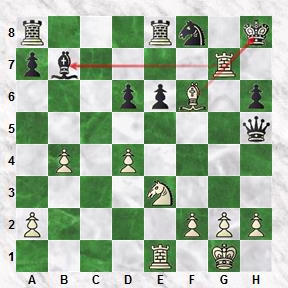
Here's the windmill in visual mode. White's rook unleashes a discovered check from the bishop and after taking pieces on the rank, rebounds back to g7 to check and start the process over again.
To make this point even more vivid to young students, I have altered the position slightly allowing for more captures and a mating pattern at the end of the line.

Here's my improved Variation on a Theme by Torre-Lasker. Now, 25.Bf6!! Qxh5 26.Rxg7+ will be followed by captures on f7, e7, c7, b7, a7 and finally the Ra1 will take on a8 with unstoppable mate on f8. Not an improvement on the classic, but a more vivid example for young minds to cope with! The knight on e3 even stops Qd1 mate at the end!
So here is the position where Torre famously sacrificed his queen with 25.Bf6!! There followed 25..Qxh5 26.Rxg7+ Kh8 27.Rxf7+ [The Windmill motif] 27..Kg8 28.Rg7+
Here's the windmill in visual mode. White's rook unleashes a discovered check from the bishop and after taking pieces on the rank, rebounds back to g7 to check and start the process over again.
To make this point even more vivid to young students, I have altered the position slightly allowing for more captures and a mating pattern at the end of the line.

Here's my improved Variation on a Theme by Torre-Lasker. Now, 25.Bf6!! Qxh5 26.Rxg7+ will be followed by captures on f7, e7, c7, b7, a7 and finally the Ra1 will take on a8 with unstoppable mate on f8. Not an improvement on the classic, but a more vivid example for young minds to cope with! The knight on e3 even stops Qd1 mate at the end!
Sunday, July 16, 2017
Out Of Retirement
It is time to bring this blog back out of retirement. I mean, if Kasparov can come out of retirement to play in the Grand Chess Tour, then chess lovers of the world should all be excited. And that isn't the only exciting thing in the chess world. Magnus Carlsen has become less dominant so we have a great situation at the top of the game where there are a whole bunch of players challenging to take the number 1 spot on the FIDE rating list. Magnus has a small 10 point lead over Kramnik with Wesley So only 12 behind, Aronin 13 behind, Caruana 15 behind and Mamedyarov 22 off the top spot. I'm not sure I ever remember such a tightly packed group at the top and it makes it an exciting time at the top of the game.
While the elite side of the game intrigues me, it is difficult to get to grips with their ability and I therefore tend to concentrate more on other things when I'm studying chess. I love the history of the game and I've ordered a book of the 1922 London International tournament. This was a great event won by Capablanca ahead of Alekhine, Rubinstein etc. The tournament book was written by Maroczy who was competing in the event, and I'm quite excited to read this book as I've never read any of Maroczy's writings before.
As a chess coach I'm also interested in junior chess, and it is an exciting time with Chinese superstar Wei Yi heading towards the top 10 in the world, and Indian super kid, Praggnanandaa trying hard to beat Sergey Karjakin's 15 year old record of being the youngest Grand Master in history. Pragga is not yet 12, and has come close to scoring GM norms already. His rating is sitting at 2479 which is absolutely amazing. If you want to know more about Pragga, then follow Chessbase India, which I've recently discovered, and which I find excellent. There's plenty of information about the players making these super players more accessible.
We in Australia might not have a talent quite like Pragga, but we do have some great juniors and I obviously find Australian chess interesting. I'll be following it as best I can. I've been playing lots of chess and have some things to write. My club, the Melbourne Chess Club, is as active as always and I'm currently playing in the Victorian Championships.
I'll also be writing about women's chess, or at least my take on women's chess. I've written here before that I don't like the way that women are treated in our chess community and I'll continue to write about it until things change! I've worked with a number of girls in Australia and I have listened to their concerns about the game of chess and their place in it.
I was recently coaching on a camp and I showed a game from London 1922, the fantastic Alekhine-Yates game. If you haven't seen it, then take a look. It is a strategic masterpiece with a beautiful finish. Yates weakens his e5 square and Alekhine uses it as an outpost for his knight as well as dominating the c-file. He skillfully transfers his rooks from the c-file to the seventh rank and then brings up his last reinforcement, his king as an attacking piece in the middlegame. The final position is wonderful!

Alekhine as white has just played Ke5 trapping black's rook, while mate will follow soon. Here's the full game which I look forward to analysing in some depth with Maroczy's guidance.
While the elite side of the game intrigues me, it is difficult to get to grips with their ability and I therefore tend to concentrate more on other things when I'm studying chess. I love the history of the game and I've ordered a book of the 1922 London International tournament. This was a great event won by Capablanca ahead of Alekhine, Rubinstein etc. The tournament book was written by Maroczy who was competing in the event, and I'm quite excited to read this book as I've never read any of Maroczy's writings before.
As a chess coach I'm also interested in junior chess, and it is an exciting time with Chinese superstar Wei Yi heading towards the top 10 in the world, and Indian super kid, Praggnanandaa trying hard to beat Sergey Karjakin's 15 year old record of being the youngest Grand Master in history. Pragga is not yet 12, and has come close to scoring GM norms already. His rating is sitting at 2479 which is absolutely amazing. If you want to know more about Pragga, then follow Chessbase India, which I've recently discovered, and which I find excellent. There's plenty of information about the players making these super players more accessible.
We in Australia might not have a talent quite like Pragga, but we do have some great juniors and I obviously find Australian chess interesting. I'll be following it as best I can. I've been playing lots of chess and have some things to write. My club, the Melbourne Chess Club, is as active as always and I'm currently playing in the Victorian Championships.
I'll also be writing about women's chess, or at least my take on women's chess. I've written here before that I don't like the way that women are treated in our chess community and I'll continue to write about it until things change! I've worked with a number of girls in Australia and I have listened to their concerns about the game of chess and their place in it.
I was recently coaching on a camp and I showed a game from London 1922, the fantastic Alekhine-Yates game. If you haven't seen it, then take a look. It is a strategic masterpiece with a beautiful finish. Yates weakens his e5 square and Alekhine uses it as an outpost for his knight as well as dominating the c-file. He skillfully transfers his rooks from the c-file to the seventh rank and then brings up his last reinforcement, his king as an attacking piece in the middlegame. The final position is wonderful!
Alekhine as white has just played Ke5 trapping black's rook, while mate will follow soon. Here's the full game which I look forward to analysing in some depth with Maroczy's guidance.
Loading embedded chess game...
Monday, April 17, 2017
Chess, The Learning Process
So most people who play our game have some ambition of becoming better. But just what exactly does that mean? And how does someone go about becoming better at chess? The first question seems easy to answer, we just become stronger players! But what exactly is a better player? Higher rated? What if a player improves, but not as quickly as others? So better can be a relative thing, and is a difficult subject to answer. How does one get better might be easier to answer. There are a set of stages in our development as chess players.
- first we gain knowledge of patterns and ideas.
- second we learn to recognise what we know in our games.
- third we develop an understanding of when our knowledge can and cannot be used.
So I guess we can say that we look to acquire as much chess knowledge as possible, then we try to apply that knowledge in our games to a deeper and gradually more successful degree.
Most people start by learning tactical processes, but this is a never ending process. And we find tricks that become evermore elaborate, good enough to beat top players! Like in the recent American Championship, the winner Wesley So played a brilliant attacking game against reigning World Junior Champion, Jeffery Xiong. It all started with an excellent sacrifice which paved the way for So's minimal force to jump into the attack.

So, as black played 21..Nxf2! and after 22.Kxf2 Rxb2+ 23.Kf1 Qh5 the position had become impossible to defend and So won shortly after.
 After So's sacrifice, Jeffery Xiong has an impossible task defending as white.
The knight sacrifice removed a defender, opening up white's king and isolating it for an attack by minimal forces. A brilliant sacrificial attack? Well yes, of course, but there are plenty of examples of this sort of sacrifice, and a player of Wesley So's ability would almost definitely be aware of the pattern. However, the rest of us can learn from this and other examples of this sort.
For example, yesterday, Yifan Hou finished her game from the Grenke GM event with a similar knight sacrifice.

This one is much easier to spot, especially when you know what you are looking for. 29..Nxf2! This opens white's king, and let's black's heavy pieces into the attack. 30.Kxf2 Qe2+ 31.Kg1 Re3, an overwhelming force to attack a lone king. The game finished 32.Qc2 Rg3+ 33.Kh1 Rxh3+ 34.Kg1 Qe3+ a position which caused the white player, Georg Meier, to resign.
 White's best is to play 35.Qf2 which will cost a queen after 35..Rh1+ distracting white's king.
Here's an early example of the sacrifice.
 This is the game Burn-Pollock Belfast 1886 and black came up with our themed move 12..Nxf2! The key to understanding the success of the knight sacrifice now, is spotting that is followed by another knight leap opening black's light squared bishop to help threaten mate on g2. 13.Kxf2 Nd4! the joint threat of winning a queen and mate in 1 on g2 was too much for white to handle and although the game endured, the result was in little doubt.
 Here's a classic example of the same theme, but taken to the extreme. Black has a whole army to break through which he starts with our custom sacrifice. Golgidze-Flohr Moscow 1935: 19..Nxf2 20.Kxf2 Qh4+ White's king has been attracted into a queen check and has to advance to hold on to material, 21.Kf3

But what now? Flohr's concept is absolutely brilliant, denuding white's king of defenders one by one until the white king faces a small but powerful black force alone. 21..Bxh3 22.Bxh3 Qxh3+ 23.Kf2 Qh4+ 24.Kf3 White's rearguard has gone.

And now Flohr removes the final defender, the dark squared bishop 24..Be5 Against this sacrificial onslaught white now crumbled 25.e3 Bxf4 26.exf4 Qh3+ 27.Kf2 Re3 with a similar force to that which Yifan Hou finished with yesterday!

White played a couple more moves before resigning, which brings another point to this issue. The fact is that it is harder to defend than to attack, and there are examples where the sacrifice wasn't fully correct but still worked. Like for instance the game Norman-Colle Hastings 1928

I don't know much about Colle except for his opening, and a game where he played a Greek Bishop Sacrifice. Here he comes up with our themed sacrifice: 19..Nxf2!? 20.Kxf2 Rae8

Although the white king looks in danger, it is also hard to see where the white attack will come from. The cool 21.Rhd1 Qe7 22.Kg1 would have removed much of the threat to white's king, but what better than to trade? 21.Rhe1?! Qe7!
 Probably now white realised that trading on e3 is impossible 22.Ne2 [22.Rxe3?? Qxe3+ 23.Kf1 Nc4 when white has to play 24.Rd1 but that puts rook, queen and king in forking position of a knight 24..Qf4+ with the lovely final variation 25.Kg1 Ne3
 Black's fork is countered by a white pin 26.Qd2 but black has the temporary queen sacrifice 26..Nxd1! 27.Qxf4 Re1+ 28.Qf1 Rxf1+ 29.Kxf1 Nxc3 with an easily won endgame] 22..Nc4 throwing another piece forward, again without anything concrete 23.Bd3
 I guess Colle just couldn't resist, and decided that it was time to give up his other knight! 23..Nb2?! 24.Qxb2 Rxd3
 At this point white had to move his knight, but he missed this defensive possibility, losing quickly after the blunder 25.Rc3?? which allowed black's pieces to penetrate 25..Qe3+ 26.Kf1 Re6 and it was all over soon after.
Here are these last 2 classic games!
So by looking at a number of examples with the same theme, we can gain knowledge and hopefully get to use it in our own games, or at least prevent our opponent from using the theme against us. There is one last game with this theme, that happened only a few days ago, but I think I'll show this tomorrow as it was a genuinely magnificent example that deserves a post of its own,
- first we gain knowledge of patterns and ideas.
- second we learn to recognise what we know in our games.
- third we develop an understanding of when our knowledge can and cannot be used.
So I guess we can say that we look to acquire as much chess knowledge as possible, then we try to apply that knowledge in our games to a deeper and gradually more successful degree.
Most people start by learning tactical processes, but this is a never ending process. And we find tricks that become evermore elaborate, good enough to beat top players! Like in the recent American Championship, the winner Wesley So played a brilliant attacking game against reigning World Junior Champion, Jeffery Xiong. It all started with an excellent sacrifice which paved the way for So's minimal force to jump into the attack.
So, as black played 21..Nxf2! and after 22.Kxf2 Rxb2+ 23.Kf1 Qh5 the position had become impossible to defend and So won shortly after.
The knight sacrifice removed a defender, opening up white's king and isolating it for an attack by minimal forces. A brilliant sacrificial attack? Well yes, of course, but there are plenty of examples of this sort of sacrifice, and a player of Wesley So's ability would almost definitely be aware of the pattern. However, the rest of us can learn from this and other examples of this sort.
For example, yesterday, Yifan Hou finished her game from the Grenke GM event with a similar knight sacrifice.
This one is much easier to spot, especially when you know what you are looking for. 29..Nxf2! This opens white's king, and let's black's heavy pieces into the attack. 30.Kxf2 Qe2+ 31.Kg1 Re3, an overwhelming force to attack a lone king. The game finished 32.Qc2 Rg3+ 33.Kh1 Rxh3+ 34.Kg1 Qe3+ a position which caused the white player, Georg Meier, to resign.
Here's an early example of the sacrifice.
But what now? Flohr's concept is absolutely brilliant, denuding white's king of defenders one by one until the white king faces a small but powerful black force alone. 21..Bxh3 22.Bxh3 Qxh3+ 23.Kf2 Qh4+ 24.Kf3 White's rearguard has gone.
And now Flohr removes the final defender, the dark squared bishop 24..Be5 Against this sacrificial onslaught white now crumbled 25.e3 Bxf4 26.exf4 Qh3+ 27.Kf2 Re3 with a similar force to that which Yifan Hou finished with yesterday!
White played a couple more moves before resigning, which brings another point to this issue. The fact is that it is harder to defend than to attack, and there are examples where the sacrifice wasn't fully correct but still worked. Like for instance the game Norman-Colle Hastings 1928
I don't know much about Colle except for his opening, and a game where he played a Greek Bishop Sacrifice. Here he comes up with our themed sacrifice: 19..Nxf2!? 20.Kxf2 Rae8
Although the white king looks in danger, it is also hard to see where the white attack will come from. The cool 21.Rhd1 Qe7 22.Kg1 would have removed much of the threat to white's king, but what better than to trade? 21.Rhe1?! Qe7!

Here are these last 2 classic games!
So by looking at a number of examples with the same theme, we can gain knowledge and hopefully get to use it in our own games, or at least prevent our opponent from using the theme against us. There is one last game with this theme, that happened only a few days ago, but I think I'll show this tomorrow as it was a genuinely magnificent example that deserves a post of its own,
Saturday, April 15, 2017
Watching for Captures
There is currently a huge amount of chess happening across the world. Magnus Carlsen comes out to play in Germany later today, while Kramnik, Anand et al are fighting it out in Zurich. Here in Australia there is the annual Doeberl Cup and there are a number of other being shown on chess websites such as chess24, TWIC, or chessbomb.
While playing a good amount of chess is a must for any aspiring player, study is also important. Watching games falls into this category. Watching live can be almost like playing a game, as you try to guess moves and analyse positions. Invariably, you tend to take one side and try to defend their position, so it really is like playing. But more than this, watching games, just like playing through games from databases and books, builds our store of knowledge, assuming we're thinking while we are watching (so turn your computer engine off!).
Watching games live also allows us to see players in action, some of whom will be familiar to us, while some will be unknowns. It's then possible to find some lesser known players to follow, master strength of under who have a style we can enjoy and possibly emulate.Saying that, I tend to like watching complicated games while my style increasingly shies away from complications.
One player who I seem to have seen a few games from recently is the young Iranian IM Aryan Gholami. Chess is flourishing in Iran at the moment with a bunch of strong players. The Iranian Junior Championship is currently taking place, and so I watched a game by Gholami in the first round. Aryan was white and rated 200 points higher than his opponent, so a win would be expected, and in the end he won the game. But 2 positions caught my eye in the game for the same reason.

Black has just played 10..Bd7. This not only protects the knight on c6, but threatens 11..Nxe5. So it seems that 11.Bxc6 is the best move in the position, otherwise you are losing a pawn. But Gholami played 11.Nb3?! and his opponent duly took on e5 leaving the young master a pawn down.
Looking at all captures is something we try to instill into kids, but it is especially important to look at central pawns and when they can be taken.
The game then kind of continued with black not finding a way to develop his position and becoming stuck. White gained a big development lead as well as there being weaknesses around black's king.

Working on the basis of examining all captures, white played 22.Rxc5! The point is that black doesn't have time to recapture or white will infiltrate on the weak dark squares around black's king. eg 22..Qxd4 23.Qxe7 Qxc5 24.Qf6 when black will have to give up the queen to prevent mate on g7.

Anyway, after 22.Rxc5! black played 22..Nc8 and there followed 23.Rxc8! getting a least 2 pieces for the rook 23..Rfxc8 with the following position.

So continuing the theme of looking for all captures, white's knight is attacked and to deal with this Gholami created a bigger threat with 24.Qe7. Now the familiar theme of 24..Qxd4 25.Qf6 with 26.Bh6 is in the air, so black retreated and the game dragged on for another 30 moves with white finally winning. However, by looking at captures, white could have found 24.Nxe6!!

The knight can't be taken, it is forced mate. So black has to try 24..Rc6 when white has 25.Qd7!

Black's rook is pinned, so it can't take the knight, and 25..fxe6 still loses to 26.Bh6. Black's best here is 25..Rc4 when white has another nice move, 26.Qxd5, leaving the knight en prise again, abut hitting black's a8 rook.

At this point, black pretty much has to bail out with 26..Qc6, accepting an endgame where he is an exchange and a pawn down..
So I guess the moral of the story is watch games critically, and not just by the top players, but by anyone. Even at the local chess club it is possible to look at games as they are in play and try to work out what is happening. You can talk to the players after the game about the position that interested you, and don't get computer help, analyse the games in your head, as if you were playing them!
While playing a good amount of chess is a must for any aspiring player, study is also important. Watching games falls into this category. Watching live can be almost like playing a game, as you try to guess moves and analyse positions. Invariably, you tend to take one side and try to defend their position, so it really is like playing. But more than this, watching games, just like playing through games from databases and books, builds our store of knowledge, assuming we're thinking while we are watching (so turn your computer engine off!).
Watching games live also allows us to see players in action, some of whom will be familiar to us, while some will be unknowns. It's then possible to find some lesser known players to follow, master strength of under who have a style we can enjoy and possibly emulate.Saying that, I tend to like watching complicated games while my style increasingly shies away from complications.
One player who I seem to have seen a few games from recently is the young Iranian IM Aryan Gholami. Chess is flourishing in Iran at the moment with a bunch of strong players. The Iranian Junior Championship is currently taking place, and so I watched a game by Gholami in the first round. Aryan was white and rated 200 points higher than his opponent, so a win would be expected, and in the end he won the game. But 2 positions caught my eye in the game for the same reason.
Black has just played 10..Bd7. This not only protects the knight on c6, but threatens 11..Nxe5. So it seems that 11.Bxc6 is the best move in the position, otherwise you are losing a pawn. But Gholami played 11.Nb3?! and his opponent duly took on e5 leaving the young master a pawn down.
Looking at all captures is something we try to instill into kids, but it is especially important to look at central pawns and when they can be taken.
The game then kind of continued with black not finding a way to develop his position and becoming stuck. White gained a big development lead as well as there being weaknesses around black's king.
Working on the basis of examining all captures, white played 22.Rxc5! The point is that black doesn't have time to recapture or white will infiltrate on the weak dark squares around black's king. eg 22..Qxd4 23.Qxe7 Qxc5 24.Qf6 when black will have to give up the queen to prevent mate on g7.

Anyway, after 22.Rxc5! black played 22..Nc8 and there followed 23.Rxc8! getting a least 2 pieces for the rook 23..Rfxc8 with the following position.
So continuing the theme of looking for all captures, white's knight is attacked and to deal with this Gholami created a bigger threat with 24.Qe7. Now the familiar theme of 24..Qxd4 25.Qf6 with 26.Bh6 is in the air, so black retreated and the game dragged on for another 30 moves with white finally winning. However, by looking at captures, white could have found 24.Nxe6!!
The knight can't be taken, it is forced mate. So black has to try 24..Rc6 when white has 25.Qd7!
Black's rook is pinned, so it can't take the knight, and 25..fxe6 still loses to 26.Bh6. Black's best here is 25..Rc4 when white has another nice move, 26.Qxd5, leaving the knight en prise again, abut hitting black's a8 rook.
At this point, black pretty much has to bail out with 26..Qc6, accepting an endgame where he is an exchange and a pawn down..
So I guess the moral of the story is watch games critically, and not just by the top players, but by anyone. Even at the local chess club it is possible to look at games as they are in play and try to work out what is happening. You can talk to the players after the game about the position that interested you, and don't get computer help, analyse the games in your head, as if you were playing them!
Subscribe to:
Posts (Atom)